When building a Blazor application, you may want a custom base component for all your Razor components. This is useful for sharing common functionality like cancellation tokens, logging, or state management across all components. Instead of adding @inherits YourBaseComponent to every Razor file, you can use the _ViewStart.razor file to set it globally. Using _ViewStart.razor to set a default base…
The Gates Foundation marked its 25th anniversary in May 2025 with a panel, from left: Emma Tucker, Wall Street Journal’s editor-in-chief; Mark Suzman, CEO of the Gates Foundation; and Bill Gates. (GeekWire screenshot from live stream)
The Gates Foundation trust no longer owns any shares of Microsoft, the company that made Bill Gates one of the world’s richest people and ultimately led him to launch the Seattle-based global health organization 26 years ago.
The sale was disclosed in a Securities and Exchange Commission filing on Friday, with 7.7 million shares sold for approximately $3.2 billion, as first reported by The Times of India.
The move doesn’t reflect any souring on the Redmond, Wash., tech giant but is the continuation of a Microsoft selloff that began in the last quarter of 2023. The assets that fund the foundation are independently managed by a separate entity, the Gates Foundation Trust.
The foundation’s trust was once heavily concentrated in Microsoft stock — at its 2022 peak, those shares represented 27% of its holdings, per International Business Times.
One year ago, the foundation announced that it would sunset in 2045, with Gates pledging to give away $200 billion — nearly all of his wealth — over the next two decades through the organization.
Cascade Asset Management Company, which manages the foundation’s trust, did not respond to a request for comment.
On the same day as the foundation’s selloff, hedge fund manager Bill Ackman and his firm Pershing Square Capital Management snapped up approximately 5.65 million shares of Microsoft worth about $2.09 billion. The purchase was funded by the sale of Pershing Square’s Alphabet holdings.
“Microsoft operates two of the most valuable franchises in enterprise technology, which account for approximately 70% of the company’s overall profits: M365 and Azure,” Ackman said on X.
Wall Street was less enthusiastic following Microsoft’s quarterly returns in April, sending the company’s stocks down 5% after the disclosure that its capital expenditures would hit roughly $190 billion this year.
The Gates Foundation is the world’s largest philanthropy and has disbursed more than $110 billion since its founding, supporting global vaccinations, educational programs, women’s health and other initiatives. The organization has been ramping up its grantmaking, issuing $8.5 billion last year, and committing to distributing $9 billion this year.
“There are too many urgent problems to solve for me to hold onto resources that could be used to help people. That is why I have decided to give my money back to society much faster than I had originally planned,” Gates wrote in announcing his philanthropic plans last May.
By the end of last year, the foundation’s endowment was worth $89 billion.
An anonymous reader quotes a report from the New York Times: The World Health Organization declared on Saturday that the spread of the Ebola virus in the Democratic Republic of Congo and Uganda was a global health emergency. The announcement was made a day after Africa's leading public health authority reported that an outbreak in a province in the northeast of the country was linked to dozens of suspected deaths. By Saturday, cases had also been confirmed in Kampala, the capital of Uganda, the W.H.O. said.
In Congo's Ituri province, where the outbreak was first identified, 246 suspected cases and 80 deaths attributed to the virus had been reported, although only eight cases had been definitively linked to the virus through laboratory testing. There is no approved vaccine and no therapeutics for the Bundibugyo species of Ebola behind the outbreak, according to the W.H.O. The scale of the outbreak could be far larger than has been detected and reported, the W.H.O. said in declaring a "public health emergency of international concern." It added that there were "significant uncertainties" about the precise number of people infected and the "geographic spread."
The W.H.O.'s declaration signals a public health risk requiring a coordinated international response, and is intended to prompt member countries to prepare for the virus to spread and to share vaccines, treatments and other resources needed to contain the outbreak. [...] The risk of the outbreak spreading is exacerbated by a humanitarian crisis, high population mobility and a large network of informal health care facilities in the area, the agency said. Containing an Ebola outbreak depends on the speed and scale of the public health response. The virus is transmitted through direct contact with the bodily fluids of an infected person, putting family members and caregivers at particular risk. Tracing people who may have come into contact with sufferers, isolating and treating victims promptly and safely, and burying the dead properly are all viewed as critical steps.
The best GitHub Copilot workflows don’t happen one–thing–at–a time. You might have an agent refactoring a module in VS Code, another debugging tests in the CLI, and a third scaffolding a new feature in the background.
Managing all of that used to only be possible from your desk. The moment you stepped away from your laptop, you lost visibility into every session you had running.
Now, developers can take their GitHub Copilot agent anywhere, with remote control forGitHub Copilot CLI sessions, now generally available on github.com and the GitHub Mobile app. We’re also introducing remote control in VS Code and JetBrains IDE, making GitHub Copilot truly multi-surface and available across any device.
How it works
Start a Copilot session in VS Code or the CLI, take it on the go with /remote on. Your session will be available on github.com and the GitHub Mobile app. Developers will experience one continuous workflow across CLI, VS Code, web, and mobile. Remote control works with any repository as well as directories without repositories, so you can take your work on the go, regardless of set up.
Monitor in real time
Open your session on any device to track progress as it happens. See exactly what Copilot is doing in real time, from the plans it’s researching, files it’s reading, the changes it’s making, to the commands it’s running.
Change course mid-flight
Send additional instructions to a running session from anywhere using natural language. If an agent is heading in the wrong direction, you can send a follow-up to redirect it. Or you can tell your agent to expand scope while a task is in progress. Approve or deny permission requests and manage your sessions on the go.
Complete the full workflow, from anywhere
Remote control enables a complete developer workflow once a session is sent to the web or GitHub Mobile app. For example, using Copilot CLI you could:
/planand scaffold with Copilot CLI.
/remote onto monitor progress in the GitHub Mobile app or web.
Steer the session with follow-up instructions.
Review the implementation plan and proposed changes.
Create and review a pull request, right from your phone.
Merge and move on.
/remote on brings everything together, removing the pain of switching surfaces.
Private by default
Your sessions are only visible to you. Remote control maintains full privacy; no one else can see or access your sessions.
Get started
Remote control is more than a convenience feature. It’s another step toward an end-to-end agentic platform.
Or, if you’re already using the latest version of GitHub Copilot CLI or GitHub Copilot in VS Code, there’s nothing new to install. Start a session as you normally would, then use /remote on to send it to the web or mobile.
Open source is the foundation for AI and, as AI workloads scale, developers need that foundation to be more secure, more predictable, and easier to build apps and agents.
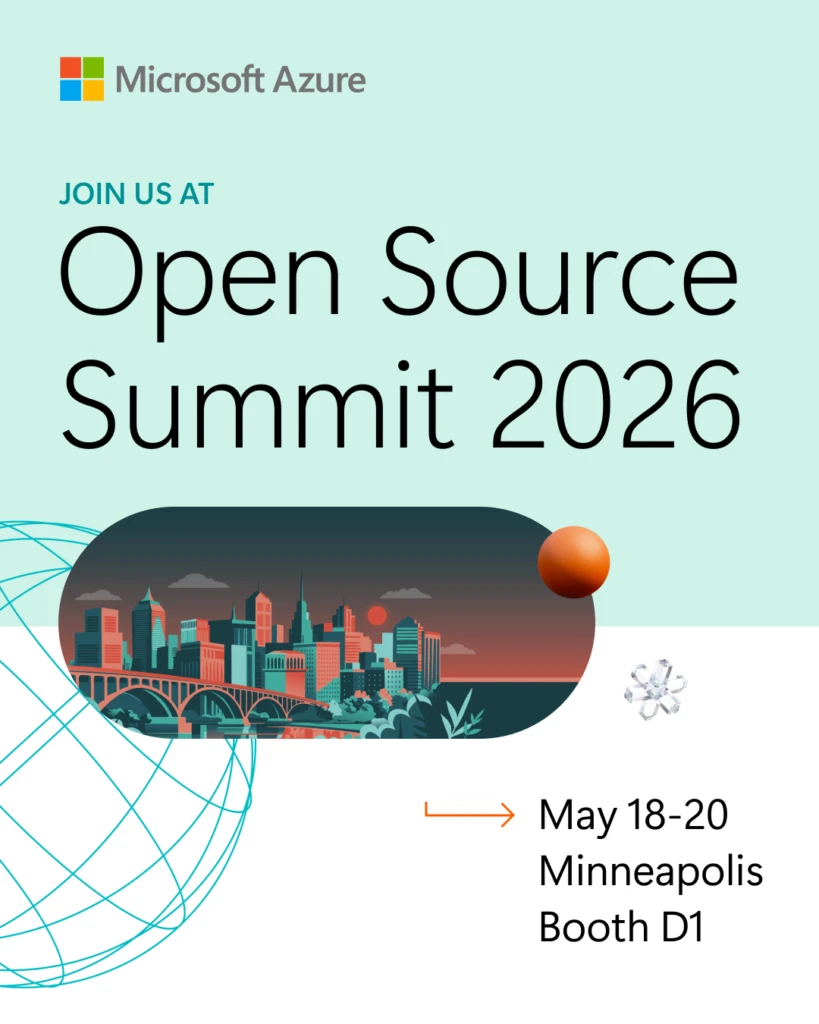
At Open Source Summit North America 2026, we’re announcing two updates that strengthen exactly that: the upcoming public preview of Azure Linux 4.0 on Azure Virtual Machines and the general availability of Azure Container Linux, our immutable container-optimized operating system (OS), with the broader rollout at Microsoft Build on June 2. Together, they give developers and organizations a hardened Linux distribution purpose-built for cloud native and AI workloads.
That foundation is also what makes the next chapter possible. The move from cloud native to AI native is the next evolution of open source,and it’s the focus of my keynote this week, From Open Source to Agentic Systems: Building the AI Native Era. Open source is already at the core of AI today, and AI in turn is reshaping how open source itself gets built, from how we collaborate, to how we test, to how the developer experience comes together. We’ve done this before. We know what it takes to build an open ecosystem at scale, and we know that openness is what makes it work.
How open source built the modern cloud: Linux, Kubernetes, and containers
Linux, Kubernetes, and containers have made the modern cloud possible. Every hyperscaler, every AI training cluster, every inference endpoint serving millions of tokens a second is built on open source. Open standards, shared governance, and community innovation have been the way an ecosystem of this scale comes together, allowing the best ideas, from anywhere, to compound.
Today, more than two-thirds of customer cores in Azure run Linux, and the platforms running Microsoft 365, GitHub, and OpenAI’s ChatGPT all sit on Linux foundations. When ChatGPT scales across more than 10 million compute cores worldwide and serves a billion queries a day, Linux and Kubernetes are what make that possible.
Azure Linux 4.0 and Azure Container Linux: A secure Linux foundation for cloud native and AI workloads
For developers running modern workloads on Azure, the OS layer should be invisible: secure by default, consistent across hosts and containers, and out of your way. That’s what Azure Linux and Azure Container Linux are designed to do.
Both are hardened, with a reduced package footprint, transparent supply chain, and consistent performance characteristics from the host all the way up to the container. Teams running regulated or security-sensitive workloads get a smaller attack surface and a Linux distribution maintained by the same team that operates the cloud it runs on. And because we develop in the open and contribute upstream first, the work that hardens Azure Linux benefits the broader ecosystem too.
How AI is reshaping open source development
AI isn’t just a new workload sitting on top of open source; it’s changing how open source itself gets built.
Maintainers are using coding agents to triage issues, generate tests, and review PRs.
Agentic tooling is starting to handle the toil associated with dependency updates and security patches.
And the contribution loop is opening to more developers, in more languages, at a faster cadence than we have ever seen.
That’s a good thing for the ecosystem, but it raises the bar on the fundamentals: provenance, review discipline, supply chain integrity, and clear standards. The communities that figure out how to fold AI into their workflows while keeping the trust model intact are the ones who will define the next decade of open source.
Building an open agentic stack: Frameworks, protocols, and governance for AI agents
Delivering agentic systems at global scale takes collaboration across the open source ecosystem. Agents need to work everywhere developers build—across frameworks, clouds, languages, and runtimes. That kind of portability only happens when the foundations are open.
That’s why we are working alongside the open source community on the building blocks of an open agentic stack:
Microsoft Agent Framework: Our open source SDK and runtime for building, deploying, and managing multi-agent systems. It carries forward the lessons of Semantic Kernel and AutoGen into a single foundation that maps cleanly from local development to cloud deployment, with the observability, evaluation, and lifecycle primitives production systems need.
Rayand NVIDIA Dynamo: Partnerships and contributions that let agents and AI workloads compose across the most widely adopted open frameworks in the ecosystem.
A2A (agent-to-agent) protocols: Open interfaces so agents from different vendors, frameworks, and clouds can communicate, delegate, and coordinate.
Agent Governance Toolkit: The control-plane primitives (identity, policy, audit, access boundaries) that let organizations deploy agents responsibly. Just as Kubernetes needed RBAC and admission controllers to be enterprise-ready, agentic systems need governance primitives and those primitives belong in the open.
Those building blocks need a shared standards body to keep them interoperable. That is where the Agentic AI Foundation comes in.
The Agentic AI Foundation: Open standards for agent interoperability
The Agentic AI Foundation (AAIF) is already the fastest-growing project in Linux Foundation history. Microsoft is a founding member, and we believe deeply in its mission: establishing open standards for agent-to-agent communication, agent runtimes, and agent orchestration.
The AAIF builds on and complements what the Cloud Native Computing Foundation (CNCF) has done for cloud native—the two are designed to work together. The reason this is happening so quickly is straightforward: customers and the broader community are asking for interoperability. They don’t want to bet their agentic future on a single vendor’s stack and open standards are how we make sure they do not have to.
The early momentum across industry and academia tells you how much the ecosystem wants this to be open. As customers scale multi-agent systems composed of custom built and third party agents, interoperability becomes essential to truly deliver on the business transformation goals. The agentic future cannot be proprietary, and the AAIF is how we make sure it isn’t.
Securing the open source supply chain for AI
None of this works if the underlying ecosystem isn’t trustworthy. The same projects that power the cloud and AI also power critical infrastructure, and the people maintaining them are often a handful of volunteers in their spare time. As agents become more autonomous, every dependency they touch becomes part of their trust boundary. Securing open source isn’t just hygiene anymore. It’s a prerequisite for letting AI agents do real work.
That’s why Microsoft has made a sustained, multi-phase investment in OpenSSF and Alpha-Omega:
A kick-start investment to seed Alpha-Omega’s mission of improving the security posture of critical open source software through expert engagement and automated security testing.
A second round of funding to Alpha-Omega and OpenSSF to scale sustainable, AI-powered open source security solutions, using the same agentic capabilities we’re building elsewhere to harden the supply chain itself.
We’re also a founding partner in the GitHub Secure Open Source Fund, which pairs direct financial support ($10,000 per project) with a three-week program of security education, mentorship from GitHub Security Lab, tooling, and ongoing check-ins. The model is designed to scale; invest in maintainers as people, not just packages, and the security improvements compound across the dependency graph.
Kubernetes and CNCF: Where Microsoft contributes upstream
Dalec: Declarative format for building system packages and containers in a secure way.
Flatcar: Container-optimized Linux, accepted into CNCF at the incubating level.
Headlamp:Kubernetes dashboard UI for managing and visualizing clusters for workloads.
Inspektor Gadget:eBPF-powered observability toolkit for deep Kubernetes and container runtime insights.
Every one of these projects started with a problem we hit running Kubernetes on Azure at scale. When we do work in the open, we get better solutions, and the broader community strengthens and benefits from the work too.
From cloud-native to AI-native: The open source principles that carry over
The takeaway from a decade of cloud native is that the principles still apply:
Open interfaces, so workloads and agents are portable.
Shared governance, so no single vendor controls the runway.
Distributed innovation, so the best ideas can come from anywhere.
Collective security, so the foundation everyone depends on stays trustworthy.
Kubernetes and Linux fueled the cloud era as the foundational layers. We believe they will be foundational for the agentic era too, alongside the new open standards the community is building right now.
Come find us in Minneapolis
If you’re at the summit this week, please come say hello. The Microsoft team is at the booth with live demos across:
We have engineers, maintainers, and product managers ready to dig into whatever’s on your mind—whether that’s a thorny Kubernetes question, an idea for a new CNCF sandbox project, an AAIF contribution, or how to get your first agent into production.
The cloud era was built by this community. The AI native era will be too. I can’t wait to see what we build together.
See you in Minneapolis.
—Brendan
Ready to try Azure Linux 4.0?
Sign up to express your interest in the upcoming public preview and be among the first to get access.
 Log in