 Log in

Build and sell your own Blazor product with Blazorise Indie for €149 per year per registered project.

|
Sr. Content Developer at Microsoft, working remotely in PA, TechBash conference organizer, former Microsoft MVP, Husband, Dad and Geek.
|

Pennsylvania, USA


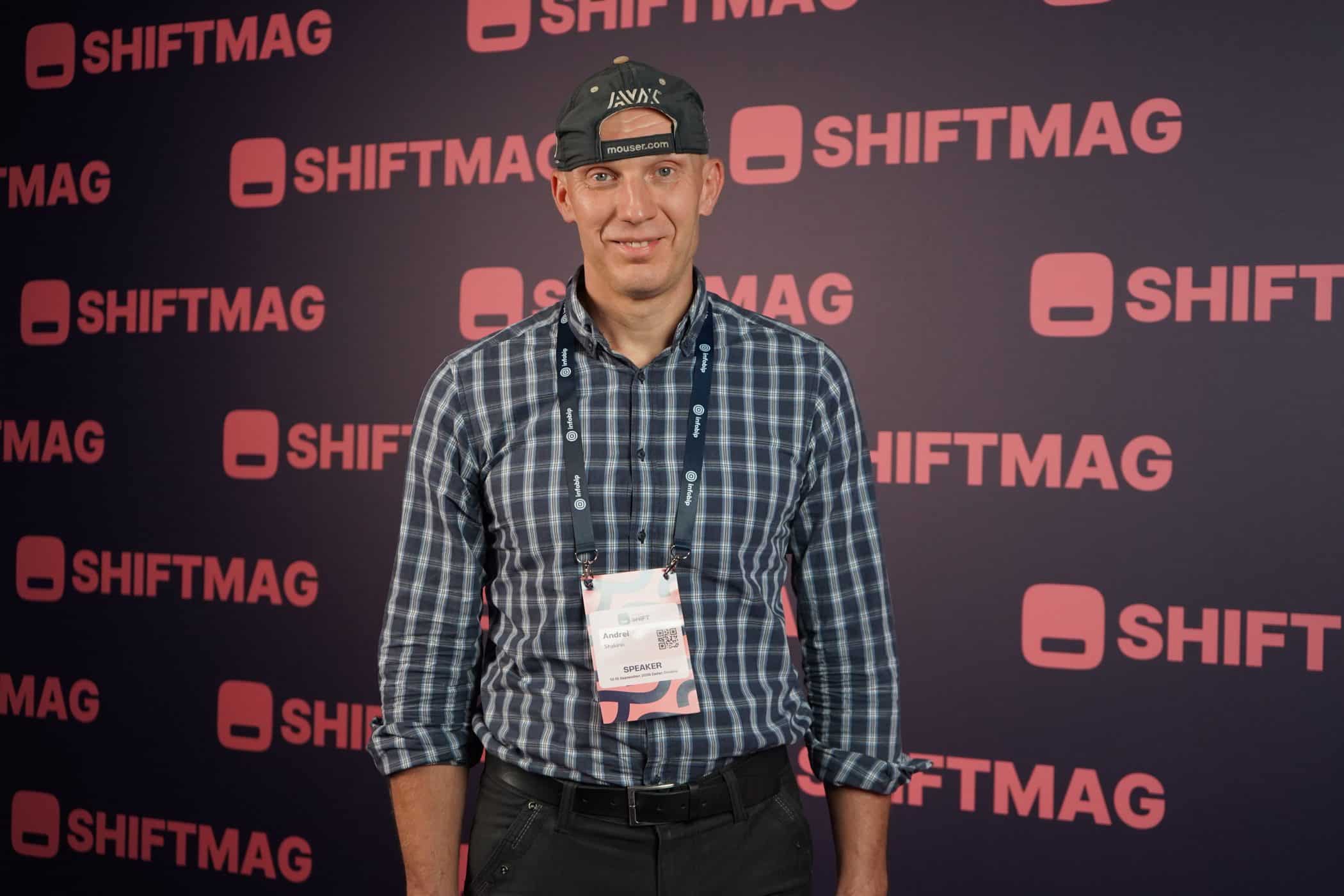
I talked to Andrei Shakirin, a Solution Architect at AWS, about how engineering teams should rethink their work with AI, and why architecture and business knowledge matter more than ever.
He’s been at AWS for two years, mostly helping customers solve AI-related problems. Before that, he worked as a software engineer and engineering lead in e-commerce and software development teams, so he has seen the work from both sides.
That experience shapes how he sees AI. In his view, writing code makes up only 10 to 20 percent of an engineer’s job, so AI has much more to offer than code generation. Yet that’s where many teams stop.
Andrei keeps seeing the same mistake: teams use AI to write code and little else. But even when an agent builds a feature in minutes, someone still has to review the pull request, test it and check that it works. That’s why he thinks AI should help across the whole development lifecycle, from the first idea and requirements to architecture, testing, deployment and production monitoring.
Agents are good at well-defined work, but architecture decisions are still up to humans
AI agents are already useful for tasks with clear requirements and predictable outcomes. Andrei gives examples like writing unit tests, refactoring codebases, updating dependencies, and migrating applications to newer language or framework versions. These tasks give agents clear instructions and measurable results.
Architecture decisions are different: they involve business context, and an understanding of what an organisation actually needs. An agent can suggest different approaches, but it can’t always tell which one makes the most sense for a specific company:
Architecture is always a trade-off. You make a decision with some pros and cons. You need to analyze these pros and cons and make the decision that’s more fit on your business situation.
“All of that is still a human role. Only you know what your company and your team need,” he said.
Therefore you need to lead agent in the right direction. So make the right choice as a human.
Agents need clean context, real testing and enforced guardrails
To get reliable results from AI, and not just experiments, teams need to set agents up properly. Andrei points to three things: clean context, proper testing and guardrails.
First, agents need the right information for the task, without a lot of unrelated context getting in the way.
Second, teams need testing that actually checks what the agent built. For example, if you ask an agent to implement an API call, it might generate mocks that make the code look like it works, without building the real integration.
Agents are very creative and very smart at working around your requirements.
If you say, “I need to call some API,” you can, for example, generate some mocks and it looks like it works, but in reality, it’s not what you want, Andrei explained.
Organisations need to make sure their internal standards and best practices are consistently applied. This can include security requirements, architectural guidelines, and coding conventions. Andrei recommends using deterministic mechanisms, such as hooks, to enforce these rules instead of relying entirely on instructions given to an agent.
The broader idea is to rethink development as an AI-driven lifecycle, rather than simply adding an AI coding assistant to an existing workflow.
Teams should measure AI by business results and the full cost
Now that agents can generate thousands of lines of code in a day, traditional productivity metrics became less meaningful. Counting lines of code or the number of pull requests might have provided some indication of output in the past, but these numbers can easily increase without producing better software.
Andrei suggests focusing on business-oriented metrics, including DORA metrics. These help teams understand how frequently they deploy software, how long it takes for a change to reach production, and how effectively they recover from incidents. Ealier this year I talked to Trisha Gee, one of the most recognized voices in the Java space about this too.
Teams today should also consider how long it takes to deliver a business feature, how many incidents follow a deployment, and how much code needs to be rewritten or discarded.
There is also the question of the cost. Evaluating AI’s impact means looking beyond token consumption and considering the human time spent reviewing, correcting, and validating generated code. Andrei says:
It’s interesting to calculate the whole cost, including human time and tokens together. How expensive is my business feature?
And productivity should not come at the expense of the people doing the work. He also considers employee satisfaction and engagement important indicators of a healthy engineering team.
Engineers may take more universal role
Unless you live under a rock, it’s obvious that the skills expected of software engineers are changing almost daily.
Andrei believes that writing code from clear instructions could become a commodity. Understanding systems, architectural patterns and business requirements, however, will remain essential.
Engineers will increasingly act as a bridge between business teams and technical implementation, turning domain knowledge into system design and deciding on the right solutions.
He expects developers to be less tied to specific programming languages or to the split between frontend and backend. Instead, they may take on a more universal role, working at a higher level of abstraction and directing agents to build what’s needed.
But more abstraction doesn’t mean less responsibility. Engineers will still need to define tasks clearly, understand their systems, set guardrails and evaluate the results.
As AI takes on more of the implementation work, writing code will become a smaller part of what makes a good engineer. Understanding business problems, making sound architectural decisions and guiding agents toward reliable outcomes will matter more and more.
The post If Code Is Only 20% of the Job, Using AI Just for Code Aims Too Low appeared first on ShiftMag.
Pennsylvania, USA

James Coker writes: In 2026, we saw a vast number of class action settlement agreements reached in regard to high-profile data breach incidents that have taken place during the past few years, some of which have also been subject to separate regulatory action. Here are the biggest data breach class action settlement agreements announced in...
Pennsylvania, USA
Paulina Okunytė reports: The American branch of British multinational bank Barclays has suffered a data breach, exposing credit card application data. Barclays Bank Delaware, a US banking subsidiary that issues credit cards to American consumers, has started informing affected customers. According to a breach notice sent to affected individuals and shared with the authorities, an...
Pennsylvania, USA


A developer reported that WinUI 3 apps built with Windows App SDK 2.6.5 can retain title bar rendering resources and internal UI objects after a window closes. In apps that keep running in the notification area, resources could accumulate as windows are reopened.
Key points
- What happened: A bug report describes rendering resources that remain after a window with a custom WinUI 3 title bar closes.
- UI objects left behind: A separate report describes how windows containing a Page can retain their visual tree during shutdown if a XamlRoot has been created.
Pennsylvania, USA

Welcome to episode 382. It’s a special show today; we’re making our re:Invent 2026 predictions! Whether you’ll be on the ground in Vegas, watching the livestream from home, or ditching all together, we invite you to make your predictions about what’s coming from AWS. Let’s get started!
Titles we almost went with this week
- We have a chance to Re:Invent the world… with AI
- re: Invent Predictions: We’re Probably Wrong, But With Confidence
- Place Your Bets: The House Always Wins and the House Is Garman
- All AI, All the Time: A re:Invent Prediction Show
- Find the Non-AI Announcement: A re: Invent Scavenger Hunt
- In Vegas, the Only Safe Bet Is AI
A big thanks to this week’s sponsors:
We’ve got a great new sponsor this week! BackyardBBQ – the premier online retailer for high-end backyard cooking and dining.
Your infrastructure is scalable. Your deployments are automated. Your uptime is legendary. But let’s talk about your backyard. Is your grill still running on legacy hardware? It’s time for an upgrade! At https://BackyardBBQ.com, we’re bringing serious hardware to the most important production environment of all: your backyard. Premium grills, smokers, and outdoor cooking equipment built for people who appreciate performance. No Kubernetes required. Just great food. Visit BackyardBBQ.com and upgrade your backyard infrastructure.
Use discount code CLOUDPOD for additional savings.
AWS
re:Invent 2026 – Keynote Predictions
Matthew Kohn
- Managed or serverless DuckDB over S3 Tables
- Big AgentCore expansion: agent governance, spend limits, ROI measurement
- Strict limits on AI usage in an AWS account/quota’s
Ryan
- A new version of Trainium 4
- AgentCore identity cross-account JAG in AgentCore
- AI Registry and Identity across accounts, Bedrock agents, foundational models
Justin
- A new LLM flagship model with or without Nova branding
- After DevOps, Security and FinOps Agent… a new agent like data, migration or compliance agent
- Big Security Platform moment like an Agentic SOC capability
Honorable mentions
- AWS Context / Knowledge Graph for Agents — Justin
- FinOps GA with pricing — Justin
- Kiro AI written code, something — Justin
- Savings/Reserved Instances for tokens — Justin
- Graviton 6 preview — Justin
- World Model / Partnership Odyssey — Justin
- A drop in annoying priced services – NAT Gateways, Cloud custom metrics — Matt
- Marketplace for AgentCore — Matt
- Something with Quick — Matt
- Nitro with a major release — Matt
- Quantum chip or partnership — Ryan
- Werner shows up with a keynote — Ryan
Closing
And that is the week in the cloud! Visit our website, the home of the Cloud Pod, where you can join our newsletter, Slack team, send feedback, or ask questions at theCloudPod.net or tweet at us with the hashtag #theCloudPod
Download audio: https://episodes.castos.com/5e2d2c4b117f29-10227663/2706375/c1e-v0z0cpr0dzao851p-rkk592p4fz0k-ucgq5m.mp3
Pennsylvania, USA
Next Page of Stories