

Sr. Content Developer at Microsoft, working remotely in PA, TechBash conference organizer, former Microsoft MVP, Husband, Dad and Geek.
150025 stories
·
33 followers

How to Build an Xbox Controller With Xbox Design Lab

1 Share

How to Build an Xbox Controller With Xbox Design Lab

Xbox Design Lab Hero Image

Xbox Design Lab is a one-stop shop that allows you to create your very own controller. From the controller itself to every external component, Xbox Design Lab is a hugely customizable platform that lets you create controllers for yourself, or as a truly personal gift for the Xbox player in your life.

But before you get started, There are a lot of options to choose from – let us break down every single one, to help you create the perfect Xbox controller:

Choose Your Controller

The key question before you begin using Xbox Design Lab is: which Xbox controller do you want to design?

  • Xbox Wireless Controller – Starting at $79.99 USD, the Xbox Wireless Controller is our standard model, bringing you high performance at an affordable price. With textured triggers and grips, a hybrid D-Pad, and Bluetooth technology that allows you to connect it to multiple devices. Click here to start creating an Xbox Wireless Controller.
  • Xbox Elite Wireless Controller Series 2 Starting at $169.99 USD, the Elite Series 2 makes our premium controller better than ever. With refined components, paddle slots offering extra options, adaptable elements like adjustable thumbsticks and hair trigger locks, and rubberized grips as standard, this controller delivers pro-level performance. Click here to start creating an Xbox Elite Wireless Controller Series 2.

Customize Components

Once you’ve chosen your controller, Xbox Design Lab gives you 10 different customization options, allowing you to make a controller that’s uniquely yours. And if you can’t quite decide as you go, Xbox Design Lab allows you to preview your controller at any time, as well as save designs to your own personal gallery, allowing you to create multiple options to compare before you pick the final one.

Body
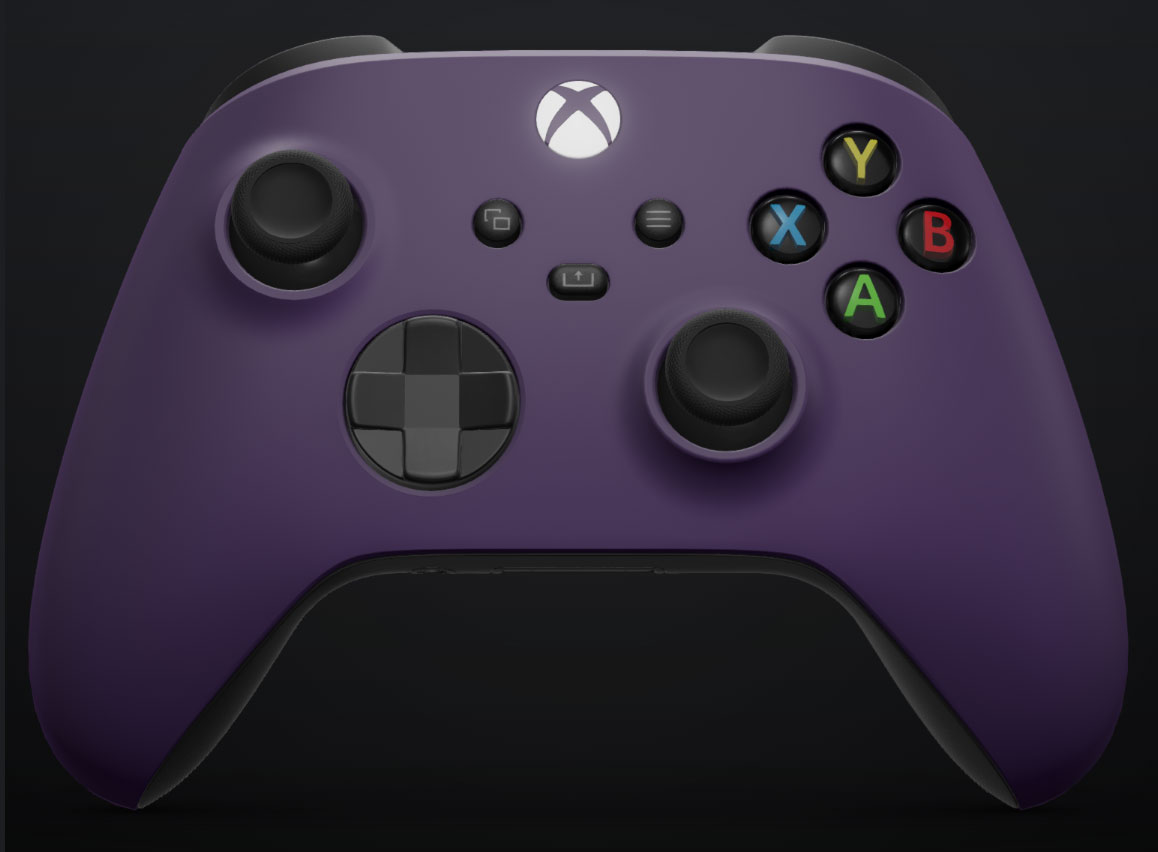
Applied to the entire front case, your choice of Body makes a statement. With the Xbox Wireless Controller, choose from a variety of matte finishes, or from a selection of gorgeous patterns, including the swirling Vapor designs, the multi-toned Shift patterns, bold Camo looks, our vibrant Pride design, or special, game-inspired designs like the Fallout top case. With the Xbox Elite Wireless Controller Series 2, choose from matte finishes, our Cipher series – which adds a transparent case that allows you to see through the case to the components inside, or game-inspired designs.

Back
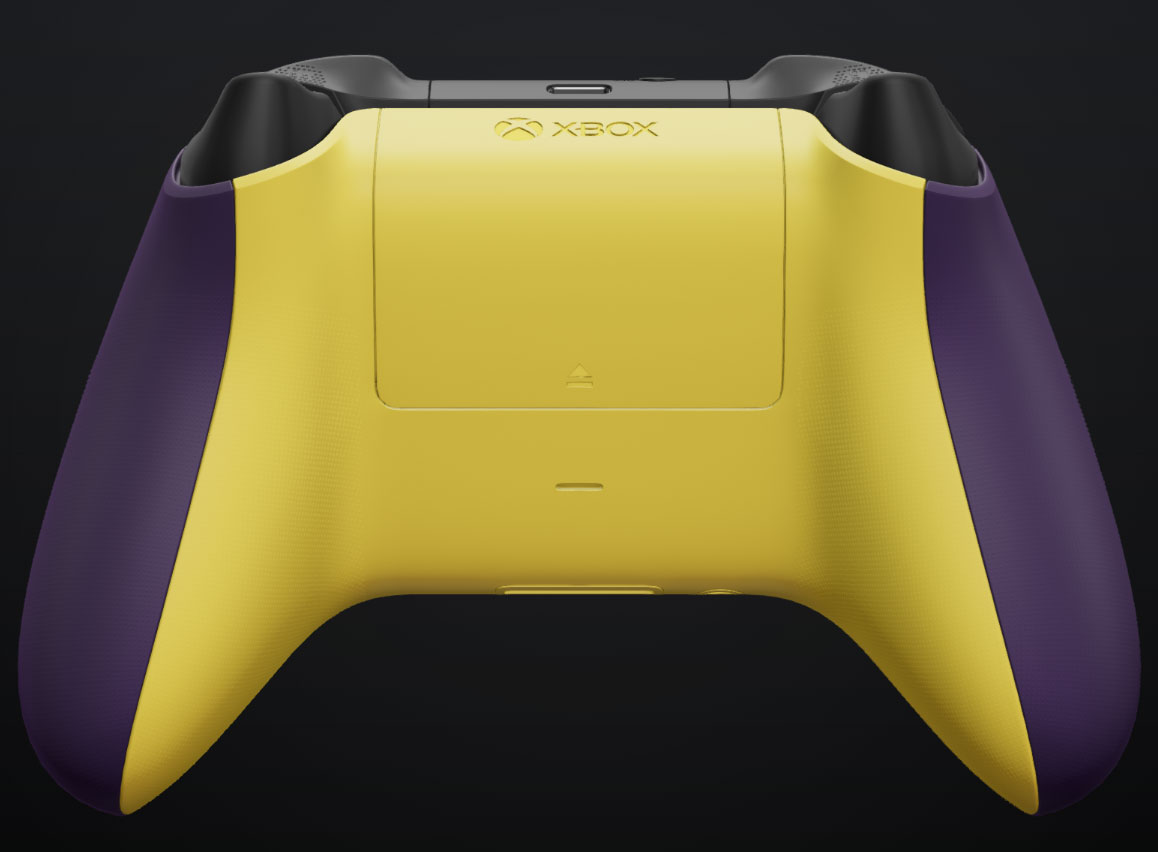
Your choice of Back encompasses everything behind the grips on your controller. With all the standard colors available in the Body category, you can choose to match the front of the controller, or create a two-tone pop of color.

Grips
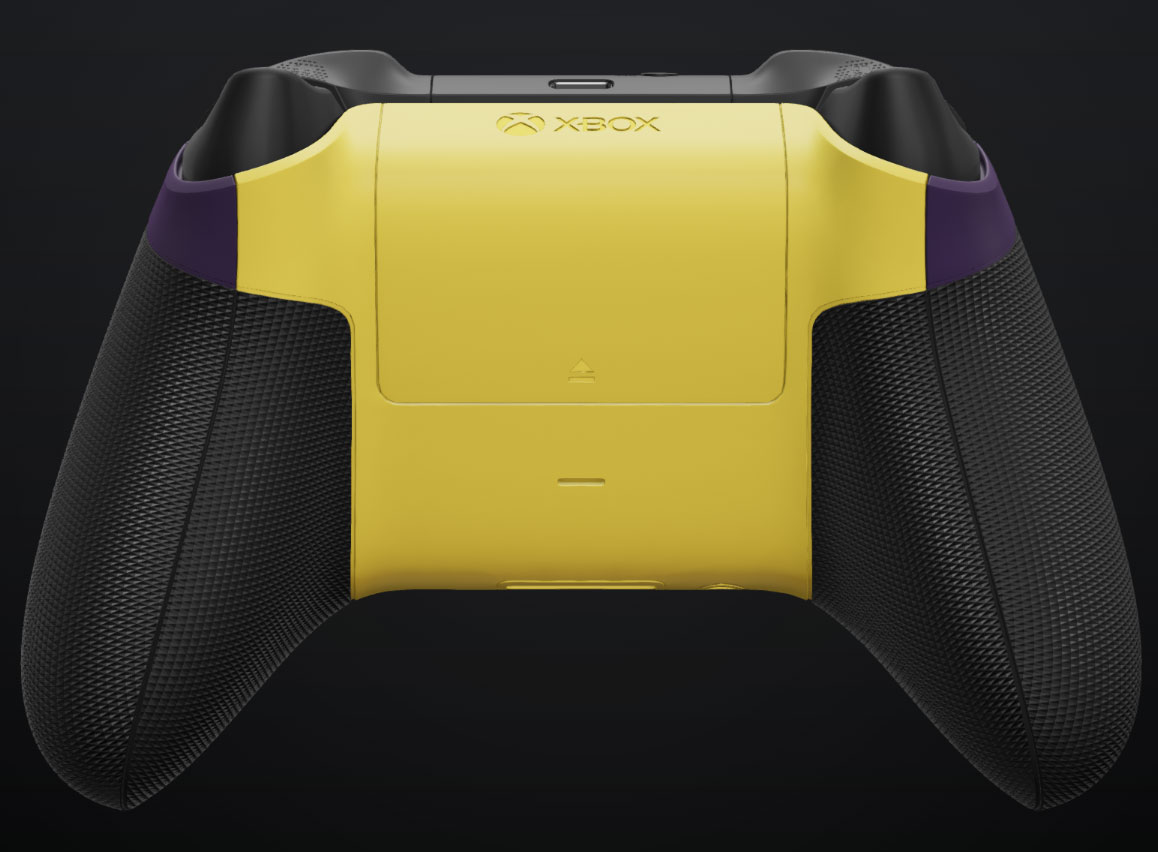
For a small extra cost, you can add rubberized back and side grips to your Xbox Wireless Controller, offering an extra level of control in the hand. Rubberized grips come as standard on the Xbox Elite Wireless Controller Series 2.

Bumpers
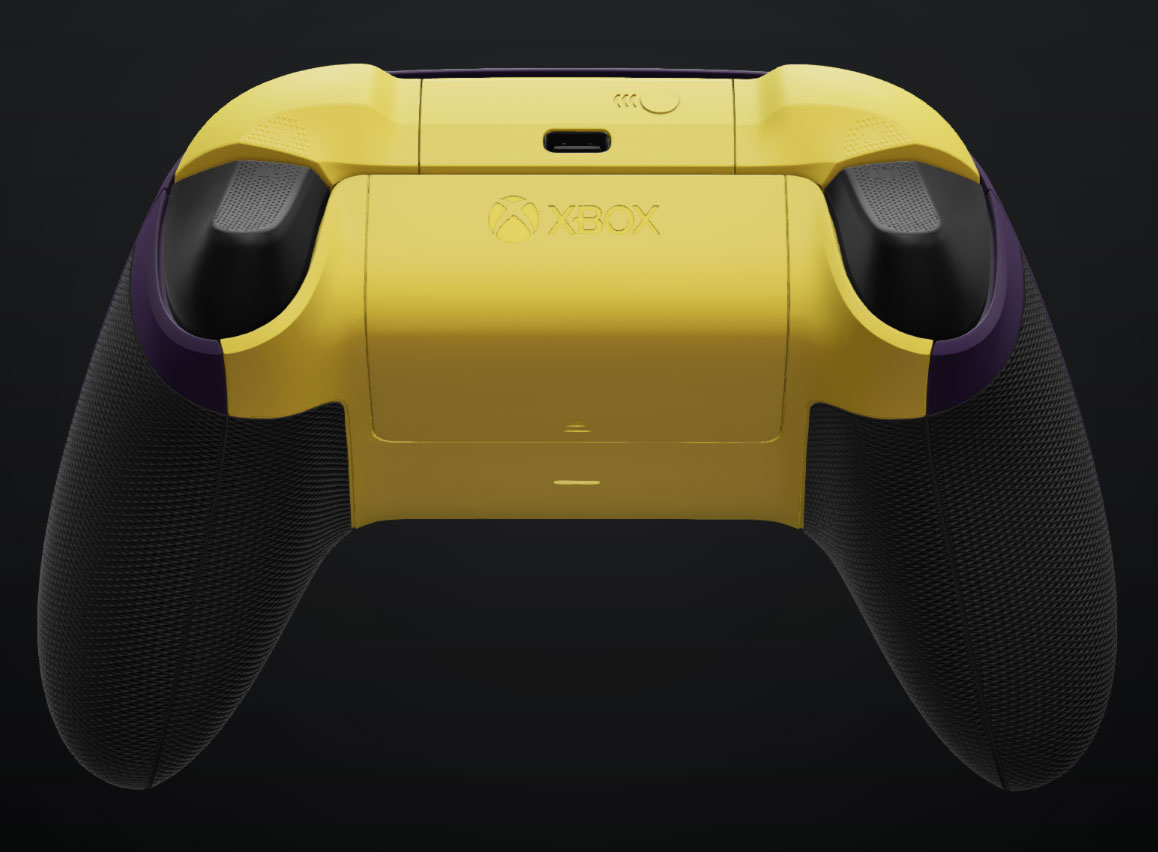
Your choice of Bumper color encompasses the two buttons on the top of the controller, and the case in between them. On the Xbox Wireless Controller, choose from all the standard colors available for the Body and Back. For the Xbox Elite Wireless Controller Series 2, choose from an array of metallic finishes.

Triggers
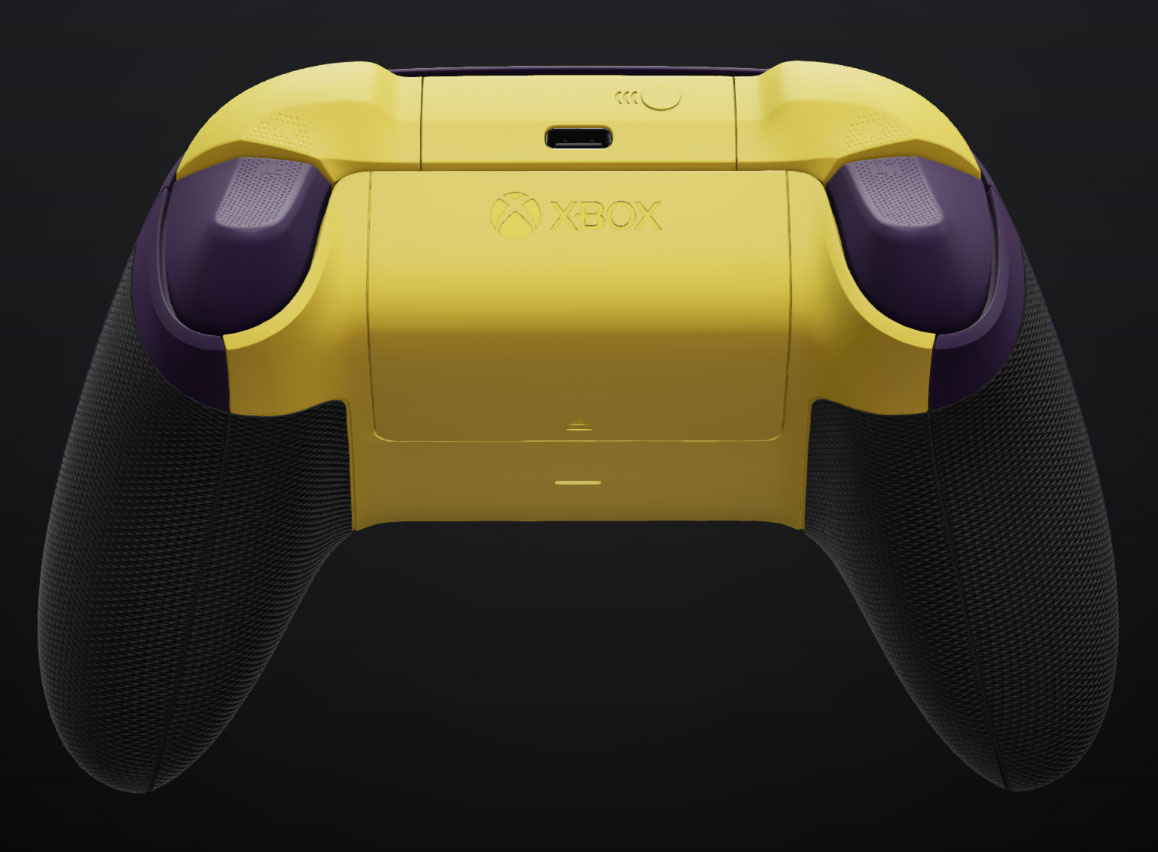
The Triggers are key to controlling many games, and come with multiple options. With the Xbox Wireless Controller, all the standard colors are available, but Xbox Design Lab also offers a variety of metallic options, allowing you to add a stately point of difference from the rest of the design. On the Xbox Elite Wireless Controller Series 2, choose from a series of metallic designs that can blend in with your bumpers, or choose a different tone to create a standout design.

D-Pad
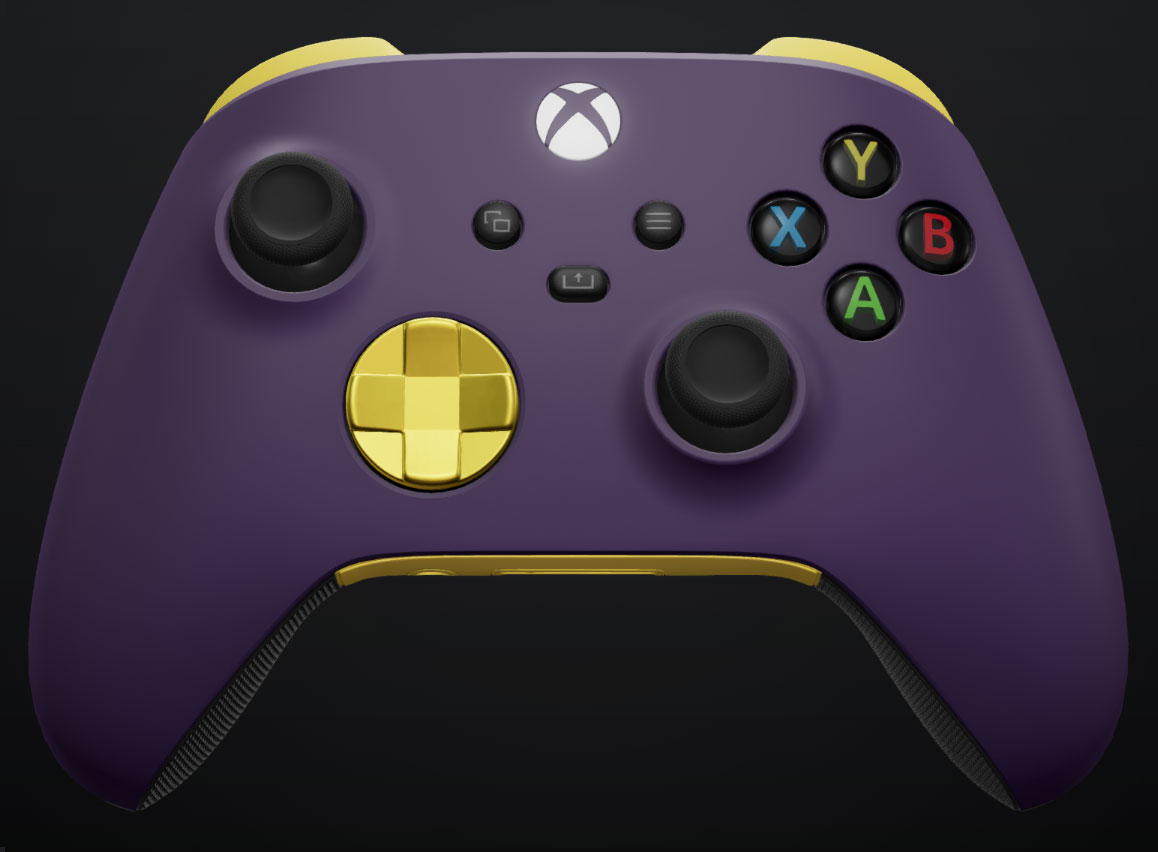
On the Xbox Wireless Controller, choose from all the standard colors available in other categories, or pick a metallic hue. On the Xbox Elite Wireless Controller Series 2, pick from the classic four-direction D-Pad, or our unique Faceted design for extra control. Both D-Pad choices offer a variety of single-tone metallic finishes, or pick our multi-toned Chroma designs for a truly standout look.

Thumbsticks
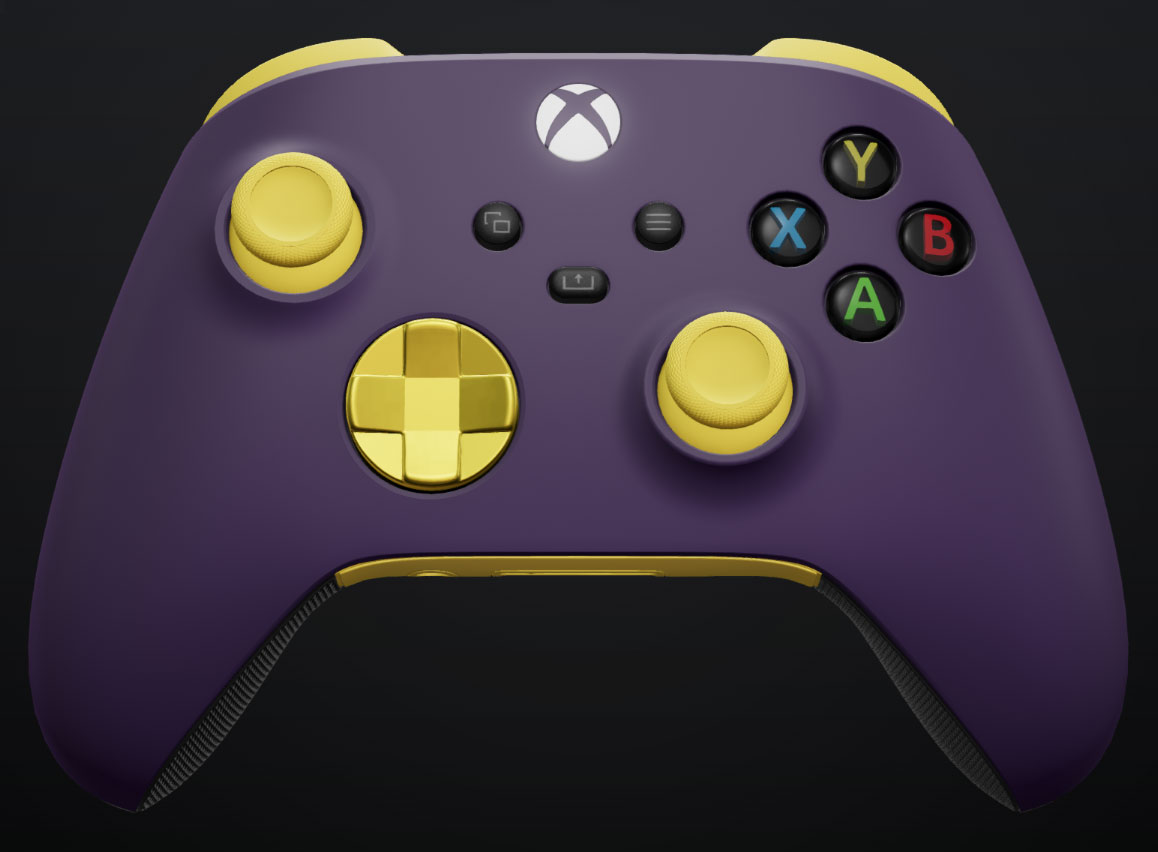
On the Xbox Wireless Controller, thumbsticks can take on any of the standard colors available on the rest of the controller. Take more control with the Xbox Elite Wireless Controller Series 2 – pick the color of the metal base, as well as separate colors for both the thumbstick ring and topper.

ABXY Buttons
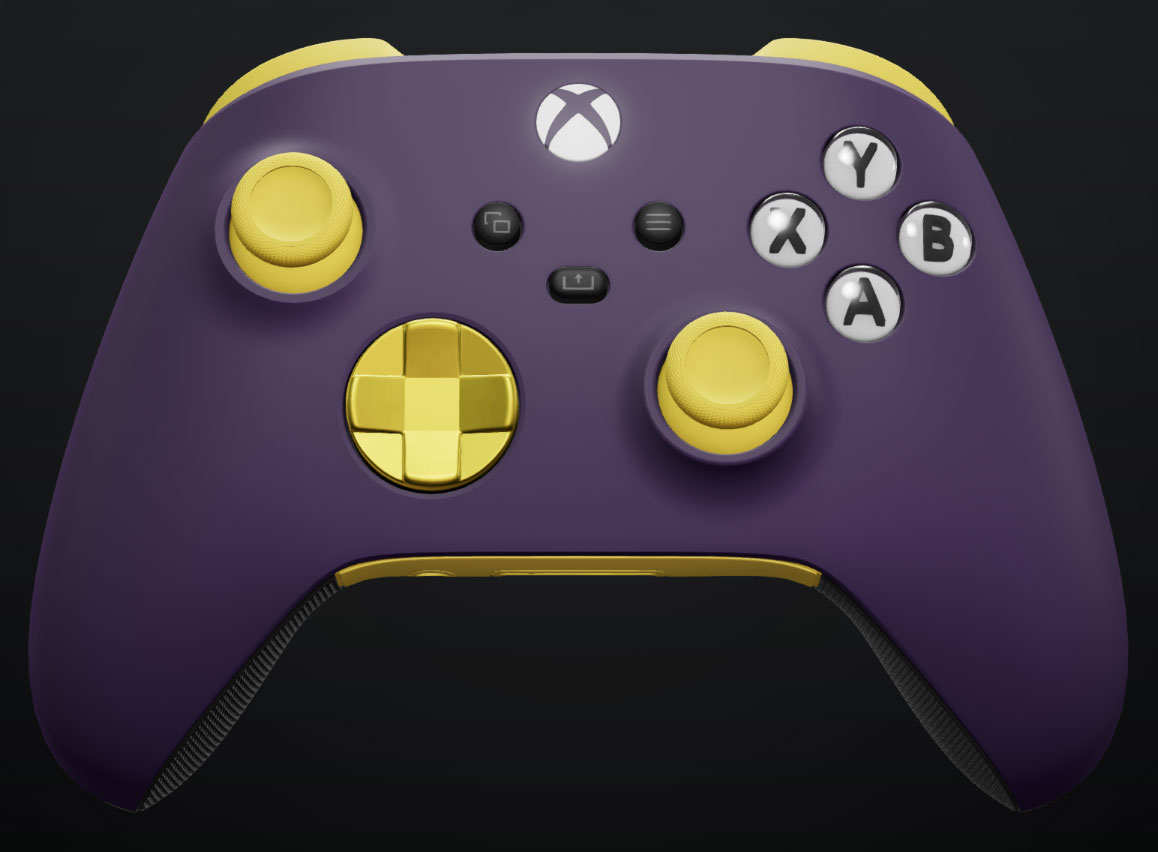
On the Xbox Wireless Controller, pick from seven different designs for the iconic Xbox buttons, from classic colored looks to different two-tone treatments. With the Xbox Elite Wireless Controller Series 2, get even more choice with 20 different treatments, including colored variants that allow you to create even more specific looks.

View, Menu, Share Buttons
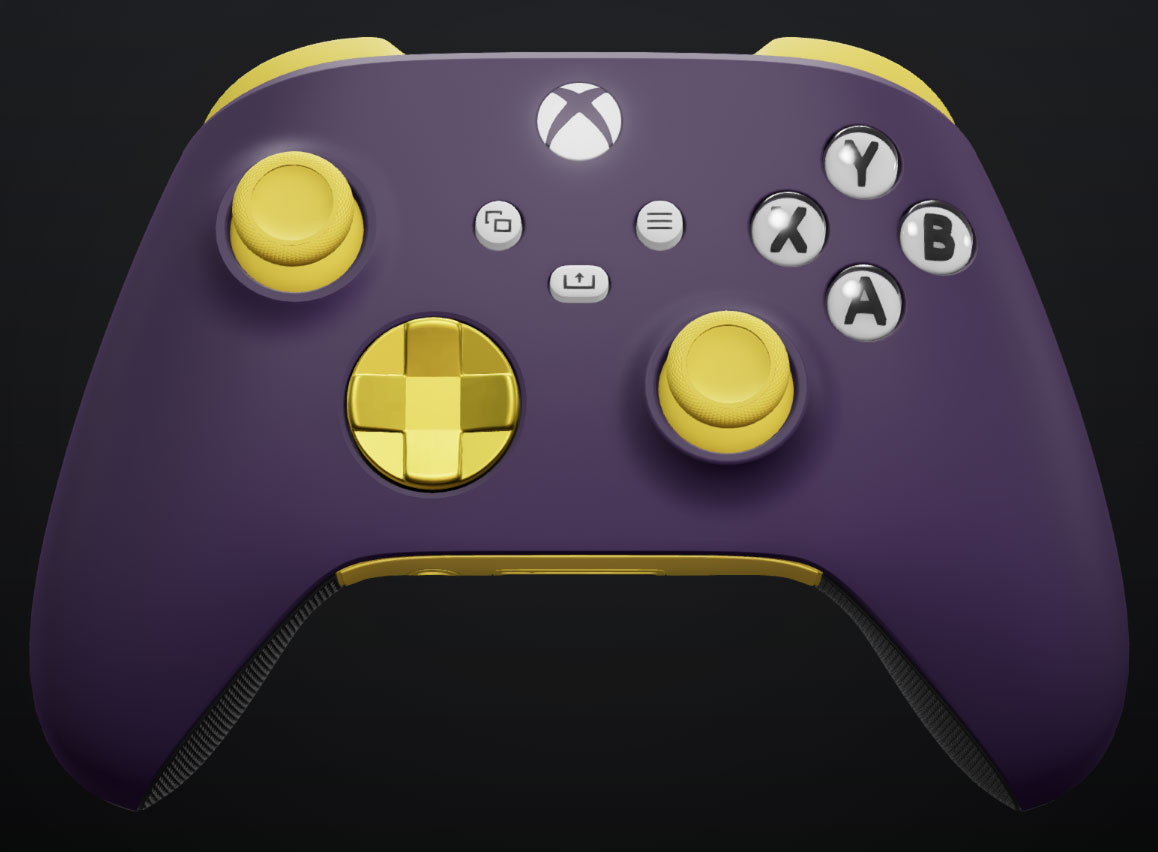
On the Xbox Wireless Controller, choose from 5 different designs for the central buttons on your controller. With the Xbox Elite Wireless Controller Series 2, pick from 24 color options to help bring your design to life.

Engraving
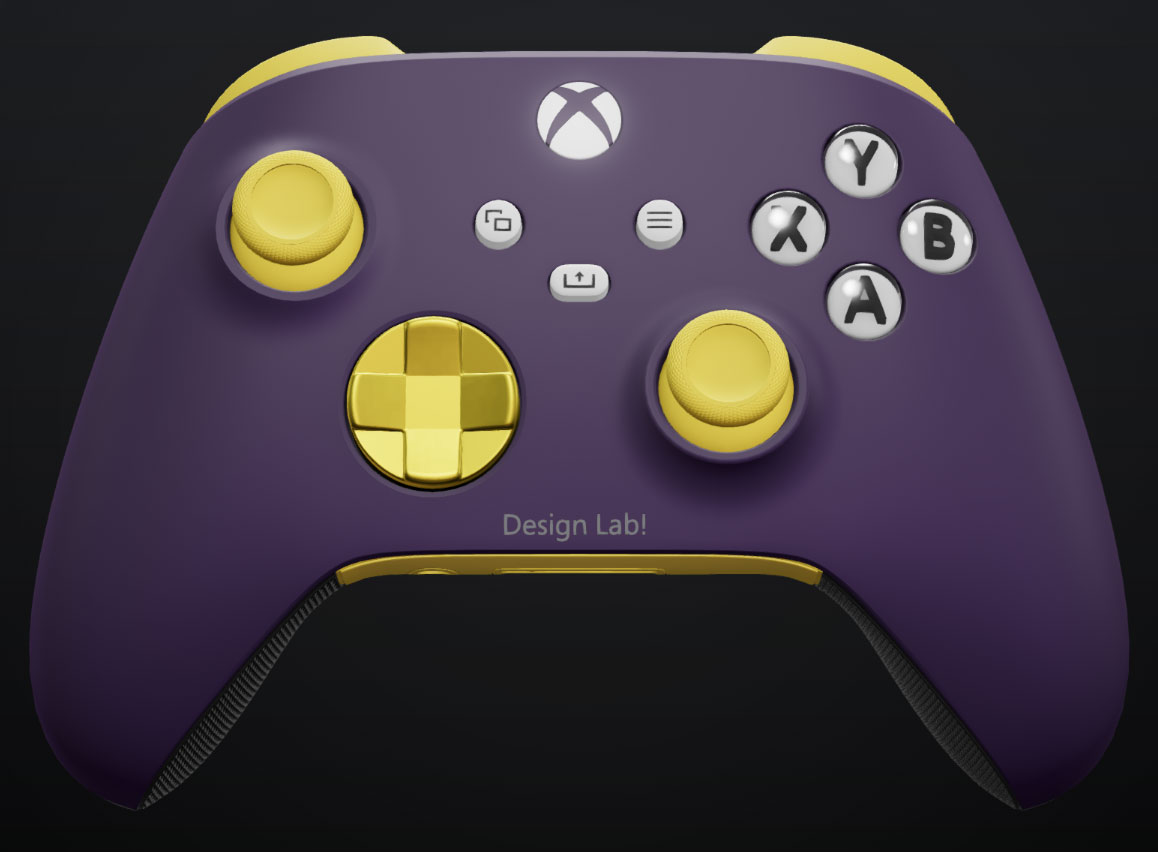
For that final touch, both controller types allow you to add a 16-character engraving. Add a name, a Gamertag, or a personal message to make the controller truly theirs.

Pick a Pre-Made Design
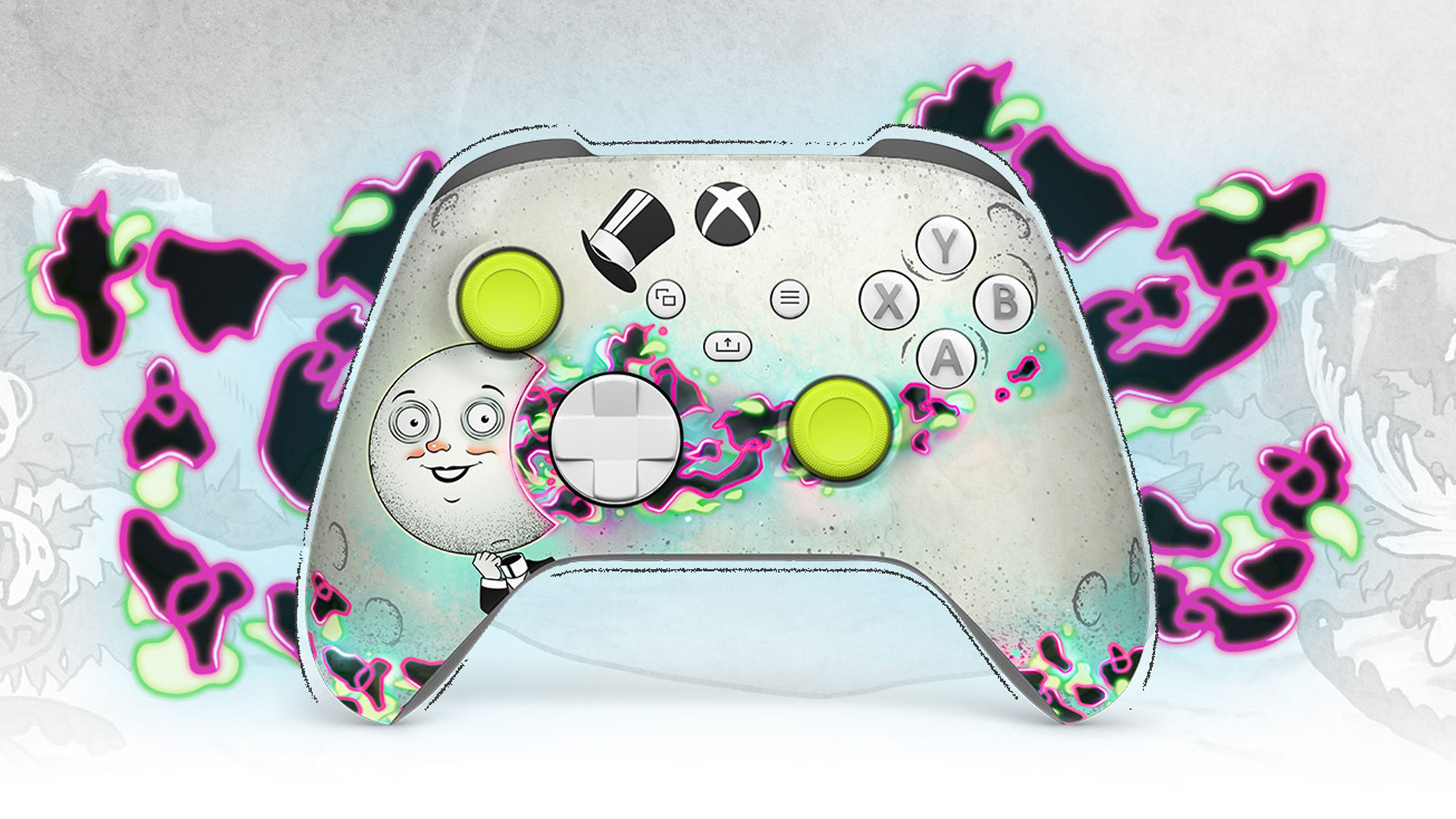
If you’re looking to create a controller to celebrate a particular game, we may already have what you need. Check out the Xbox Design Lab Collection for customizable special edition controllers based on the likes of The Outer Worlds 2Ninja Gaiden 4, and more. 

Design Lab also offers ‘Inspired By’ designs that celebrate games on Xbox – pick a pre-configured design, make any changes you see fit, and show your fandom. From Hollow Knight: Silksong to Silent Hill F, Design Lab can help to create the perfect companion for your favorite titles. 

Choose Some Elite Extras

If you’re opting for an Xbox Elite Wireless Controller Series 2, Xbox Design Lab offers a number of extra adjustable elements for the premium controller, all of which can be customized to fit your design. The Carrying Case and Charging Pack helps you take your controller anywhere in safety. The Paddle Pack adds a number of easily added extra paddles for the back of your controller, which can be used by adjusting options on your console. The Thumbsticks and D-pad Pack offers both D-Pad options and multiple interchangeable thumbsticks to let you swap how you want to play, game-by-game. And the Everything Pack includes all of the above in a single package. If you already own an Elite Series 2 controller, you can also opt to purchase the additional accessories packs by themselves.

Adaptive Thumbstick Toppers

We collaborated with community members, charity organizations, and a hospital involved in adaptive gaming and 3D printing to design complimentary 3D printable files for adaptive thumbstick toppers with Xbox Design Lab. Available to download, these designs can be 3D printed to create thumbsticks that meet multiple accessibility needs – and are available for both the Xbox Wireless Controller and Xbox Elite Wireless Controller Series 2. Xbox Design Lab also offers thumbstick topper designs for the Xbox Adaptive Joystick


You now have everything you need to start creating a unique Xbox controller – head over to Xbox Design Lab to start experimenting!

This article was originally published in 2024, and has been updated for 2025. 

The post How to Build an Xbox Controller With Xbox Design Lab appeared first on Xbox Wire.

Read the whole story
alvinashcraft
15 seconds ago
reply
Pennsylvania, USA
Share this story
Delete

From Encrypted Messaging to Secure AI: Cryptography Patterns in .NET 10

1 Share
Learn post-quantum cryptography with .NET 10: ML-DSA signatures, AES-GCM encryption, and securing AI applications. Practical patterns for C# developers.
Read the whole story
alvinashcraft
30 seconds ago
reply
Pennsylvania, USA
Share this story
Delete

Pulumi Kubernetes Operator v2.3.0: Preview Mode and Structured Configuration

1 Share

We’re excited to announce the release of Pulumi Kubernetes Operator v2.3.0, introducing two powerful capabilities that enhance GitOps workflows: preview mode for validating infrastructure changes before deployment, and structured configuration support for managing complex data types. Building on the success of the v2.0 GA release, this update addresses long-standing community requests while maintaining full backwards compatibility. These features enable safer, more sophisticated infrastructure management patterns for platform engineering teams.

Preview mode: Validate infrastructure changes before deployment

Preview mode enables you to run Pulumi stacks in dry-run fashion, allowing you to visualize what infrastructure changes would occur without actually applying them. This capability is essential for GitOps workflows that require validation gates and incremental rollouts.

By adding preview: true to your Stack specification, the operator runs pulumi preview instead of pulumi up. The Stack’s Ready condition indicates preview success, and you get full status including preview links, standard output, and program outputs—all without making actual infrastructure changes.

This unlocks sophisticated workflow patterns:

  • Multiple Stacks for what-if analysis: Create several Stack resources pointing to the same Pulumi stack, with all-but-one operating in preview mode to compare different configurations
  • Branch validation: Preview changes from feature branches before merging to production
  • Tick-tock rollout patterns: Toggle the preview flag on and off with external verification steps between each deployment phase

Here’s a simple example showing a production stack alongside its preview counterpart:

# Production stack
apiVersion: pulumi.com/v1
kind: Stack
metadata:
 name: my-infrastructure
spec:
 stack: org/project/prod
 projectRepo: https://github.com/example/infra
 branch: main
---
# Preview stack - same Pulumi stack, preview mode
apiVersion: pulumi.com/v1
kind: Stack
metadata:
 name: my-infrastructure-preview
spec:
 stack: org/project/prod
 projectRepo: https://github.com/example/infra
 branch: feature-branch
 preview: true # Only runs pulumi preview

Preview mode closes issue #16, one of our longest-standing feature requests.

Structured configuration: Native support for complex data types

Configuration management takes a significant step forward with native support for complex data types. Previously limited to string values, Stack configuration now supports objects, arrays, numbers, and booleans as first-class citizens.

This enhancement addresses the reality that complex environments require rich configuration. You can now express sophisticated configuration structures inline in your Stack manifests or load them from ConfigMaps with automatic JSON parsing—all using Kubernetes-native patterns.

The implementation leverages Pulumi CLI’s JSON configuration support (available in v3.202.0+) with automatic version detection. If your workspace uses an earlier CLI version, you’ll receive clear guidance to upgrade. Existing string-only configurations continue to work without modification, ensuring full backwards compatibility.

Here’s an example of inline structured configuration:

apiVersion: pulumi.com/v1
kind: Stack
metadata:
 name: my-app
spec:
 stack: org/app/prod
 projectRepo: https://github.com/example/app
 branch: main
 config:
 # String values (existing behavior)
 environment: "production"

 # Objects (NEW)
 database:
 host: "db.example.com"
 port: 5432
 ssl: true

 # Arrays (NEW)
 regions: ["us-west-2", "us-east-1", "eu-west-1"]

 # Numbers and booleans (NEW)
 maxConnections: 100
 enableCaching: true

You can also reference ConfigMaps for more complex scenarios:

apiVersion: v1
kind: ConfigMap
metadata:
 name: app-settings
data:
 database.json: |
 {
 "host": "db.example.com",
 "port": 5432,
 "maxConnections": 100
 }
---
apiVersion: pulumi.com/v1
kind: Stack
metadata:
 name: my-app
spec:
 stack: org/app/prod
 projectRepo: https://github.com/example/app
 branch: main
 configRefs:
 database:
 name: app-settings
 key: database.json
 json: true # Parse as JSON

Note that Secrets are not a supported source of structured configuration values.

Structured configuration closes issue #258 and issue #872, addressing long-standing configuration management needs from the community.

Bug fixes and reliability improvements

This release includes several fixes that improve operational reliability:

  • Stack name validation: Added validation to limit Stack names to 42 characters, preventing resource naming conflicts (#899)
  • secretsProvider fix: The secretsProvider parameter now properly applies when creating new stacks (#935)
  • Helm chart fix: Resolved YAML parsing errors for podLabels containing special characters like colons (#1014)
  • Stack deletion: Stack deletion is no longer blocked when prerequisite stacks are missing, enabling proper cleanup workflows (#751)
  • Update TTL: Completed Update objects now respect the ttlAfterCompleted setting for automatic garbage collection (#960)

Upgrading to v2.3.0

This release includes updates to the Custom Resource Definitions (CRDs) to support the new features. If you’re using Helm, you’ll need to manually apply the updated CRDs before upgrading, as Helm v3 does not automatically upgrade CRDs:

# Apply updated CRDs
kubectl apply --server-side -k 'github.com/pulumi/pulumi-kubernetes-operator//operator/config/crd?ref=v2.3.0'

# Upgrade via Helm
helm upgrade pulumi-kubernetes-operator \
 oci://ghcr.io/pulumi/helm-charts/pulumi-kubernetes-operator \
 --version 2.3.0 \
 -n pulumi-kubernetes-operator

If you’re using the quickstart YAML installation method, the CRDs will update automatically when you apply the new manifest.

All changes are backwards compatible—existing Stack resources work without modification. For structured configuration support, ensure your workspace pods use Pulumi CLI v3.202.0 or later; the operator provides automatic version detection with clear upgrade guidance when needed.

Get started today

The v2.3.0 release enhances the Pulumi Kubernetes Operator with safer deployment workflows and more flexible configuration management. Preview mode enables validation-first GitOps patterns, while structured configuration simplifies complex multi-environment setups.

Get started with the Pulumi Kubernetes Operator in our documentation, or view the complete v2.3.0 release notes on GitHub. Join the conversation in the Pulumi Community Slack #kubernetes channel—we’d love to hear how these features impact your workflows.

Read the whole story
alvinashcraft
42 seconds ago
reply
Pennsylvania, USA
Share this story
Delete

Vite+ - A New Toolset

1 Share
Read the whole story
alvinashcraft
51 seconds ago
reply
Pennsylvania, USA
Share this story
Delete

DeepSeek just dropped two insanely powerful AI models that rival GPT-5 and they're totally free

1 Share

Chinese artificial intelligence startup DeepSeek released two powerful new AI models on Sunday that the company claims match or exceed the capabilities of OpenAI's GPT-5 and Google's Gemini-3.0-Pro — a development that could reshape the competitive landscape between American tech giants and their Chinese challengers.

The Hangzhou-based company launched DeepSeek-V3.2, designed as an everyday reasoning assistant, alongside DeepSeek-V3.2-Speciale, a high-powered variant that achieved gold-medal performance in four elite international competitions: the 2025 International Mathematical Olympiad, the International Olympiad in Informatics, the ICPC World Finals, and the China Mathematical Olympiad.

The release carries profound implications for American technology leadership. DeepSeek has once again demonstrated that it can produce frontier AI systems despite U.S. export controls that restrict China's access to advanced Nvidia chips — and it has done so while making its models freely available under an open-source MIT license.

"People thought DeepSeek gave a one-time breakthrough but we came back much bigger," wrote Chen Fang, who identified himself as a contributor to the project, on X (formerly Twitter). The release drew swift reactions online, with one user declaring: "Rest in peace, ChatGPT."

How DeepSeek's sparse attention breakthrough slashes computing costs

At the heart of the new release lies DeepSeek Sparse Attention, or DSA — a novel architectural innovation that dramatically reduces the computational burden of running AI models on long documents and complex tasks.

Traditional AI attention mechanisms, the core technology allowing language models to understand context, scale poorly as input length increases. Processing a document twice as long typically requires four times the computation. DeepSeek's approach breaks this constraint using what the company calls a "lightning indexer" that identifies only the most relevant portions of context for each query, ignoring the rest.

According to DeepSeek's technical report, DSA reduces inference costs by roughly half compared to previous models when processing long sequences. The architecture "substantially reduces computational complexity while preserving model performance," the report states.

Processing 128,000 tokens — roughly equivalent to a 300-page book — now costs approximately $0.70 per million tokens for decoding, compared to $2.40 for the previous V3.1-Terminus model. That represents a 70% reduction in inference costs.

The 685-billion-parameter models support context windows of 128,000 tokens, making them suitable for analyzing lengthy documents, codebases, and research papers. DeepSeek's technical report notes that independent evaluations on long-context benchmarks show V3.2 performing on par with or better than its predecessor "despite incorporating a sparse attention mechanism."

The benchmark results that put DeepSeek in the same league as GPT-5

DeepSeek's claims of parity with America's leading AI systems rest on extensive testing across mathematics, coding, and reasoning tasks — and the numbers are striking.

On AIME 2025, a prestigious American mathematics competition, DeepSeek-V3.2-Speciale achieved a 96.0% pass rate, compared to 94.6% for GPT-5-High and 95.0% for Gemini-3.0-Pro. On the Harvard-MIT Mathematics Tournament, the Speciale variant scored 99.2%, surpassing Gemini's 97.5%.

The standard V3.2 model, optimized for everyday use, scored 93.1% on AIME and 92.5% on HMMT — marginally below frontier models but achieved with substantially fewer computational resources.

Most striking are the competition results. DeepSeek-V3.2-Speciale scored 35 out of 42 points on the 2025 International Mathematical Olympiad, earning gold-medal status. At the International Olympiad in Informatics, it scored 492 out of 600 points — also gold, ranking 10th overall. The model solved 10 of 12 problems at the ICPC World Finals, placing second.

These results came without internet access or tools during testing. DeepSeek's report states that "testing strictly adheres to the contest's time and attempt limits."

On coding benchmarks, DeepSeek-V3.2 resolved 73.1% of real-world software bugs on SWE-Verified, competitive with GPT-5-High at 74.9%. On Terminal Bench 2.0, measuring complex coding workflows, DeepSeek scored 46.4%—well above GPT-5-High's 35.2%.

The company acknowledges limitations. "Token efficiency remains a challenge," the technical report states, noting that DeepSeek "typically requires longer generation trajectories" to match Gemini-3.0-Pro's output quality.

Why teaching AI to think while using tools changes everything

Beyond raw reasoning, DeepSeek-V3.2 introduces "thinking in tool-use" — the ability to reason through problems while simultaneously executing code, searching the web, and manipulating files.

Previous AI models faced a frustrating limitation: each time they called an external tool, they lost their train of thought and had to restart reasoning from scratch. DeepSeek's architecture preserves the reasoning trace across multiple tool calls, enabling fluid multi-step problem solving.

To train this capability, the company built a massive synthetic data pipeline generating over 1,800 distinct task environments and 85,000 complex instructions. These included challenges like multi-day trip planning with budget constraints, software bug fixes across eight programming languages, and web-based research requiring dozens of searches.

The technical report describes one example: planning a three-day trip from Hangzhou with constraints on hotel prices, restaurant ratings, and attraction costs that vary based on accommodation choices. Such tasks are "hard to solve but easy to verify," making them ideal for training AI agents.

DeepSeek employed real-world tools during training — actual web search APIs, coding environments, and Jupyter notebooks — while generating synthetic prompts to ensure diversity. The result is a model that generalizes to unseen tools and environments, a critical capability for real-world deployment.

DeepSeek's open-source gambit could upend the AI industry's business model

Unlike OpenAI and Anthropic, which guard their most powerful models as proprietary assets, DeepSeek has released both V3.2 and V3.2-Speciale under the MIT license — one of the most permissive open-source frameworks available.

Any developer, researcher, or company can download, modify, and deploy the 685-billion-parameter models without restriction. Full model weights, training code, and documentation are available on Hugging Face, the leading platform for AI model sharing.

The strategic implications are significant. By making frontier-capable models freely available, DeepSeek undermines competitors charging premium API prices. The Hugging Face model card notes that DeepSeek has provided Python scripts and test cases "demonstrating how to encode messages in OpenAI-compatible format" — making migration from competing services straightforward.

For enterprise customers, the value proposition is compelling: frontier performance at dramatically lower cost, with deployment flexibility. But data residency concerns and regulatory uncertainty may limit adoption in sensitive applications — particularly given DeepSeek's Chinese origins.

Regulatory walls are rising against DeepSeek in Europe and America

DeepSeek's global expansion faces mounting resistance. In June, Berlin's data protection commissioner Meike Kamp declared that DeepSeek's transfer of German user data to China is "unlawful" under EU rules, asking Apple and Google to consider blocking the app.

The German authority expressed concern that "Chinese authorities have extensive access rights to personal data within the sphere of influence of Chinese companies." Italy ordered DeepSeek to block its app in February. U.S. lawmakers have moved to ban the service from government devices, citing national security concerns.

Questions also persist about U.S. export controls designed to limit China's AI capabilities. In August, DeepSeek hinted that China would soon have "next generation" domestically built chips to support its models. The company indicated its systems work with Chinese-made chips from Huawei and Cambricon without additional setup.

DeepSeek's original V3 model was reportedly trained on roughly 2,000 older Nvidia H800 chips — hardware since restricted for China export. The company has not disclosed what powered V3.2 training, but its continued advancement suggests export controls alone cannot halt Chinese AI progress.

What DeepSeek's release means for the future of AI competition

The release arrives at a pivotal moment. After years of massive investment, some analysts question whether an AI bubble is forming. DeepSeek's ability to match American frontier models at a fraction of the cost challenges assumptions that AI leadership requires enormous capital expenditure.

The company's technical report reveals that post-training investment now exceeds 10% of pre-training costs — a substantial allocation credited for reasoning improvements. But DeepSeek acknowledges gaps: "The breadth of world knowledge in DeepSeek-V3.2 still lags behind leading proprietary models," the report states. The company plans to address this by scaling pre-training compute.

DeepSeek-V3.2-Speciale remains available through a temporary API until December 15, when its capabilities will merge into the standard release. The Speciale variant is designed exclusively for deep reasoning and does not support tool calling — a limitation the standard model addresses.

For now, the AI race between the United States and China has entered a new phase. DeepSeek's release demonstrates that open-source models can achieve frontier performance, that efficiency innovations can slash costs dramatically, and that the most powerful AI systems may soon be freely available to anyone with an internet connection.

As one commenter on X observed: "Deepseek just casually breaking those historic benchmarks set by Gemini is bonkers."

The question is no longer whether Chinese AI can compete with Silicon Valley. It's whether American companies can maintain their lead when their Chinese rival gives comparable technology away for free.


Read the whole story
alvinashcraft
1 minute ago
reply
Pennsylvania, USA
Share this story
Delete

AWS re:Invent preview: What’s at stake for Amazon at its big cloud confab this year

1 Share
Amazon re:Invent is the company’s annual cloud conference, drawing thousands of business leaders and developers to Las Vegas. (GeekWire File Photo)

As we make our way to AWS re:Invent today in Las Vegas, these are some of the questions on our mind: Will Amazon CEO Andy Jassy make another appearance? Will this, in fact, be Amazon CTO Werner Vogels’ last big closing keynote at the event? Will we be able to line up early enough to score a seat inside the special Acquired podcast recording Thursday morning? 

And how many million enterprise AI billboards will we see between the airport and the Venetian?

But more to the point for Amazon, the company faces a critical test this week: showing that its heavy artificial intelligence investments can pay off as Microsoft and Google gain ground in AI and the cloud.

A year after the Seattle company unveiled its in-house Nova AI foundation models, the expansion into agentic AI will be the central theme as Amazon Web Services CEO Matt Garman takes the stage Tuesday morning for the opening keynote at the company’s annual cloud conference.

The stakes are big, for both the short and long term. AWS accounts for a fifth of Amazon’s sales and more than half of its profits in many quarters, and all the major cloud platforms are competing head-to-head in AI as the next big driver of growth.

With much of the tech world focused on the AI chip race, the conference will be closely watched across the industry for news of the latest advances in Amazon’s in-house Trainium AI chips. 

But even as the markets and outside observers focus on AI, we’ve learned from covering this event over the years that many AWS customers still care just as much or more about advances in the fundamental building blocks of storage, compute and database services.

Amazon gave a hint of its focus in early announcements from the conference:

  • The company announced a wave of updates for Amazon Connect, its cloud-based contact center service, adding agents that can independently solve customer problems, beyond routing calls. Amazon Connect recently crossed $1 billion in annual revenue.
  • In an evolution of the cloud competition, AWS announced a new multicloud networking product with Google Cloud, which lets customers set up private, high-speed connections between the rival platforms, with an open specification that other providers can adopt. 
  • AWS Marketplace is adding AI-powered search and flexible pricing models to help customers piece together AI solutions from multiple vendors.

Beyond the product news, AWS is making a concerted effort to show that the AI boom isn’t just for the big platforms. In a pitch to consultants and integrators at the event, the company released new research from Omdia, commissioned by Amazon, claiming that partners can generate more than $7 in services revenue for every dollar of AWS technology sold.

Along with that research, AWS launched a new “Agentic AI” competency program for partners, designed to recognize firms building autonomous systems rather than simple chatbots.

Garman’s keynote begins at 8 a.m. PT Tuesday, with a dedicated agentic AI keynote from VP Swami Sivasubramanian on Wednesday, an infrastructure keynote on Thursday morning, and Vogels’ aforementioned potential swan song on Thursday afternoon. 

Stay tuned to GeekWire for coverage, assuming we make it to the Strip!

Read the whole story
alvinashcraft
51 minutes ago
reply
Pennsylvania, USA
Share this story
Delete
Next Page of Stories