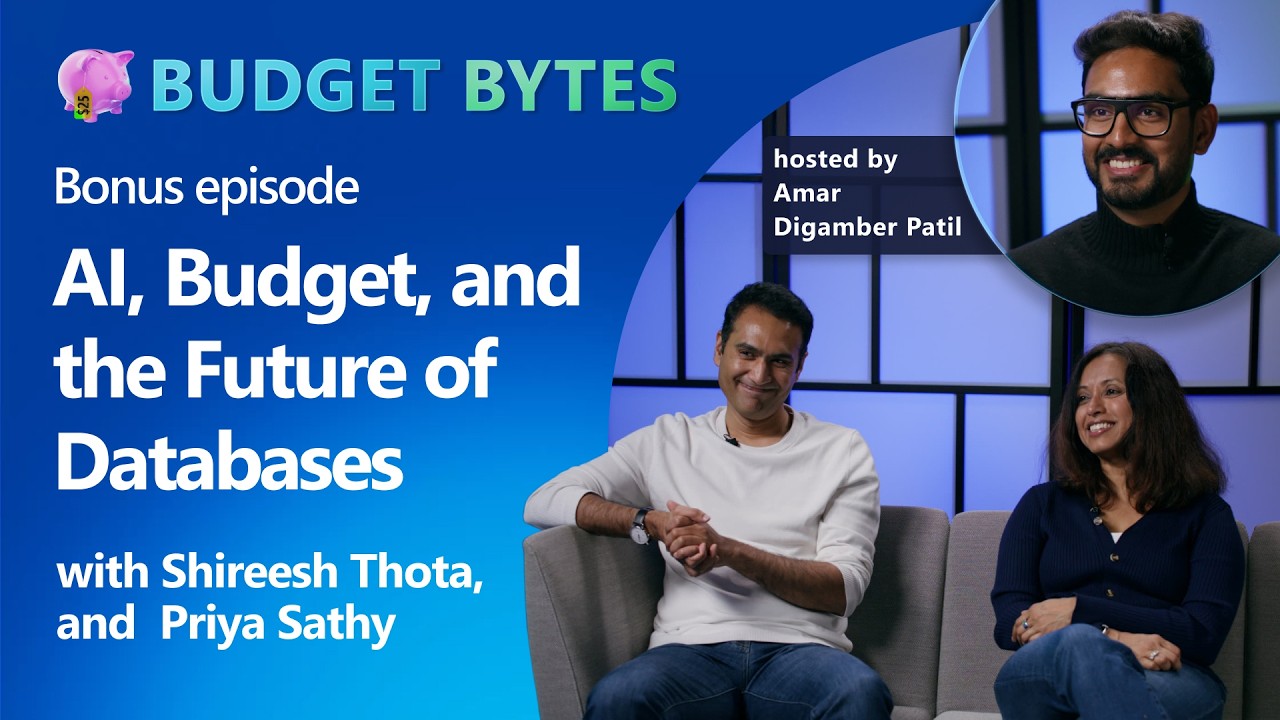
In this Budget Bites finale, we take a step back to explore what building AI-powered applications on a budget really signals for developers today. Join Microsoft leaders Shireesh (CVP, Azure Databases) and Priya Sati (VP, SQL) as they reflect on the season’s journey - from building AI apps with just $25 to scaling production-ready systems using Azure SQL, GitHub Copilot, and intelligent agents.
⏱️ Chapters 00:07 – Welcome to Budget Bites and the $25 AI challenge 01:09 – What’s changed for customers building AI today 01:43 – The AI–Cloud–Developer experience trifecta 03:02 – Building AI on a budget: Azure SQL perspective 04:25 – AI infrastructure costs and what people get wrong 07:13 – Data as the new oil: what’s the modern refinery? 08:53 – Why experience matters in the age of AI and agents 10:23 – DBA agents and reducing operational drudgery 13:52 – Agents + structured, governed data with Azure SQL 18:26 – Scaling from free Azure SQL to hyperscale production 20:24 – From data to unified intelligence: Microsoft’s vision 25:02 – Final takeaways and building budget-smart AI apps
"10X SOC" sounds great. But for an organization stuck in "SIEM 1.0" with poor data quality and manual workflows, is "AI-native MDR" a "leapfrog" opportunity or a recipe for disaster?
We've seen the rise of "Decoupled SIEM" and security data lakes. Does a "Modern SIEM" even need to exist if an MDR platform has an agentic layer doing the heavy lifting?
You've argued for AI-native over AI-bolted-on. For an end user, what are the tangible differences of using "AI inside a legacy SIEM" versus using an "AI-native separate product"?
What is the one task you thought AI would handle by now that still requires a senior human analyst to step in?
If a CISO is using an AI MDR, "Mean Time to Detect" (MTTD) starts to look like a vanity metric because the machine is instant. What is the new golden metric for an AI-powered SOC? Is it "Time to Context," "Reduction in Human Toil," or something else?
How do you help a skeptical SOC Manager—who has been burned by false positives for a decade—trust an autonomous agent to perform a "containment" action at 3:00 AM?
As generative AI transforms applications into dynamic, reasoning-driven systems, traditional observability tools fall short—Microsoft is redefining what it means to monitor AI and agents at scale. Unveiled at Microsoft Ignite, Azure Monitor and AI Foundry deliver a unified observability solution for GenAI agents, featuring the AI Agent Overview Dashboard, AI-Tailored Trace Views, and Low-Code GenAI Agent Monitoring across infrastructure and application. Built on open standards OpenTelemetry, this approach eliminates vendor lock-in and empowers enterprises to govern AI workloads with the same operational discipline applied to traditional software—ensuring quality, compliance, and cost efficiency at every layer.
GitHub Copilot already generates awesome SQL code but awesome is different from aligned with your team. In this episode, we explore how to take full control of GitHub Copilot context inside VS Code using the MSSQL extension.
We start with a clean workspace to demonstrate what GitHub Copilot produces with zero context, then add a single custom instruction file that teaches it your team's exact T-SQL conventions automatically. We then use Plan Mode to design a full data model from a PRD (Product Requirements Document) and bring it to life in Schema Designer with Agent Mode, connecting GitHub Copilot to your actual database. From there, we create a skills file that teaches GitHub Copilot your vector search architecture as a slash command, generating SQL Server 2025/Azure SQL Database T-SQL without explaining anything in the prompt. To wrap up, we open the GitHub Copilot debug panel to inspect the full LLM request payload, including the system prompt and injected context, so you can see exactly what GitHub Copilot receives with every request.
Learn how to make GitHub Copilot and the MSSQL extension for VS Code work like a teammate who already knows your standards and architecture in this episode of Data Exposed.
Welcome to Episode 425 of the Microsoft Cloud IT Pro Podcast. In this audio and video episode recorded live at Microsoft headquarters during the MVP Summit, Ben welcomes a return guest, Joy Apple, to the Microsoft Cloud IT Pro Podcast and discuss her 20-year career in the Microsoft collaboration space, from financial services to SharePoint training, consulting, and her current role at Orchestry Software. Joy explains Orchestry as a Microsoft 365 governance automation layer covering templated provisioning for SharePoint and Teams, archiving policies (including Microsoft 365 Archive), guest management, and OneDrive governance. They emphasize that AI and Copilot amplify existing information architecture, permissions, and data hygiene issues, making governance more critical. They describe the MVP Summit as a “family reunion” where MVPs attend sessions and reconnect with peers. Joy and Ben also spend some time describing paths becoming an MVP and how much they just enjoy the community around the Microsoft 365 ecosystem and connecting with people both at MVP Summit as well as various conferences throughout the year.
About Joy Apple
Joy is a Microsoft MVP and Director of Success and Enablement at Orchestry. With years of experience as an information technologist, I’m dedicated to helping organizations implement technology with a purpose-driven, “human-first” approach, ensuring tools like Microsoft 365 empower people to do their best work.
Teaching and knowledge-sharing are at the heart of what I do. Whether it’s through volunteering in the Microsoft Community, speaking at events, or writing as the “Joy of SharePoint,” I’m passionate about helping others unlock their potential with modern workplace solutions.
Im also a cohost of the Guardians of M365 Governance podcast, where I explore the challenges and rewards of governance, and a columnist for She is Tulsa, a quarterly magazine celebrating impactful stories from my local community.
Outside of work, you’ll often find me enjoying live music or discovering new spots in Tulsa, Oklahoma, combining my love of connection and creativity wherever I go.
TrustedTech is a leading Microsoft Cloud Solution Provider (CSP) specializing in Microsoft Cloud services, Microsoft perpetual licensing, and Microsoft Support Services for medium and enterprise-sized businesses. Our robust team of in-house, U.S-based Microsoft architects and engineers are certified in all 6/6 Microsoft Solutions Partner Designations in the Microsoft Cloud Partner Program.
Your migration and governance solution for Microsoft 365
ShareGate helps your teams simplify tenant migrations, get Copilot-ready, and take control of Microsoft 365 governance.
Our Microsoft 365 experts and Microsoft Azure experts focus on the Microsoft cloud, so you can focus on what you do best! Learn more how we can help you!
Disclaimer: I've created everything on my channel in my free time. Nothing is officially affiliated or endorsed by Microsoft in any way. Opinions and views are my own! 🩷
 Log in