
Sr. Content Developer at Microsoft, working remotely in PA, TechBash conference organizer, former Microsoft MVP, Husband, Dad and Geek.
152428 stories
·
33 followers

Dell will still have Copilot+ PC branding for Microsoft’s sake, but it will focus on gaming, build-quality, not Windows 11 AI efforts

1 Share

AI can help companies attract investors, but not necessarily consumers, and Dell seems to be the first PC maker to realize that the “AI PC” push isn’t working, at least not right now. While Microsoft wants you to buy a new PC to run AI agents or models locally, Dell disagrees and plans to focus instead on design, comfort, battery life, and displays.

Dell generates about 40% of its revenue from selling PCs and laptops, and the US-based company doesn’t want to lose its loyal audience. During CES 2026, Dell confirmed that it’s shifting away from betting big on “AI PCs” that consumers don’t find useful.

“We’re getting back to our roots with a renewed focus on consumer and gaming,” a Dell executive said at CES 2026.

This is a U-turn from Dell’s stance in 2025 when the company strongly believed in AI and even retired product lines like XPS, Inspiron, and Latitude in favor of Dell, Dell Pro, and Dell Pro Max. Dell wanted to simplify its branding so consumers could easily pick a new “AI PC.”
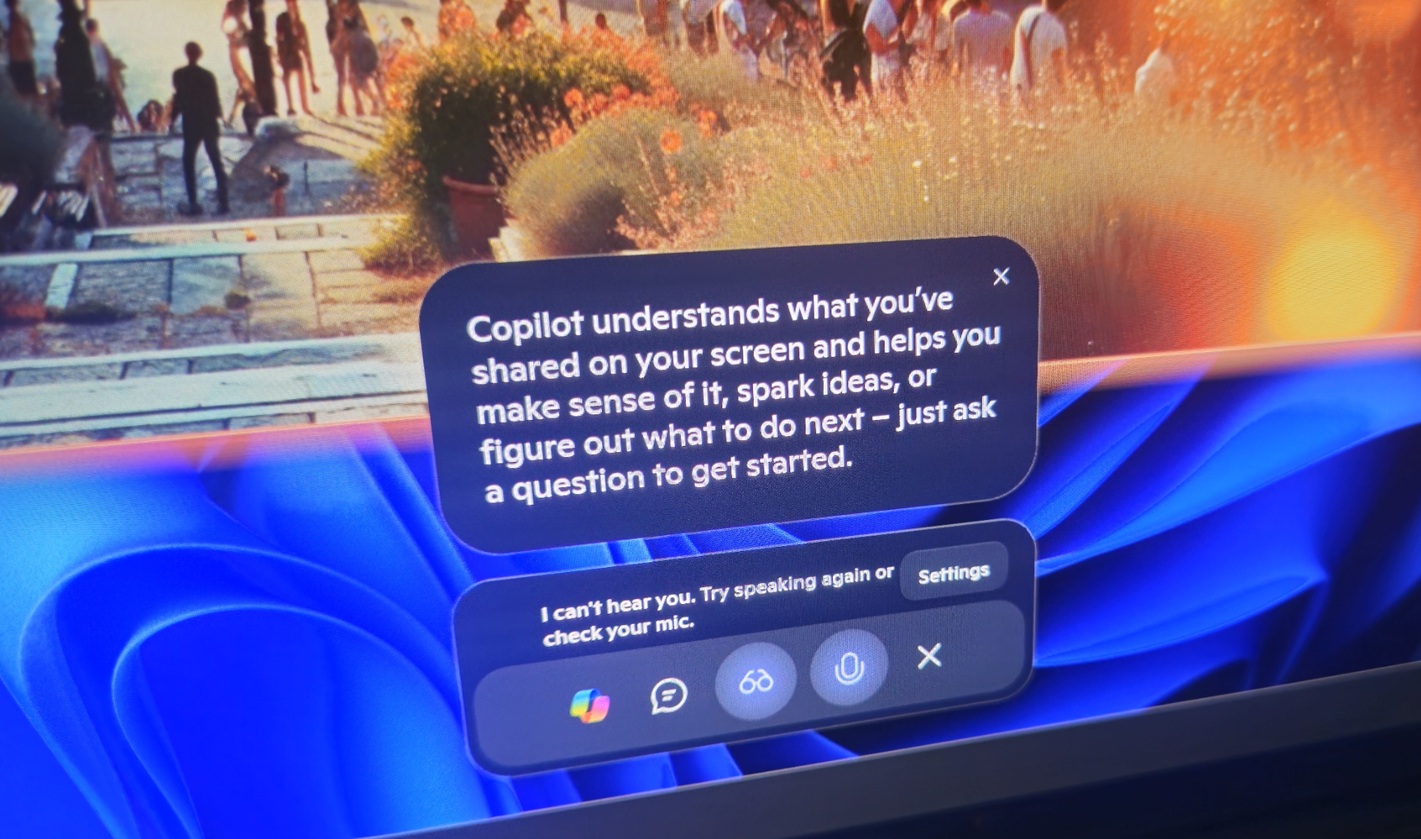
Share with Copilot button on the taskbar for Windows 11

It turns out Dell’s AI efforts haven’t been successful, but Dell isn’t alone. PC makers need to realize that not everyone wants to run AI locally on their computer, and few people use AI for tasks like generating images all the time.

“It was obvious we needed to change,” said Jeff Clarke, Vice Chairman and COO of Dell Technologies, while speaking at a CES 2026 event in New York City.

This year, Dell is bringing back XPS and scaling down its AI ambitions. Dell found that mainstream buyers care more about solid hardware than local AI features. This course correction follows weak consumer PC demand and backlash against last year’s branding and design changes.

copilot key in upcoming windows 11 laptops
Image Courtesy: Microsoft

However, Dell is not dropping the Copilot+ PC branding completely, as it still needs to follow Microsoft’s guidelines. In other words, Dell’s 2026 refresh and new XPS models will still have the Copilot key, whether you like it or not.

Dell confirmed millions are still on Windows 10

Previously, Windows Latest spotted that Dell has admitted millions are still using Windows 10, and migration to Windows 11 has been slower than expected.

During its Q3 2026 earnings call, Dell’s COO Jeffrey Clarke revealed that PC sales remain flat and that the Windows 11 transition is about 10–12 points behind Windows 10’s adoption at a similar stage.

The company noted that many users are still holding on to older PCs instead of upgrading, and while Windows 11 was meant to push new hardware sales, most consumers simply don’t see a reason to leave their stable Windows 10 systems.
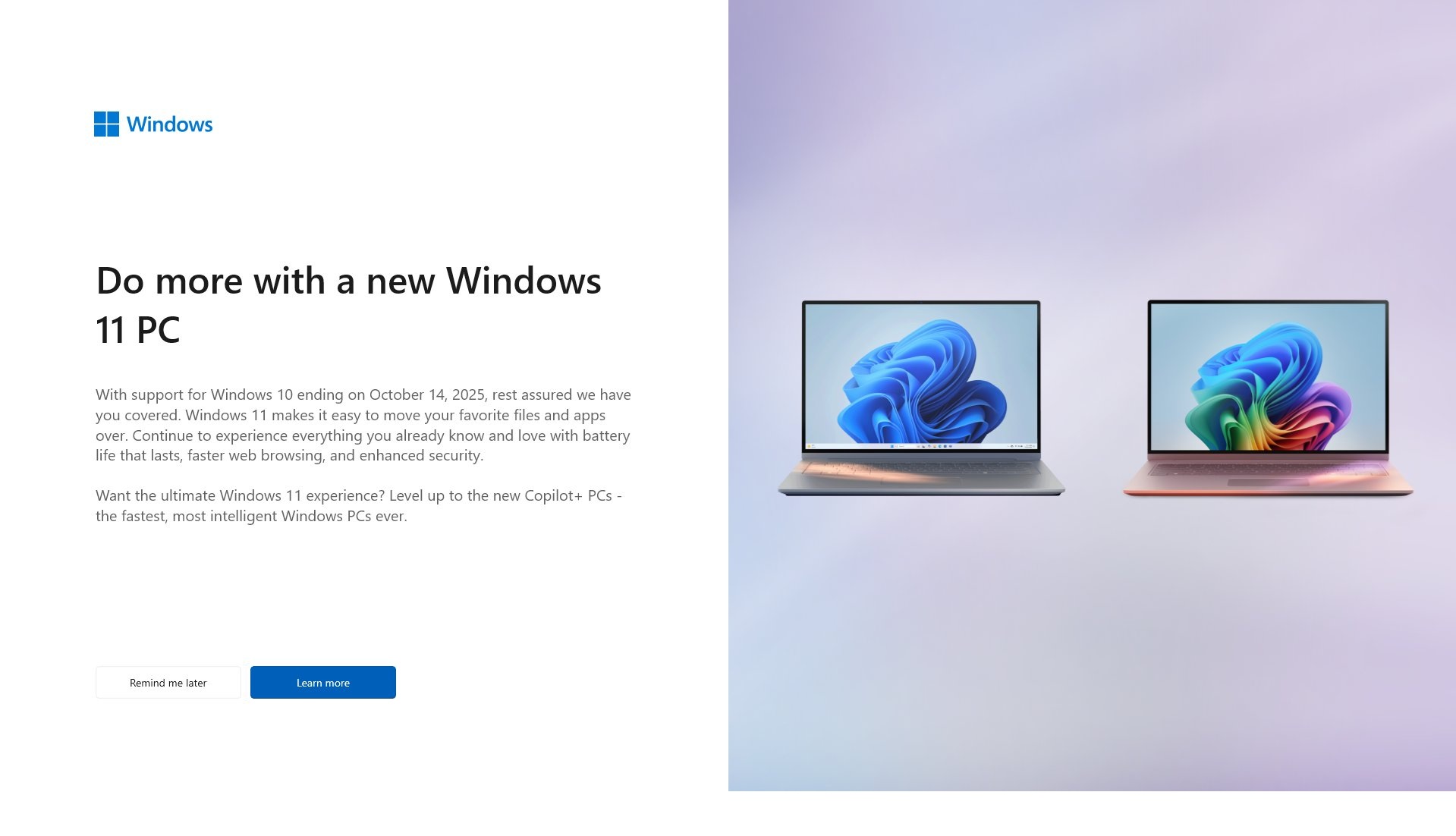
Windows 11 Copilot+ PC
Image Courtesy: WindowsLatest.com

Microsoft’s efforts to push AI are also not helping the PC makers, but could Dell’s efforts to win back consumers change the PC market for the better? Only time will tell.

You don’t fix what isn’t broken, and the same applies to Windows 11. Nobody likes unnecessary AI features or the ability to run AI models locally when the OS still struggles with real issues, such as the lack of native apps and slow performance.

The post Dell will still have Copilot+ PC branding for Microsoft’s sake, but it will focus on gaming, build-quality, not Windows 11 AI efforts appeared first on Windows Latest

Read the whole story
alvinashcraft
4 hours ago
reply
Pennsylvania, USA
Share this story
Delete

Is Microsoft losing the AI race? Copilot (web) is still stuck at 1% market share. We don’t know how popular it is on Windows 11

1 Share

Microsoft may be losing the AI race already, unless the company has a secret in-house AI model up its sleeve to surprise the crowd. Windows Latest has observed that Copilot’s market share on the web is still over just one percent, while ChatGPT is at 64.5% and Gemini has bumped to 21%. Even Perplexity is doing better than Copilot with 2% share.

This data is based on the numbers shared by SimilarWeb, which is a digital data company that tracks ‘hits’ coming to websites. Since data only covers visits to websites, such as copilot.microsoft.com or chatgpt.com, we can’t tell how popular Copilot is on the desktop or mobile apps. However, I will not keep my expectations high.

Copilot’s market share on the web is just 1.1%

If you look at the last twelve-month market share in the AI space, Copilot went from 1.5% in January 2025 to just over 1.1% in January 2026. While Copilot was growing a little every month, it suddenly lost more users recently, and mathematically, this means Copilot has stayed flat in the last six months.

Copilot and other AI market share as of January 2026
Snapshot ChatGPT Gemini DeepSeek Grok Perplexity Claude Copilot
12 Months Ago 86.7% 5.7% 1.9% 1.5% 1.5%
6 Months Ago 78.6% 8.6% 4.8% 2.1% 1.6% 1.5% 1.1%
3 Months Ago 74.1% 12.9% 3.7% 2.0% 2.4% 2.0% 1.2%
1 Month Ago 68.0% 18.2% 3.9% 2.9% 2.1% 2.0% 1.2%
Today (Jan 2) 64.5% 21.5% 3.7% 3.4% 2.0% 2.0% 1.1%

So even while ChatGPT dropped (86.7% to 64.5%) and Gemini exploded (5.7% to  21.5%), Copilot didn’t meaningfully pick up the share that’s up for grabs.

Thanks to SimilarWeb, Windows Latest also obtained a detailed breakdown of how Copilot was growing on the web. As I mentioned, Copilot growth was positive for months and even hit a peak of +19% in the last week of September, but Windows Latest observed that it stayed low to mid-teens through November.

Fast forward to December 2025, Copilot usage dropped by 19%, while other tools were as popular as before. Copilot’s traffic is now lower than it was 12 weeks earlier.

Copilot had months of positive growth, but its market share still didn’t climb. That usually means one of two things. Either the whole category grew faster than Copilot, or Copilot’s gains were too small to matter because the base is tiny. Second, on January 2, 2026, Copilot is in the red camp with OpenAI (-22%), Perplexity (-27%), Claude (-14%), and DeepSeek (-11%), while Gemini (+49%) and Grok (+52%) are surging.

Copilot growth over 12 weeks change
12wk Change 8/1 8/15 8/29 9/12 9/26 10/10 10/24 11/7 11/21 12/5 12/19 1/2
Openai 4% 5% 4% 3% 5% 5% 3% -2% 1% -4% -8% -22%
Gemini 51% 39% 20% 32% 78% 64% 69% 71% 84% 82% 44% 49%
Deepseek -27% -28% -22% -17% -8% -8% 12% 15% 12% 5% -2% -11%
Grok 9% 7% 14% 16% 6% -13% 5% 13% 28% 43% 49% 52%
Perplexity 26% 14% 17% 20% 37% 66% 39% 39% 32% 17% 7% -27%
Claude 33% 46% 42% 34% 35% 47% 56% 49% 16% 12% 12% -14%
Copilot 6% 0% 11% 12% 19% 15% 13% 12% 16% 7% 0% -19%
Meta -22% -21% -21% -21% -15% 102% 82% 73% 79% 109% 98% -3%
Huggingface 3% 12% 3% -6% -4% -14% -12% -18% -10% 4% -1% 8%
Manus 25% 2% -11% -19% -14% -23% -17% -16% -2% -1% 1% 12%

In the last month, Grok went from 2.9% to 3.4%, while Copilot went from 1.2% to 1.1% (down 0.1 points). In one month, Grok added almost half of Copilot’s entire share. That’s neat.

We can’t tell how popular Copilot is on Windows 11

We cannot figure out how popular Copilot is on Windows 11 since Microsoft does not publish data. Moreover, you can’t even use the Microsoft Store to guess the numbers because the Store does not have ‘downloads’ or ‘install’ counts. Play Store discloses the download count, but Microsoft Store skips it.

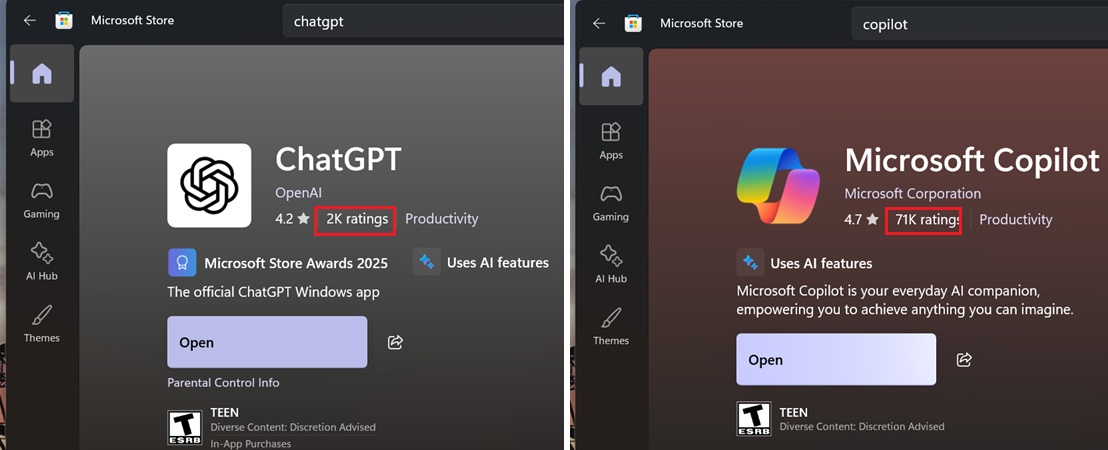
Still, I compared Copilot’s Microsoft Store reviews count with those of ChatGPT, but sadly, my analysis does not really tell us the real story.

Microsoft Store reviews count for GPT and Copilot

While ChatGPT has over 2,000 reviews in the Store, Copilot has more than 75,000. Does that mean more people use the Copilot Windows app than ChatGPT’s Windows app? I don’t think so.

First and foremost, Copilot might have more reviews because it’s installed by default on Windows. On the other hand, you need to manually install ChatGPT. Moreover, I’ve observed that OpenAI does not frequently nudge you to download the Windows 11 app, and it also arrived in the Microsoft Store much later than Copilot.

When you consider these factors, it becomes almost impossible to “guess” how popular Copilot is on Windows 11.

Microsoft’s silence makes it obvious that Copilot is not popular

Copilot is clearly not used by a lot of consumers. If Copilot were popular on Windows 11, Microsoft would have bragged about it.

You might have noticed how Microsoft never misses out on opportunities to highlight one billion active devices running Windows. Would it really not do it for Copilot if it were actually popular? I doubt.

Copilot is also integrated into Microsoft Edge, which has over 10% market share, but we can’t tell how many people use Copilot inside Edge’s sidebar.

Over to you: Do you use Copilot? If yes, how do you use Copilot? Web, Windows, or Android/iOS apps?

The post Is Microsoft losing the AI race? Copilot (web) is still stuck at 1% market share. We don’t know how popular it is on Windows 11 appeared first on Windows Latest

Read the whole story
alvinashcraft
4 hours ago
reply
Pennsylvania, USA
Share this story
Delete

Why AI is pushing developers toward typed languages

1 Share

It’s a tale as old as time: tabs vs. spaces, dark mode vs. light mode, typed languages vs. untyped languages. It all depends!

But as developers use AI tools, not only are they choosing the more popular (thus more trained into the model) libraries and languages, they are also using tools that reduce risk. When code comes not just from developers, but also from their AI tools, reliability becomes a much bigger part of the equation. 

Typed vs. untyped

Dynamic languages like Python and JavaScript make it easy to move quickly when building, and developers who argue for those languages push for the speed and flexibility they provide. But that agility lacks the safety net you get with typed languages.

Untyped code is not gone, and can still be great. I love, personally, that I can just write code and not define every aspect of something on my average side project. But, when you don’t control every line of code, subtle errors can pass, unchecked. That’s when the types-driven safety net concept becomes a lot more appealing, and even necessary. AI just increases the volume of “code you didn’t personally write,” which raises the stakes. 

Type systems fill a unique role of surfacing ambiguous logic and mismatches of expected inputs and outputs. They ensure that code from any source can conform to project standards. They’ve basically become a shared contract between developers, frameworks, and AI tools that are generating more and more scaffolding and boilerplate for developers. 

With AI tools and agents producing larger volumes of code and features than ever, it only makes sense that reliability is more critical. And… that is where typed languages win the debate. Not because untyped languages are “bad,” but because types catch the exact class of surprises that AI-generated code can sometimes introduce.

Is type safety that big of a deal?

Yes!

Next question.

But actually though, a 2025 academic study found that a whopping 94% of LLM-generated compilation errors were type-check failures. Imagine how much your projects would improve if 94% of your failures went away! Your life would be better. Your skin would clear. You’d get taller. Or at least you’d have fewer “why does this return a string now?” debugging sessions.

What Octoverse 2025 says about the rise of typed languages

Octoverse 2025 confirmed it: TypeScript is now the most used language on GitHub, overtaking both Python and JavaScript as of August 2025. TypeScript grew by over 1 million contributors in 2025 (+66% YoY, Aug ‘25 vs. Aug ‘24) with an estimated 2.6 million developers total. This was driven, in part, by frameworks that scaffold projects in TypeScript by default (like Astro, Next.js, and Angular). But the report also found correlative evidence that TypeScript’s rise got a boost from AI-assisted development.

That means AI is influencing not only how fast code is written, but which languages and tools developers use. And typed ecosystems are benefiting too, because they help AI slot new code into existing projects without breaking assumptions. 

It’s not just TypeScript. Other typed languages are growing fast, too! 

Luau, Roblox’s scripting language, saw >194% YoY growth as a gradually typed language. Typst, often compared to LaTeX, but with functional design and strong typing, saw >108% YoY growth. Even older languages like Java, C++, and C# saw more growth than ever in this year’s report.

That means gradual typing, optional typing, and strong typing are all seeing momentum—and each offers different levels of guardrails depending on what you’re building and how much you want AI to automate.  

Where do we go from here?

Type systems don’t replace dynamic languages. But, they have become a common safety feature for developers working with and alongside AI coding tools for a reason. As we see AI-assisted development and agent development increase in popularity, we can expect type systems to become even more central to how we build and ship reliable software.

Static types help ensure that code is more trustworthy and more maintainable. They give developers a shared, predictable structure. That reduction in surprises means you can be in the flow (pun intended!) more.

Looking to stay one step ahead? Read the latest Octoverse report and try Copilot CLI.

The post Why AI is pushing developers toward typed languages appeared first on The GitHub Blog.

Read the whole story
alvinashcraft
4 hours ago
reply
Pennsylvania, USA
Share this story
Delete

Why Are Grok and X Still Available in App Stores?

1 Share
Elon Musk’s chatbot has been used to generate thousands of sexualized images of adults and apparent minors. Apple and Google have removed other “nudify” apps—but continue to host X and Grok.
Read the whole story
alvinashcraft
4 hours ago
reply
Pennsylvania, USA
Share this story
Delete

Why Everyone Is Obsessed with Claude Code

1 Share
From: AIDailyBrief
Duration: 25:25
Views: 699

Claude Code and Opus 4.5 sparked a leap in AI coding, enabling autonomous agents to build complex apps without traditional code. Predicted impacts include a post‑UI world with agent‑first products, enterprise workflow transformation, and new management skills for orchestrating AI agents. Opportunities range from rapid indie app creation and personal software to major economic shifts and job redefinition driven by automation.

Brought to you by:
KPMG – Go to ⁠www.kpmg.us/ai⁠ to learn more about how KPMG can help you drive value with our AI solutions.
Vanta - Simplify compliance - ⁠⁠⁠⁠⁠⁠⁠https://vanta.com/nlw

The AI Daily Brief helps you understand the most important news and discussions in AI.
Subscribe to the podcast version of The AI Daily Brief wherever you listen: https://pod.link/1680633614
Get it ad free at
Join our Discord: https://bit.ly/aibreakdown

Read the whole story
alvinashcraft
4 hours ago
reply
Pennsylvania, USA
Share this story
Delete

What Microsoft's Recent M365 Bundling Moves Mean for You

1 Share
Microsoft is bundling more separately priced features with Microsoft 365 SKUs, making the imminent inevitability of an E7 less likely. Directions analyst Wes Miller talks through the details and customer impact with Mary Jo Foley.


Download audio: https://www.directionsonmicrosoft.com/index.php?pda_v3_pf=/_pda/2026/01/season5ep1miller.mp3
Read the whole story
alvinashcraft
4 hours ago
reply
Pennsylvania, USA
Share this story
Delete
Next Page of Stories