 Log in

v1.24.10212.0

|
Sr. Content Developer at Microsoft, working remotely in PA, TechBash conference organizer, former Microsoft MVP, Husband, Dad and Geek.
|

Pennsylvania, USA

Pennsylvania, USA

We’re in the middle of a transition period for the software industry.
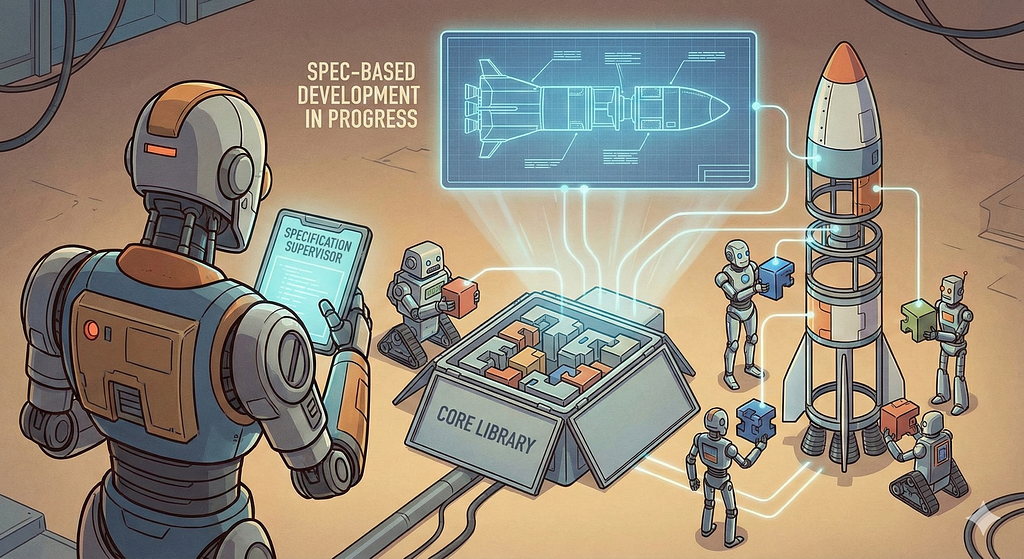
Not just a new toolchain or another framework, but a shift in how we think about software: how it’s written, which paradigms we rely on,
and who the real “actors” in the system are.
We’ve lived through major paradigm shifts before:
- Monoliths to microservices
- Imperative to declarative programming
- On-premise infrastructure to cloud-native systems
- Server-centric systems to mobile-first applications
- Centralized backends to IoT and edge-driven architectures
- Manual operations to infrastructure as code
Each shift forced us to rewrite our mental models.
AI is no longer just assisting developers, it is actively producing, shaping, and evolving software through agentic workflows, spec-driven development, and reusable agent skills.
That reality forces us to rethink something fundamental:
What should a library look like when humans are no longer the only, or even the primary, consumer?
Libraries Were Built for Developers — Not for Agents
For years, libraries and packages were designed almost exclusively for developer experience.
We optimized for:
- Friendly APIs
- Fluent abstractions
- IntelliSense and discoverability
- Boilerplate reduction
- Familiar industry conventions
We spent enormous effort answering questions like:
- Should this be opinionated or flexible?
- What feels natural to developers?
- How do we reduce mistakes through API design?
And we were right to do so.
But something has changed.
Developers are no longer the only ones writing code.
From Prompting to Agentic Development
AI-assisted development evolved quickly:
- From simple prompting
- To inline suggestions
- To slash commands
- To autonomous agents
- To spec-driven development powered by agent skills
In these workflows, agents:
- Generate significant portions of code
- Make architectural decisions
- Adapt code to local standards
- Apply patterns repeatedly and consistently
At that point, agents become consumers of libraries.
And like in any other industry, when your customer changes, your product must evolve.
This is where Skills-Native Libraries enter the picture.
Skills-Native Libraries: The Missing Link
A Skills-Native Library is not just a package.
It is a combination of:
- A core library that provides real, durable value
- One or more agentic skills designed to use that library correctly
In practice, this means:
- The library encodes the hard, non-trivial logic
- The agent skill encodes best practices, patterns, and usage knowledge
- Together, they form a coherent unit that works naturally in agentic workflows
Skills-Native Libraries can exist in any ecosystem (e.g., npm, pip, NuGet).
What makes them “skills-native” is not the runtime — it’s the intentional pairing of library and agent skill.
Generative Agents Don’t Need Determinism, They Need Boundaries
Modern AI code agents are not deterministic systems.
They are probabilistic, generative models that excel at:
- Adapting to context
- Personalization
- Filling in gaps
- Working with incomplete specifications
But when the decision space is too wide, they can:
- Hallucinate behavior
- Infer incorrect assumptions
- Misuse APIs that look right
- Violate hidden invariants
The goal is not to constrain agents into rigid contracts.
The goal is to shape the problem space.
Skills-Native Libraries do exactly that:
- The library provides strong invariants and guardrails
- The agent skill guides usage within those boundaries
- Flexibility is preserved — but channeled
This is why agent skills and skills-native libraries are better together.
When Skills Replace Libraries and When They Don’t
In some simple cases, an agent skill might fully replace a library.
That’s fine.
But for non-trivial domains — event sourcing, consistency, concurrency, durability, data correctness, core logic belongs in a library.
The right model is:
- Libraries for durable, high-value, invariant-heavy logic
- Agent skills for usability, adaptation, and evolution
A well-designed Skills-Native Library might include:
- A strong core package
- A SKILL.md definition (governs tools, MCP, etc).
The Real Shift
The key shift is not: “AI replaces libraries”
The shift is:
Libraries and agentic skills are complementary primitives.
Together, they enable:
- Safer agentic development
- Faster iteration
- Better alignment with domain intent
- Less accidental complexity
Final Thought
Agentic development is not just about generating more code.
It’s about embedding knowledge into systems, some of it in libraries, some of it in skills.
Skills-Native Libraries are the foundation for better agentic results and faster dev cycles.
Pennsylvania, USA

This week, we’re sharing powerful stories and hands-on code! The Angular community is defined by its willingness to share personal journeys, provide practical examples, and dive deep into major features like Signal Forms.
Check out these valuable resources from Angular experts:
- From ASP.NET to Angular: My MVP Story
Sonu Kapoor @SonuKapoor1978 shares a compelling personal story about transitioning from the ASP.NET ecosystem to becoming an Angular expert and MVP. This is a great read for anyone navigating a career shift! - Read the inspiring journey: https://techcommunity.microsoft.com/blog/mvp-blog/from-asp-net-to-angular-my-mvp-story---sonu-kapoor/4458699
- Angular Signal Forms (3-Part Series)
Ferdinand Malcher @fmalcher01 & Danny Koppenhagen provide the definitive guide to mastering the new Signal Forms API in Angular! This three-part series offers everything you need to know about this major update to forms management.
Part 1: https://angular-buch.com/blog/2025-10-signal-forms-part1
Part 2: https://angular-buch.com/blog/2025-10-signal-forms-part2
Part 3: https://angular-buch.com/blog/2025-10-signal-forms-part3 - Building AI-Powered Content with Angular and Gemini
Ready to integrate AI into your apps? Babatunde Lamidi shares a complete code sample showing you exactly how to build an AI-powered content generator using Angular and the Gemini API.
Explore the GitHub repo: https://github.com/babatundelmd/ng-content-generator - Modernizing Angular Control Flow
Antonio Cardenas @yeoudev provides essential real-world guidance and code examples for updating your applications to use Angular’s new, more efficient built-in Control Flow syntax.
See the code sample: https://dev.to/turingsoracle/updating-to-angular-20-a-real-world-guide-2h9o
Have you integrated Signal Forms or the new Control Flow into your app yet? Share your experience or a snippet of your code!
Help grow the ecosystem! Use #AngularSparkles to share your favorite Angular resources.
Community Stories, Code Samples, and Signal Forms! 🌟 was originally published in Angular Blog on Medium, where people are continuing the conversation by highlighting and responding to this story.
Pennsylvania, USA


The date is set for a transportation milestone that could impact how thousands of Seattle-area commuters travel between home and work, especially at the region’s major tech hubs.
Sound Transit announced Friday that the “Crosslake Connection” of the Link light rail system will open to the public on March 28.
The route will carry light rail passengers across a floating bridge for the first time, serving as a 7.4-mile extension of the 2 Line and ultimately connecting downtown Seattle to downtown Bellevue and the Redmond Technology station at Microsoft’s headquarters campus.
- Are you a tech worker looking forward to using light rail to commute between Seattle and the Eastside? We’d love to hear from you: tips@geekwire.com
Testing of trains on the bridge, between new stations at Mercer Island and Judkins Park, began in September. A 6.6-mile East Link segment of the 2 Line, including eight stations, opened last April.
The entire Seattle-Eastside line — plagued by planning, construction and cost issues — has taken nearly 18 years to deliver, The Seattle Times noted after a test ride this week.
The region has changed substantially in that time.
The tech boom and subsequent population explosion in Seattle clogged area roadways, turning a roughly 13-mile commute between Seattle and Microsoft HQ into an often time-consuming headache.
Bellevue has also grown, thanks in part to Amazon, as the tech giant has shifted thousands of workers to various buildings in that city. Roughly 50,000 corporate employees work in Seattle.
While Microsoft, Amazon, Expedia and other companies run private buses between offices in Seattle and Eastside cities for their employees, light rail service adds another wrinkle to the commute landscape.
Sound Transit projects that the fully integrated 2 Line will serve about 43,000 to 52,000 daily riders in 2026.
Trains over Lake Washington will operate at speeds of 55 mph, running every 10 mins, 5:30 a.m. to 9:30 p.m., seven days a week.
Pennsylvania, USA

GitHub Coplot CLI+WorkIQ+Nightscout...can I correlate which coworker is stressing me out? Satya?
https://github.com/features/copilot/cli/
https://developer.microsoft.com/blog/bringing-work-context-to-your-code-in-github-copilot

Pennsylvania, USA
Next Page of Stories