Sr. Content Developer at Microsoft, working remotely in PA, TechBash conference organizer, former Microsoft MVP, Husband, Dad and Geek.
165707 stories
·
33 followers

As MCP turns two, Claude gets Skills over MCP and better support for long-running tasks

1 Share

Anthropic on Tuesday marked the second anniversary of the Model Context Protocol (MCP) by bringing support for skills, long-running tasks, and file uploads over MCP to Claude.

Skills over MCP, which lets MCP servers publish skills alongside their tools, is now available in public beta, while Tasks, which first landed in Claude Code as a beta in October, and Elicitation are now generally available. File uploads will roll out soon.

All three are meant to help agents work more autonomously and for longer stretches of time, which, according to the protocol’s maintainers, is also where the project focused much of its second year. In its announcement, Anthropic says these features let Claude treat an MCP server more like another agent that it can learn from and delegate work to.

Den Delimarsky, a lead maintainer of MCP at Anthropic, tells The New Stack, “You have long-running tasks, you have events, you have file uploads and downloads, you have skills over MCP, and all of them working together now enable a completely different spectrum of scenarios.”

Credit: MCP project.

From early adoption to agents

When Anthropic first launched MCP in November 2024, it wasn’t clear whether the protocol would pan out, says David Soria Parra, who co-created MCP at Anthropic and remains one of its lead maintainers. That first year was mostly about adoption, he says.

Anthropic says the MCP SDKs now see more than 700 million downloads per month (up from the 400 million it reported in July) and that there are now more than 10,000 MCP connectors for Claude. claude

It’s no secret that MCP saw an impressive adoption curve, and by its first birthday, it had become clear that there was a need for an open protocol, but also that it still had a lot of pain points, especially for companies that deployed it in production at scale.

In reaction to this, the MCP team released the 2026-07-28 version of the spec earlier this year, which removed sessions from the protocol and made it stateless — and with that, a lot easier to run behind a standard load balancer, for example.

At the same time, Claude Code also kept getting more popular, and it became clear that the industry wanted agents, Soria Parra says. MCP, though, had launched without any primitives built specifically for agents. But as Soria Parra notes, that is part of the development philosophy behind MCP.

“MCP never tries to predict where the future goes, but tries to pick up people where they currently are, which is why we did not have agentic primitives from the very beginning, but just tools and resources,” Soria Parra tells The New Stack.

Anthropic’s David Soria Parra at AGNTCon+MCPCon Europe 2026. Credit: AAIF.

Building for autonomous agents

Now, however, agents are everywhere and the MCP community is reacting to that.

“We’ve seen in the past year the world shift from the expectation that somebody’s always in front of the keyboard to a world where agents are now autonomously doing things,” Delimarsky says.

When MCP first launched, for example, its authorization flow still assumed that a user would be there to always click a consent button. That’s not the case now that agents have become widely used. With the Enterprise-Managed Authorization extension, which the MCP team worked on with Okta and others, admins can now authorize an MCP server once for all of their users.

The team is now also working on the Workload Authorization Grant (WAG), Delimarsky says, a standard for agents that need to access third-party services on their own.

Like most of the recent additions to MCP, this work didn’t start with the maintainers deciding what they wanted to build, he says: “It actually comes from real industry needs that we see shifting.”

Long-running tasks and Elicitation

Among the MCP features that are now generally available in Claude are Tasks and Elicitation. Tasks allow an MCP server to start a long-running job in the background and then report back when it’s done, while Elicitation lets the server pause and ask the user for input.

Developers have been asking for a way to handle these long-running operations for quite a while, Soria Parra says. “People effectively use MCP servers not just to provide tools that are singular actions, but effectively expose full-on agents.”

Credit: Anthropic.

This means a developer in Claude Code could, for example, ask an MCP server to investigate a failing CI run. The agent on the other side might then work on this for a few hours, and once it’s done, the chat session pops back open with the answer.

That’s also closer to how people tend to work with each other, Soria Parra argues, since they usually kick something off and then wait for the work to get done “rather than just always sitting there and interacting with something.”

Quite a few companies already use Tasks internally, where they control their own harnesses, he says, and he expects that usage will pick up now that Claude supports the feature. ZoomInfo, for example, uses Tasks for account and contact research jobs that previously took users several prompts, Anthropic says.

Servers will mostly use Elicitation to get a user’s approval, through a form or a link, before they do something that costs money or can’t easily be undone. Supabase, for example, now confirms the cost with the user before it creates a paid project, while GitHub asks users to type in a repository’s name before an agent can delete it.

Both features are now generally available in Claude and Claude Code for users on Anthropic’s Pro, Max, and Ultra plans and are still rolling out to Team and Enterprise users.

Skills over MCP

Skills over MCP, which became an official MCP extension in September, brings the Agent Skills format to MCP servers. A server can now provide not only its tools but also the instructions for how to best use them.

Since these skills live on the server, developers can update them whenever they update their tools, and users don’t have to install anything. Claude also only loads a skill into its context when it actually needs it.

Soria Parra believes this is one of the most exciting features to come to MCP in a long time.

“If you are a Figma MCP server, you could — and I don’t know if they do it, but you could hypothetically support a skill for designers and a skill for engineers,” he says.

Since many MCP servers already require users to log in, they can now also serve skills that are highly personalized for a specific user or organization. That’s something a plugin can’t do, Soria Parra says.

“You can totally imagine an MCP server that just generates a skill that’s only for you,” he says.

Credit: Anthropic.

Shopify, HubSpot, and Atlassian are among the first companies to offer skills through their MCP servers. Shopify’s skills, for example, walk Claude through building and updating a merchant’s online store.

Adding skills to an MCP server is quite easy, Soria Parra notes, but supporting them in a client like Claude Code is a bit harder.

“Skills are text that steers the model, and that comes with security and approval implications, and those are the difficult part,” Soria Parra says. “Reading a file over MCP and giving it to a context is the easy part. Making sure that it’s done safely and securely is a much harder piece.”

Skills over MCP is now available in Claude and Claude Code and turned on by default for users on the Pro, Max, and Ultra plans. Admins on the Team plan have to enable it first, and support for Enterprise plans is coming soon.

It’s worth noting that Anthropic isn’t the only company working on this, though. The extension is also already available in preview in Microsoft’s Foundry.

File uploads are coming soon

File uploads remain the most experimental of these new features.

In Claude and Claude Code, they’ll roll out soon to users on the Pro, Max, and Ultra plans (and eligible Team and Enterprise plans), and at first, they’ll only work with the MCP servers from Intuit and Dropbox.

The MCP extension itself is also still a draft that Delimarsky and Google’s Wil St. Charles first published earlier this month.

It was already possible to send files to an MCP server before, Delimarsky says, but that was “a little hacky” because it involved encoding the file in base64 and embedding it in a tool call. That doesn’t work for the large audio and video files that some of his favorite MCP servers handle.

“I can’t rely on base64 and loading a 1.2 gigabyte file,” he says.

With the new extension, the file never passes through the model’s context. Instead, the server provides an upload target (typically a pre-signed URL) and the client then sends the file there directly over HTTPS.

The team built this on top of existing HTTP conventions because it’s “trying not to reinvent the wheel unless we absolutely have to,” Delimarsky says. The protocol also doesn’t set any limits on file sizes (though servers can set their own).

“We inherently did not bake any limits because we don’t know,” he says.

Extensions as a testing ground

All three of these features are extensions to MCP and not part of the core protocol. That also means they aren’t specific to Claude, and Anthropic notes that a server that supports them will work in any other compatible client, too.

That’s very much by design, Delimarsky says and he credits Soria Parra with the idea that “adding things is easy, removing them is very hard.” With so many MCP clients and servers now in production, removing a feature from the core protocol and breaking those servers is “just not acceptable anymore,” he says.

Extensions give the team a way to try new ideas with partners first. Some of them could later become part of the core protocol, but others, like MCP Apps, will always remain extensions because not every client can support them.

“You need an HTML rendering interface, so terminals are out,” Soria Parra says.

The team has some experience with features that didn’t take off. Soria Parra says he was a big proponent of sampling, for example, which allowed MCP servers to use the client’s model for inference.

“It turns out people really don’t want that for a variety of reasons,” he says.

The July spec deprecated sampling (though it will keep working for at least another 12 months), and Soria Parra notes that prompts, another early MCP feature, have mostly fallen out of use as well.

MCP’s popularity also means that the maintainers now get a lot of proposals for new features. “Everybody wants to fit their tiny little use case in and comes with proposals exactly perfect for that, and it’s a selection choice,” Soria Parra says.

The core maintainers, who work at Anthropic, Microsoft, Google, OpenAI, and Amazon, have been good at picking the features that the major harnesses then adopt, he belives. He does acknowledge, though, that the group has been “a bit slow” to finalize the Events extension, for example, which lets MCP servers notify an agent when something happens.

Both Delimarsky and Soria Parra stressed that all of this work happens in public working groups. The file uploads group, for example, was led by Delimarsky and two Google engineers, with others from Microsoft and Dropbox (which will be one of the launch partners for the feature in Claude) also participating.

Anthropic donated MCP to the Linux Foundation’s Agentic AI Foundation (AAIF) last December. Soria Parra says little has changed in how the project is steered since then, but that the neutral governance has helped with adoption.

Angie Jones, the foundation’s vice president, says in a statement that she has “watched independent developers and engineers from competing companies bring real problems back to the project and solve them together.”

What’s next for MCP

As for what’s next, Soria Parra stresses that the team isn’t trying to predict where things are going. Streaming is on the list, as are voice and other modalities, but the general idea is to keep “carefully observing what the industry is doing” and then standardize that.

The team will likely also add better support for what Anthropic calls programmatic tool calling (and what others often call “code mode”), where an agent writes code that calls its tools and doesn’t have to call them one at a time. That idea has been around for more than a year and a half, Soria Parra notes, but it’s only now becoming widely known.

“Things are moving fast, but they are also at the same time slower than you expect,” he says.

Delimarsky expects that real-world usage will shape the new extensions, too. Events, for example, supports push, poll, and webhook delivery. “We don’t know which one of these three would be the most popular,” he says.

Soria Parra notes that while the major harnesses continue to invest in MCP, they’re picky about which features they support. It remains to be seen how quickly clients beyond Claude will pick up these new extensions.

The post As MCP turns two, Claude gets Skills over MCP and better support for long-running tasks appeared first on The New Stack.

Read the whole story
alvinashcraft
26 seconds ago
reply
Pennsylvania, USA
Share this story
Delete

My To Do - Replacing what Microsoft is Killing

1 Share

Earlier this week I shared the bad news that Microsoft is killing off To Do, one of the best, simplest apps around. I built a simple export tool to let you get your existing To Dos in either JSON or HTML format. At the time, I hinted at a plan to replace the app, and today I'm happy to share it.

My To Do is a web application based heavily on the UI and functionality of Microsoft's app. It's got a few lists built in, but then lets you add your own and create to dos to your heart's content. Functionality includes:

  • The ability to create groups of lists
  • The ability to set due dates and reminders.
  • The ability to create repeating tasks.
  • It's an installable PWA with offline support as well.

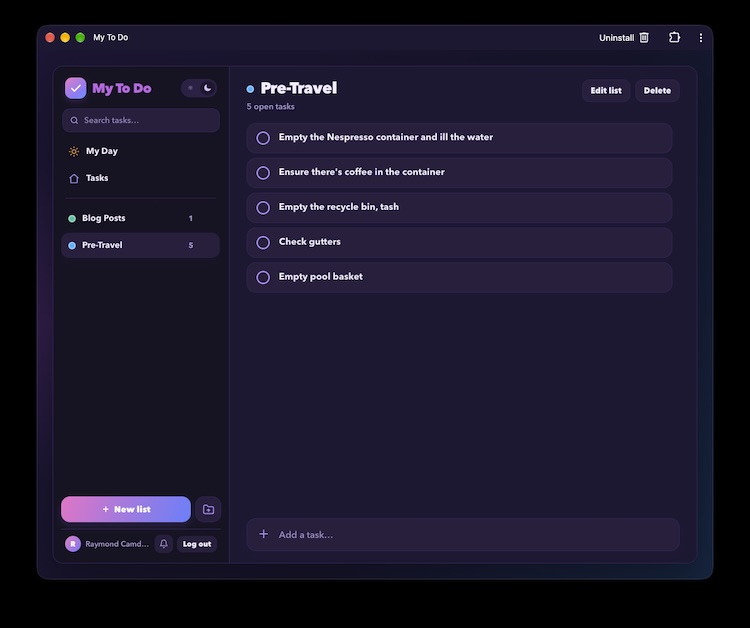
Here's an example of it running as a Mac OSX app:

App example

For folks curious, when I travel for work I try to remember to do things that make it easier for my wife while I'm gone. This is that list.

The application was built with Google Antigravity and is hosted on Netlify. I'm going to be moving my usage this week and probably will not use my own export tool as I think I probably need to clean up my blog idea's list. (I mean I'll still export it, but I'm not going to import everything.)

Finally, if you want to take a look at the code, it's all up on GitHub: https://github.com/cfjedimaster/mytodo

Read the whole story
alvinashcraft
35 seconds ago
reply
Pennsylvania, USA
Share this story
Delete

Agentic SDLC Part 2: Develop Against the Design Package

1 Share

This is part 2 of a 3-part series on the agentic SDLC. In part 1, the design phase produced a package for the architect to review: saved Context Graph findings, spec.md, the OpenAPI contract, governance checks, design tests, collections, mocks, and simulations. Now the developer picks it up.

The developer’s job in an agentic SDLC looks different from the usual one. There’s less time spent working out what to build, because the design package already answers that, and more time spent checking that what got built matches the design. This post walks through that handoff: what the developer starts with, how Claude builds the check-in feature, and how the code gets checked against simulated dependencies before anyone else sees it.

Develop against the design package

Once the architect approves, it’s time for the developer to start implementation. This is where the time we spent on design should start paying back.

I am asking Claude to implement the appointment check-in contract, reuse the existing appointment and eligibility interfaces, and build against isolated simulated dependencies. The rule stays explicit: do not change appointment status unless eligibility is approved.

Notice how much I do not have to explain again. The API choices, the error cases, and the instructions for running the integration already live in the design package. Another developer or agent can read them and have full context.

That last point matters more than it first appears. Without a design package, the developer prompt has to carry all of the context: which services to call, how to authenticate, what to do on a timeout. Every detail left out becomes a guess. With the package, the prompt can stay short because the repository holds the answers. A new teammate, or a different agent, can pick up the same work and reach the same decisions.

What the developer starts with

The package from part 1 is the input to this phase. Each piece has a job during development:

Design asset How the developer uses it
spec.md Explains what to build and how the feature fits the system
OpenAPI contract Defines the request, response, and error shapes
Saved Context Graph answers Shows why the existing appointment and eligibility APIs were chosen
Collections Turn expected behavior into runnable requests and assertions
Mocks Stand in for the appointment and eligibility services
Simulations Put the mocks together into repeatable environments, including outage and timeout cases

The prompt also states one rule outright: do not change appointment status unless eligibility is approved. Writing the rule into the request and encoding it as a test gives you two chances to catch a violation. If the code ever marks a patient as checked in without an approved eligibility response, a test fails.

Build the check-in feature

Develop: Claude builds the check-in feature, runs it against the design mocks, and reports the collection results.

Claude now takes the design we just reviewed and builds the check-in feature. It connects the existing appointment and eligibility APIs, checking coverage before marking the patient as checked in.

Then we need to see whether the code follows that design. Approved coverage should allow check-in. Denied coverage, an error, or a timeout should leave the appointment unchanged.

The order of operations is the whole feature. The code asks the eligibility API about coverage first, and only a clear approval leads to an update on the appointment. Everything else, whether that’s a denial, an error, or a response that never arrives, leaves the appointment exactly as it was. Here are the four outcomes side by side:

Eligibility result Check-in Appointment status
Approved Allowed Marked as checked in
Denied Refused Unchanged
Error Refused Unchanged
Timeout Refused Unchanged

A feature like this can look finished while the failure paths are still wrong. The happy path works on the first try, and the bugs hide in the other three rows. That’s why the next step spends its effort on the failure cases.

Run the new code against the design mocks

Using the Postman plugin’s api-simulation skill, Claude runs the new code against the mock APIs created during design. These stand in for the appointment and eligibility services, so we can test without starting those services. The api-mocking skill helps adjust their behavior when needed.

We can make eligibility approve, deny, fail, or respond too slowly. After each request, we read the appointment back from the mock to check that its status matches what we expected.

With api-testing, Claude runs the design collection against the new code: 27 requests and 30 assertions pass, plus six outage assertions. We now have a working feature checked against the design, ready for independent verification.

Two habits in this step are worth borrowing:

  • Control the dependency, not only the request. Because the eligibility mock can approve, deny, fail, or stall on demand, you can reproduce an upstream failure in seconds. Waiting for a real service to go down isn’t a test plan.
  • Read the state back. A response that says “check-in refused” tells you what the code claimed. Reading the appointment from the mock afterward tells you what the code did. The feature’s whole promise is that the status stays unchanged on failure, so that’s the thing to check.

The numbers in the last paragraph are specific for a reason. 27 requests and 30 assertions come from the design collection running against the new code, and the six outage assertions cover the failure scenarios on top of that. Passing here means the code follows the design. It doesn’t yet mean the design is right, which is why a separate person tests the feature next.

Review the workspace assets and hand off to QA

From the Postman workspace, we can see the collection, mocks, and simulation that were created.

The output from development is the implemented check-in feature, including the code that connects the appointment and eligibility APIs and applies the rules from the design. The developer has checked that integration against the simulations.

Now, the developer hands this off to the QA engineer who will independently test the feature against the approved contract.

Keep the limits of this phase in mind. The simulations are stand-ins built from the design, so a pass tells you the code behaves correctly against those stand-ins. It doesn’t tell you the real appointment and eligibility services behave the same way. The developer’s checks are a strong first line, and the QA engineer in part 3 supplies the independent second look.

Tips for developing against a design package

  • Keep the package in the repository. spec.md, the contract, and the collections only help the next agent if it can read them from the checkout.
  • Say the rule out loud in the prompt. “Do not change appointment status unless eligibility is approved” is short enough to repeat, and it gives the agent a boundary to check its own work against.
  • Run the failure cases first. If the denial, error, and timeout paths pass, the approved path rarely surprises you.
  • Treat a failing assertion as a design question. When the code and the collection disagree, decide which one is wrong before you change either.

Try it yourself

If you ran the design phase from part 1, open Claude Code in the same repo with the design package in place and give it the implementation request. Swap in the names from your own feature:

Prompt

Implement the appointment check-in contract, reuse the existing appointment and eligibility interfaces, and build against the isolated simulated dependencies. Do not change appointment status unless eligibility is approved.

Then run the design collection against the new code with the Postman CLI:

postman collection run path/to/design-collection.json

Replace the path with wherever the design phase saved your collection. Make the eligibility mock deny, fail, and respond slowly in turn, and read the appointment back from the mock after each request. If the status changes when it shouldn’t, you found the bug before QA did.

Once the run is clean, look at the workspace assets and confirm that the collection, mocks, and simulation are all there for the QA engineer to pick up. A handoff only works if the next person can find what you built.

Part 3 follows the QA engineer, who tests the running feature against the approved contract.

Resources

The post Agentic SDLC Part 2: Develop Against the Design Package appeared first on Postman Blog.

Read the whole story
alvinashcraft
46 seconds ago
reply
Pennsylvania, USA
Share this story
Delete

AWS Weekly Roundup: Local Zone in Bogotá, 30-minute Lambda timeout, and more (November 24, 2026)

1 Share

Some limits shape architecture more than any feature does. AWS Lambda launched in 2014 with a 60-second timeout, moved to 5 minutes in 2015 and to 15 minutes in 2018, and then stayed there for eight years. Last week the limit doubled, and in the same week Lambda learned to run on GPUs and gave platform teams their own runtimes. That is a lot of Lambda for one week.

Two other threads ran through the week. A new AWS Local Zone in Bogotá brought AWS infrastructure closer to users in Colombia. And AWS Security Token Service (AWS STS), Amazon Cognito, and Amazon CloudFront each shipped a piece of identity for agents: who an agent is when it shows up at your door, and how little it should be allowed to do. Now, let’s get into this week’s AWS news…

Headlines
AWS Local Zone in Bogotá, Colombia – AWS opened a new Local Zone in Bogotá, so you can now run applications that need single-digit millisecond latency closer to users in Colombia. AWS Local Zones place compute, storage, and networking near large metropolitan areas with the same APIs and tools as a Region, for workloads like real-time gaming, live streaming, and financial transactions. The Bogotá Local Zone supports Amazon EC2 C7i, M7i, and R7i instances, Amazon EBS gp3, gp2, and io1 volumes with local snapshots, Amazon S3 One Zone-Infrequent Access, Amazon ECS, Amazon EKS, AWS Direct Connect, and Application Load Balancer. To start, enable us-east-1-bog-1a in AWS Global View.

AWS Lambda now supports a 30-minute timeout for on-demand Event Functions – You can now configure any Event Function with a timeout of up to 30 minutes (1,800 seconds), double the previous limit, for synchronous, asynchronous, and event source mapping invocations. On Lambda Managed Instances, synchronous invocations also go to 30 minutes, while asynchronous and event source mapping invocations keep the 90-minute timeout from September. Standard Lambda pricing applies, in all commercial Regions. Agentic requests that chain model and tool calls, media transcoding, and file conversion are the workloads AWS calls out. Before raising the value, read the considerations in the Compute blog post: a service that invokes your function synchronously applies its own timeout, client read and socket timeouts need to be longer, and a NAT gateway drops idle connections after 350 seconds, so long calls need keep-alives. For longer work, durable functions still run for up to a year, and now emit OpenTelemetry traces.

AWS Lambda now supports GPU instances for Event Functions on Lambda Managed Instances – You can now run GPU-accelerated inference, media processing, rendering, and scientific computing as Lambda functions, packaged as OCI container images, with no GPU drivers, CUDA versions, or AMIs to reconcile. In the walkthrough, four concurrent requests shared one copy of the model on a single GPU and finished in about the same time as one. It’s optimized for inference with custom models, on G-series instances from G4dn to G6e. You pay the EC2 instance fee (Savings Plans and Reserved Instances apply), a 9.75% management fee for GPU instances, and $0.20 per million requests.

Last week’s launches
Here are some launches and updates from this past week that caught my attention:

Amazon Polly now supports voice cloning – You can now create a custom voice in Amazon Polly from a few minutes of recordings of a consenting speaker, running on the Polly generative engine. It launches in seven languages, including English, Spanish, and Portuguese, and each cloned voice speaks the language it was recorded in. Polly doesn’t keep the recordings or train on them. Creating a voice is free, and you pay for the speech you synthesize. It’s a gated release, so request access through your account team. The ML blog post covers brand-voice use cases for contact centers, voice agents, and content.

AWS Lambda now supports customer-managed runtimes – You can now manage a Lambda runtime as its own resource, separate from function deployment. Platform teams package approved SDKs, certificates, and security or monitoring agents as an OCI image in Amazon ECR, and functions pick up updates as Lambda recycles execution environments, with no per-function redeploys. Updates can be staged, with health metrics and rollback. There’s no additional charge, and the Compute blog walkthrough shows the platform-team workflow.

AWS STS announces GetScopedCredentials to scope down permissions at runtime – You can now take the temporary credentials a workload already holds and derive narrower ones, cutting permissions, session duration, or both. The result keeps the caller’s original identity, and permissions only ever narrow, so a sub-agent can never end up with more access than whoever created it. Access to the API is controlled with IAM policies, and every call lands in AWS CloudTrail. It’s available in all commercial Regions and beyond, including GovCloud (US) and China.

Amazon Cognito now supports dynamic client registration – You can now let MCP clients and AI agents register themselves at runtime (RFC 7591) instead of creating an app client in advance for each one. You choose between requiring an access token with a registration scope or opening registration to any client, and dynamically registered clients carry a client ID prefix so you can filter and manage them with the rest. It’s available on the Essentials and Plus plans, and client ID metadata documents arrived the same week.

Amazon CloudFront Functions now supports network calls – You can now call your own APIs from a function with cf.fetch() and act on the response, so authorization, personalization, or fraud checks that used to need Lambda@Edge or a trip to the origin can run at the edge. AWS’s own example: check an AI agent’s permissions and usage budget before the request reaches your API or MCP server. Network calls cost $0.10 per million on top of invocation charges and are included in the Pro flat-rate plan and above. The Networking blog post also covers cf.beacon() for background analytics.

Amazon Aurora DSQL now supports multi-Region peering across continents – You can now build a multi-Region Amazon Aurora DSQL cluster with peers on different continents, such as US East (N. Virginia) and Europe (Ireland), and read and write to one strongly consistent database from both. It was a busy week for DSQL: PL/pgSQL functions and procedures arrived, and storage upgrades brought up to 50% higher write throughput at no additional cost.

For a full list of AWS announcements, be sure to keep an eye on the What’s New with AWS page.

Other AWS news
Here are some additional posts and resources that you might find interesting:

How the BMW Group governs hundreds of agents across thousands of developers – With more than 12,500 developers in R&D, BMW treats governance as deterministic code outside the agent’s reasoning loop, mostly in the CI/CD pipeline, so neither the agent nor its prompts can override it.

AI coding agents on Amazon EC2 Mac: How Cognition scales Devin for macOS – Cognition starts a fresh macOS VM for each Devin session in under a minute on Amazon EC2 Mac hosts across six Regions. The detail worth stealing: sessions are decoupled from hosts, and Cognition reports that about 90% release their VM when idle and resume from a snapshot in seconds.

How Klaviyo processes 3 billion daily events at scale with Amazon MSK Express – Timely reading for Black Friday week. Klaviyo moved from RabbitMQ to Amazon MSK Express brokers to absorb roughly 7 times normal event volume during Black Friday and Cyber Monday. Running one set of processors across three priority topics, instead of separate infrastructure per level, cut costs by roughly 30%, according to the team.

Upcoming AWS events
Check your calendar and sign up for upcoming AWS events:

AWS re:Invent – It’s next week: join the community in Las Vegas from November 30 to December 4, or register for the free livestream to follow the keynotes and selected sessions remotely.

AWS Community Days – Find community-led technical talks, workshops, and hands-on learning near you. Check each organizer’s page for current dates and registration details.

Join the AWS Builder Center to connect with builders, share solutions, and access content that supports your development. Browse here for upcoming AWS-led in-person and virtual events and developer-focused events.

That’s all for this week. Check back next Monday for another Weekly Roundup!

– Daniel Abib

This post is part of our Weekly Roundup series. Check back each week for a quick roundup of interesting news and announcements from AWS!

Read the whole story
alvinashcraft
55 seconds ago
reply
Pennsylvania, USA
Share this story
Delete

Trusting an Agent Beyond Your Expertise

1 Share

I have a Raspberry Pi on my home network running Pi-hole, a flight tracking setup, and a few services around them, with an external solid-state drive attached to it. When I first described the machine to my coding agent, I said there was nothing particularly complicated or compute intensive running on it, or so I thought. Every so often, the Pi would stop responding, and a reboot was the only way I could bring it back. Eventually it became annoying enough that I really wanted to find out what had happened. The logs I needed seemed to disappear with the restart, so I had a way to recover the machine and very little idea of how to investigate the failure.

My Linux knowledge covers the things I’ve needed for server-side Java development over the years, and I can find my way around a terminal or follow familiar procedures. System-wide container configuration, service dependencies, and the details of IPv4 and IPv6 take me well beyond that experience. I knew enough to recognize that changing some of those settings could cut off my access and leave me running up the stairs to wire my computer up to the Pi. My dad also depends on this machine for his flight radar app and enjoys watching planes go by, so I had to consider how a change would affect him too.

Before I could consider changing any of those settings, I needed help deciding where to look. Somebody had to turn “The Pi has stopped responding” into questions I could investigate, and I decided that asking the agent was a reasonable way to do that.

It went a little too well, to be honest. The agent configured persistent logging and regular health samples so there would be information to examine after a restart. We moved to Ethernet and disabled Wi-Fi, and it checked the services, storage, and connection to the router. It later repaired forwarding for local name queries and identified a problem in the order in which the Pi-hole container stopped and its external drive was unmounted.

The container needed the drive to stay mounted until the service had stopped, so the agent added an explicit dependency on the drive’s mount to put those events in the right order. After I later installed updates and rebooted, I asked it to check again, and it found log entries showing the service stopping, followed by a successful unmount of the drive.

I could follow those steps once the agent explained them to me: finding the missing dependency, expressing it in the service configuration, and choosing the log entries to examine all required knowledge I was getting from the agent. I trusted its assessment of that reboot, relying on it to judge changes it had made with the root access I had given it over SSH. That felt very weird and gave me reason to think more carefully about the advice to “trust, but verify.”

Checking a repair I needed help to make

The agent also suggested the configuration backups and checks after changes, so I relied on it for the precautions as well as the repair. Judging whether I could recover from a failed change required some of the same Linux knowledge I just didn’t have.

In “Code Review After Code Gets Cheap,” I described starting with intended behavior, evidence, and the effects of a change elsewhere in the system. Adjusting enough of the specification to make correctness checkable also depends on knowing what to expect. With my Pi challenges, I needed help establishing those expectations while deciding whether to accept the change, which left me wondering how likely this approach was to succeed and how much trust was justified.

I had given my agent the ability to act on the assessment I was asking it to make. With root access over SSH, it could change the operating system and services, including settings that determined whether I could reach the machine again. My willingness to let it proceed depended partly on what I thought a mistake would cost me. This was my Pi on my home network, with no services exposed directly to the internet, and I was prepared to spend time repairing it if necessary. I expected that to mean writing a fresh image onto an SD card and configuring the handful of things I had done a couple of times before.

The flight radar was the closest thing to a production dependency, and interrupting it would mean a couple of disappointed messages from my dad almost immediately. A Pi-hole change could also interrupt name resolution for devices on my home network. With upstream fallbacks configured in the router, this would probably mean my kids complaining about too many ads in their favorite apps. Thinking through those dependencies was part of deciding how much disruption I was prepared to accept, and another reason to ask for help understanding the machine.

Deciding how much to hand over

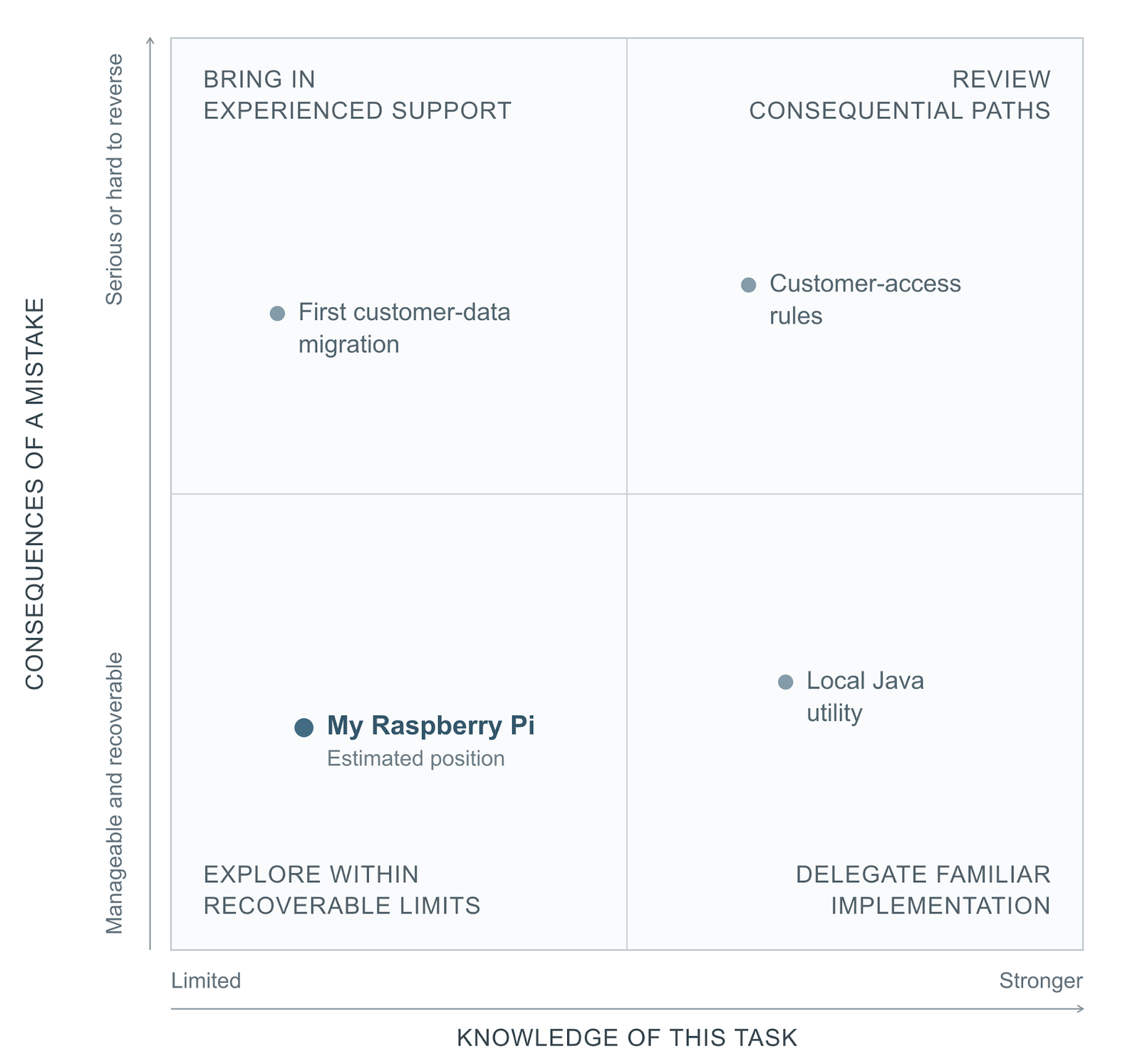
The quadrant below brings together the two things I was trying to judge: how much I understood about the task and what a mistake could affect. Across the horizontal axis is my knowledge of a particular task: how well I can explain the expected behavior, recognize a plausible failure, and assess a check. Up the vertical axis are the consequences of a mistake, including who would be affected and what recovery would involve. I place the Pi toward the lower-left, based on what I understand about it and the disruption I am prepared to accept.

For the Pi, that suggests keeping each change small enough to follow and making sure I can recover before the next one. A developer learning an unfamiliar library in an isolated project with disposable data would be in the same quadrant, with room to try changes whose effects they can contain.

Moving to the right, imagine a local Java utility with familiar inputs and expected outputs. I can give the agent more freedom over the implementation because I know how to assess the result and expect a mistake to have limited effects. My attention can go to whether it does what I asked and what else it changed.

Moving upward changes what I need from the people and systems around me. A developer attempting their first migration of customer data needs somebody who understands the data and its recovery process to review the assumptions with them. The agent can help prepare the migration against a copy, with access controls keeping it away from the live database, while the developer discusses the changes with that experienced colleague.

An experienced maintainer changing customer-access rules would be toward the upper right. Knowing the service helps them anticipate failures and choose representative tests. The consequences for customers also call for review by another person and control over how the change reaches them.

I can be on the right for a familiar Java task and on the left for the Pi’s service configuration. When choosing somebody to review a change, consider their experience with that system and the task, including where they need help.

Learning enough for the next change

Letting my agent operate as root on a Linux machine gave me another small “It can do that too?” moment, along with the discomfort of doing something I ask developers to avoid. I felt I had missed an opportunity to learn, which bothered me because I’ve always loved learning. I had let the agent do its thing and watched the results, so for further changes to my environment I want to use more of my own understanding and judgment.

In a randomized experiment with 52 developers learning the unfamiliar Python library Trio, half were given access to an AI assistant during the coding task. On a quiz taken immediately afterwards without AI, that group scored about four points lower, on average, on a 27-point scale. The result gives me another reason to think about how much I learn while an agent helps me complete an unfamiliar task.

For my next Pi change, I could break the problem down before asking for help, starting with the shutdown sequence. I could describe which events I expect to see and why, before asking the agent for an interpretation. Discussing that prediction with the agent or somebody familiar with the service manager would help me find the parts I need to understand better. I could then follow those parts through the configuration and the result, giving myself something to bring to the next investigation.

Taking those steps would require more effort than asking an agent to “fix things”; and the reward would be a better understanding of the system and, over time, more ability to judge the agent’s decisions and predictions. A team can make room for the same practice by giving a developer a small change, time to understand it, and a colleague to discuss it with. Existing acceptance tests can provide expectations the team has already agreed on, and the colleague can explain what they cover and identify a failure worth investigating. That support needs to be part of asking somebody to review the agent’s changes.

Trusting the next change

I will probably ask for the same help next time, given that all the changes on my Pi had the intended result. The flight radar kept running, and my dad sent me no text messages complaining about it. That success could make me more comfortable letting the agent take over again, so making time to understand the next change will need to be part of that decision.

If more services and people came to depend on the machine while my understanding changed little, I could find myself allowing more consequential decisions on the strength of repairs I had only partly understood. I would need to consider whether that experience justified giving the agent the same freedom.

If agents become better at planning, making changes, and checking the results, they may carry out more of an investigation before involving us. We could spend years accepting those results while getting less practice investigating systems ourselves. An outage would announce that something had gone wrong; recognizing a more subtle error could require knowledge we have stopped using or never developed. I can imagine needing the agent to tell me that its own solution is wrong.

More capable agents may also prevent and detect failures I would miss today, and relying on their checks could be reasonable. I would then need to consider how a mistake in the checking itself could be discovered, who could question the assessment, and what they would need to understand.

So the amount of trust I can justify depends on the particular task, the evidence available, and the cost of being wrong. A history of successful repairs can support confidence in similar changes. Before giving an agent more freedom on a system with a larger blast radius, build enough understanding to assess the change, bring in somebody who can, or limit what the agent is allowed to affect.

For me, trusting an agent includes the uncertainty I accept on behalf of the people using the system. I want that trust to grow alongside my ability to question its decisions, so as I hand over more of the technical judgment, I need to choose what I make time to learn. That understanding shapes how much authority I am prepared to give it and how I take responsibility for the result.


Read the whole story
alvinashcraft
1 minute ago
reply
Pennsylvania, USA
Share this story
Delete

Prompt Injection Fixes Need Regression Tests

1 Share
Read the whole story
alvinashcraft
1 minute ago
reply
Pennsylvania, USA
Share this story
Delete
Next Page of Stories