Dell has reversed course and resurrected the XPS brand as its "premium consumer" brand of laptops, admitting it was a mistake to kill it in the first place. Slashdot reader joshuark shares a report from Gizmodo: At last year's CES, Dell made the eyebrow-raising decision to ax all its legacy laptop brand names and instead opt for Apple-like conventions. Instead of XPS, we were forced to comprehend the differences between a "Dell," a "Dell Pro," a "Dell Premium," and a "Dell Pro Max." "This complicated brand we called Dell last year was trying to cover this very large consumer space with lots of similar products," Jeff Clarke, Dell's chief operating officer said. Now those non-XPS products are mostly dedicated to the base consumer and entry-level laptops, "no pluses, minuses, squares, or whatever the hell else we called them."
"We won't chase every competitor down every rabbit hole," he added. What that means is we probably won't see any kind of handheld PC from Alienware, like that age-old UFO design showed off back in 2020. Just as well, Dell isn't remodeling its entire laptop lineup for a second time in two years. The company isn't bringing back brand names like Inspiron (which became mere "Dells) or Latitude (which transformed into "Dell Pro). According to Clarke, Dell Pro "still tests well."
Microsoft has got the internet confused, again. Over the past couple of days posts on Reddit, Hacker News, and X have claimed Microsoft has rebranded Microsoft Office to Microsoft 365 Copilot. As much as Microsoft loves to shove its Copilot branding everywhere, Office hasn't been renamed to "Microsoft 365 Copilot app."
The confusion comes from Microsoft's own Office.com domain, which for the past year has acted as a way to push businesses and consumers to use the Microsoft 365 Copilot app. This app is a hub app that provides access to Copilot, as well as all the Office apps. Microsoft used to call this app simply Office, before the company …
Sony and Honda's joint venture, Sony Honda Mobility (SHM), said it will start customer deliveries of the $90,000 Afeela 1 electric vehicle in in the US in late 2026. The company also showed off an SUV concept that it said would inform a production model in the US for as early as 2028.
The new Afeela Prototype 2026 looked remarkably similar to the Afeela 1 pre-production unit, with short overhangs, a long wheelbase, and an overall larger footprint. No other details about the vehicle were released. SHM CEO Yasuhide Mizuno called it an "early-stage concept."
The announcement of customer deliveries, though, was arguably more notable. The Sony- …
Qualcomm spokesperson confirmed it’ll begin shipping new Snapdragon X2-based PCs by the end of the first quarter (April 2026). Microsoft has already confirmed it’s testing Windows 11 26H1 for new CPUs, but it hasn’t said when 26H1 will debut. Qualcomm’s timeline strongly suggests version 26H1 could show up around that window.
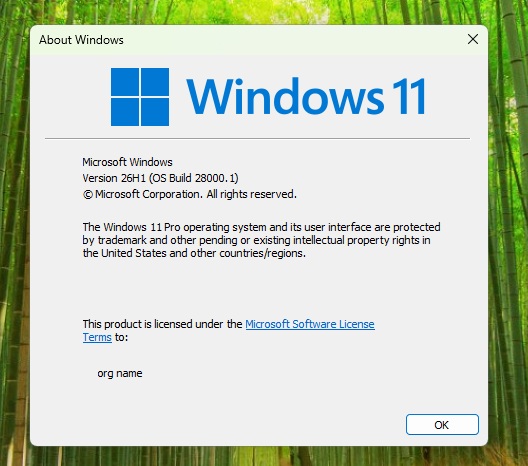
Windows 11 26H1 is not an update for existing PCs, and it’ll only ship on new Arm64 PCs. For now, these new Arm64 PCs are Snapdragon X2 lineup. That means, if you own one of the PCs with an Intel or AMD chip, you won’t get Windows 11 26H1 ever, but that’s not a bad thing.
At that time, Microsoft confirmed that Windows 11 26H1 only exists to test “platform changes” that support new specific silicon. It also warned that nobody should consider version 26H1 an upgrade. Now, it’s official that those specific silicon chips were Snapdragon X2 Plus, Elite and Extreme.
“26H1 is not a feature update for version 25H2 and only includes platform changes to support specific silicon. There is no action required from customers,” Microsoft noted in a blog post dated November 2025.
Microsoft reaffirmed that Windows 11 is sticking to “annual feature update cadence” with updates releasing in the second half of the year, usually October-November, and that lines up with our Windows 11 26H2 expectations.
“Windows 11 continues to have an annual feature update cadence, with releases in the second half of the calendar year,” the company explained in November 2025.
All PCs will get the Windows 11 26H2 update with new features in the second half of this year.
Why is Microsoft doing Windows 11 26H1?
Microsoft officially says it’s building Windows 11 26H1 to support new processors. It’s unclear how version 26H1 adds support for new processors, but we need to understand that a new SoC might require changes to the power state, Windows scheduling, and other firmware-related features.
A “new platform baseline” gives partners something they can lock onto for manufacturing and validation for devices launching in the first half of the year, even if the public “feature update for everyone” comes later.
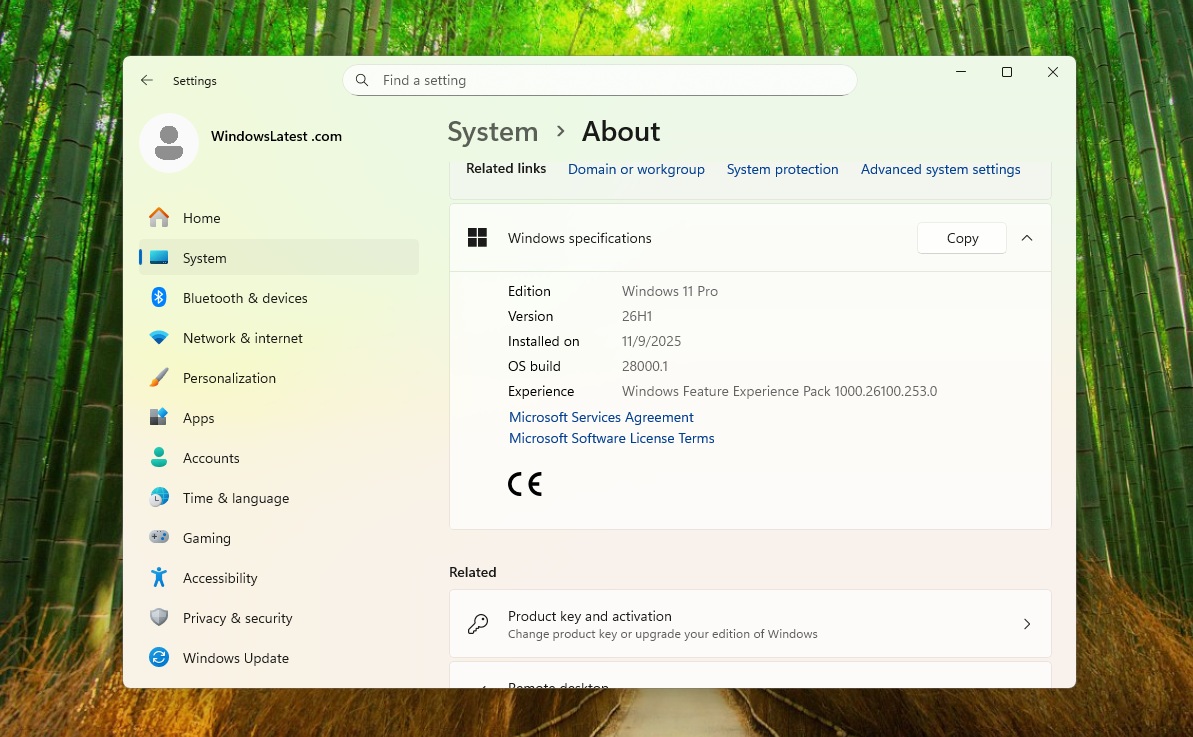
I installed Windows 11 26H1 preview builds on my test machine, and I haven’t noticed any major visible changes except the build number (bumped to 28000). I also noticed that “AI Agent” in Settings, which recommends changing system settings based on my usage pattern, is turned on by default on Copilot+ PCs.
There could be minor UI improvements, but at this point, our understanding is that Windows 11 26H1 is not going to ship with any dramatic changes out of the box. Whatever is planned will ship for everyone with Windows 11 26H2, so keep an eye on that release.
Windows 11 26H2 is planned for October 2026 with new features. It’s for everyone, including existing hardware.
Ryan hosts Akamai data scientist Robert Lester on the show to discuss how the growth of AI bots affects internet traffic, the ways these AI bots differ from the original search engine optimization ones, and why you might not want to mitigate AI bots on your websites.
Research indicates that teaching learners to use and create with data-driven technologies such as AI and machine learning (ML) requires an entirely different approach for solving problems compared to traditional programming activities.
In this blog, we share the new data paradigms framework that we have developed through research and used to help improve our understanding about how to teach and learn about AI and data science. We also invite you to register your interest in participating in our next collaborative study on the topic.
Knowledge-based approaches to systems design
Let’s start by highlighting an important distinction between different approaches to designing systems. In a knowledge-based approach to system design, a set of rules (e.g., if-then statements) are written for the system to execute. Every rule is explicitly defined. This approach is called ‘rule-based’, ‘symbolic’, or ‘logic-based’. For example, a developer could create a program that simulates dialogue by writing specific lines of code to handle a greeting, such as “IF user says “Hello” THEN output “Hi!”. If the user types “Greetings!” instead, the program fails because it has no rule for that specific word.
Knowledge-based models are often said to be explainable by design. This means the logic is accessible and interpretable and developers can trace the exact steps taken to produce an output. For example, if developers manually classify restaurant reviews as positive or negative using a pre-defined set of criteria, the rules their restaurant classifying system follows are entirely explicit, and the path from input to output is clear and explainable.
Data-driven approaches to systems design
By contrast, in a data-driven approach to system design developers do not write specific rules. Instead, they collect lots of data and train a model. In the dialogue simulator example, they would collect hundreds of examples of greetings and train a model to the pattern of a greeting. If the user types “Greetings!”, the system generates a response based on the patterns in its training data.
Data-driven models are often opaque. In other words, the internal workings of these ML models are hidden. While we can see our input and the system’s output, the internal mathematical process is so complex — often involving layers of calculations and abstractions — that we cannot simply “explain” why a specific output was produced. For example, developers can create a classification model by training a neural network using thousands of images. Due to the large quantity of data used to train the model, and complex internal parameters and hidden layers, developers and users of the system cannot understand or explain the logic or features that lead to a specific output. These kinds of models are often referred to as a “black box” (as opposed to a “glass” or “clear” box).
Comparing knowledge-based and data-driven approaches
Researchers have argued that the move from knowledge-based (or rule-based) programming to data-driven system design represents a paradigm shift and creates unique challenges for educators. The challenge is helping students shift from the expectation that a system produces a single ‘right’ answer — characteristic of traditional rule-based programming — toward an understanding that systems trained on large quantities of data produce outcomes that aren’t always fixed or explainable. If the current instruction in the classroom still relies heavily on traditional rule-based programming approaches, we might be setting students up for misconceptions.
Data paradigms: A framework for analysing data science education approaches
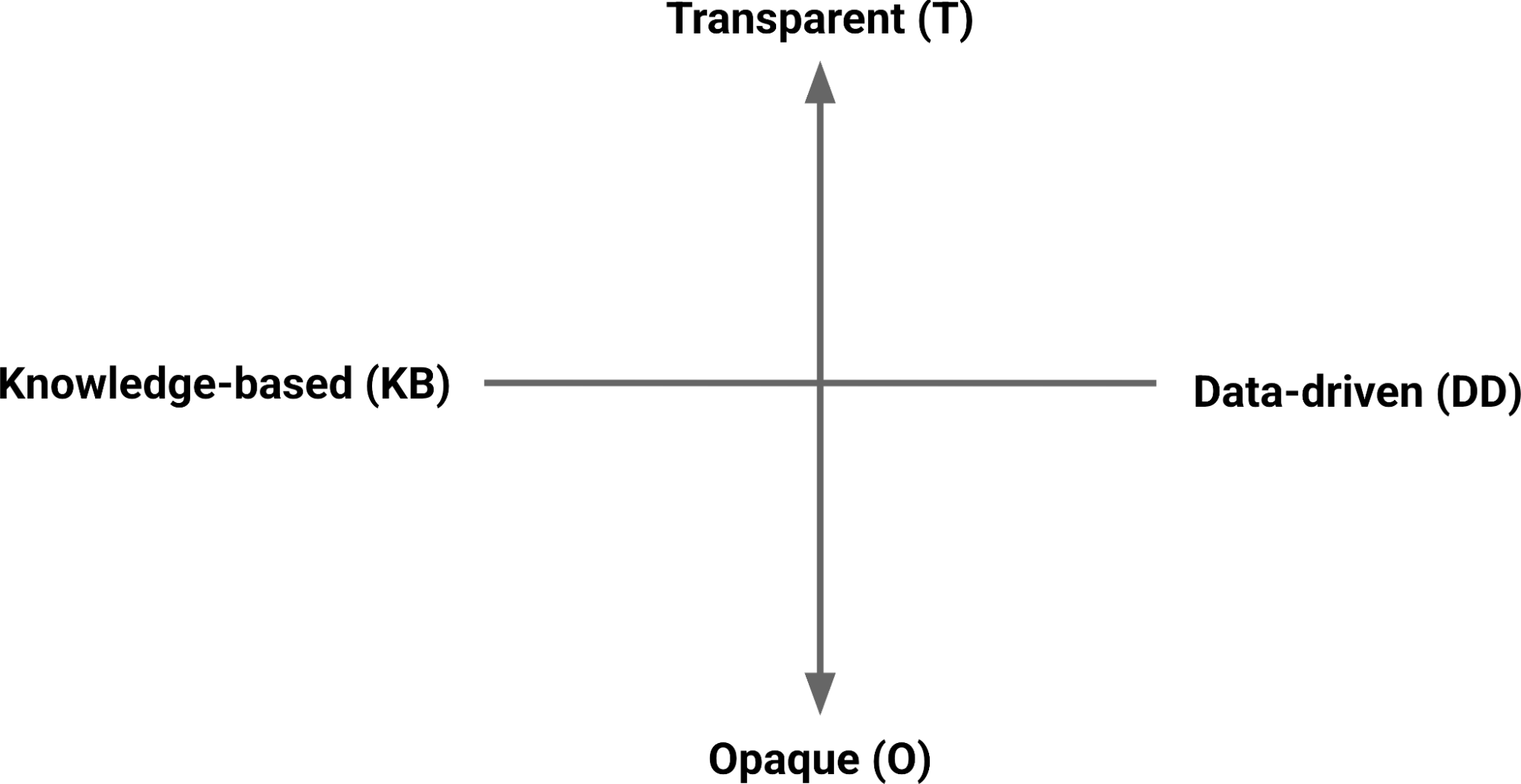
In our research work on AI and data science at the Raspberry Pi Computing Education Research Centre, we analysed 84 research studies about the teaching and learning of data science. We categorised learning activities used in the studies to understand whether they were (i) knowledge-based or data-driven, and (ii) the extent to which the underlying models used were transparent or opaque. This led us to define four distinct data paradigms:
The data paradigms framework
Knowledge-based and transparent (KB + T): Activities in this paradigm are ones where students write rules for systems, or work with systems that use rules, where the logic is fully explainable by design. For example, if students manually classify data (e.g. creating simple ‘if-then’ statements to predict an outcome), the path from input to output is clear.
Data-driven + Transparent (DD + T): In this paradigm, activities involve students working with models trained on data, but the trained model’s logic remains explainable and interpretable. For example these could be models using k-nearest neighbors (KNN) algorithm to group data points based on proximity, or using linear regression to predict a trend. Even though the model produces an output, the student can look at the inner workings of the model and see how the decision is made.
Data-driven + Opaque (DD + O): This paradigm’s activities require students to work with data-driven ML models where the models’ internal logic is hidden, for example an image classification model using a type of neural network (e.g. CNN). The model produces an output (e.g. classifying an image as ‘This is a dog’), but the student cannot inspect the system to find a rule or clear path explaining why that specific output was produced. To understand these systems, it’s necessary to use additional testing and evaluation tools.
Knowledge-based + Opaque (KB + O): Activities in this paradigm would involve systems with human-written rules that are not explainable. In our review of K–12 activities, we found no examples of activities within this paradigm.
The data paradigms framework helps us to distinguish between different kinds of modeling activities students take part in and how instructional approaches could be classified across one or more paradigms. For instance, we found that most data-driven activities were also opaque (DD + O), usually meaning that students collected and used data to train a model, but how the system worked was opaque. This pattern, where the data is visible but the model is not explainable, risks students forming misconceptions about the capabilities and limitations of data-driven systems. Without understanding how outputs are generated, students may expect data-driven ML systems to operate like fully explainable (or transparent) ones.
We think that lessons are needed in the data-driven opaque (DD + O) quadrant to explicitly teach students about how data-driven systems work and the role they play in everyday contexts. However, when teaching data-driven opaque (DD + O) activities, learners’ attention needs to be directed to concepts such as model confidence, data quality, and model evaluation. Since an ML model is not inherently explainable, we need to teach students to use post-hoc explanation methods, such as testing different inputs to see how a system’s output changes. To prepare students for this learning experience, we think that first introducing activities about rule-based systems (knowledge-based + transparent; KB + T) or simple data exploration, such as linear regression or data visualisation (data-driven + transparent; DD + T) may serve as a ‘bridge’ to understanding data-driven modeling by helping students to distinguish between systems built from specific logical rules and systems trained on data.
We believe the idea of data paradigms can serve as a way of framing teaching activities about data science and help educators and students to consider the transition between different paradigms when engaging with the systems we interact with every day.
Teachers in England, participate in our new study
We’re launching a new study to explore how to teach learners aged 9 to 11 about data-driven computing. The study will take place in collaboration with upper key stage 2 teachers in England and look at:
What key ideas pupils need to understand
How teachers currently approach topics related to data-driven computing
How pupils make sense of data and probability
Our goal is to find practical ways to help teachers build children’s confidence in working with data in computing lessons. The study will be collaborative, with two workshops held throughout 2026, and we’re inviting upper KS2 teachers in England to take part.
You can express your interest in participating by filling in this form:
 Log in