
Sr. Content Developer at Microsoft, working remotely in PA, TechBash conference organizer, former Microsoft MVP, Husband, Dad and Geek.
165035 stories
·
33 followers

I brought back WordPad on Windows 11, and it beats the AI-stuffed Notepad Microsoft wants you to use instead

1 Share

For all us folks of culture, WordPad was the proper middle ground between the basic Notepad text editor and the full-fledged Word. Unfortunately, it was mercilessly removed from Windows 11 version 24H2. But it’s not like the OS can’t run decades-old programs! So, I copied WordPad from a fresh Windows 10 installation and pasted it to my Windows 11 26H2 PC. It can format text, add pictures, and open RTF files, all without sign-in prompts or AI features.

A few days back, I saw someone on X complain about the new Notepad. I couldn’t comprehend the hate, because the Copilot branding is gone, the Writing Tools can be switched off, and formatting or tables isn’t hurting anyone. But most replies were in favour of the post, with people wishing for an old app that just works. Well, nothing fits that description better than WordPad.
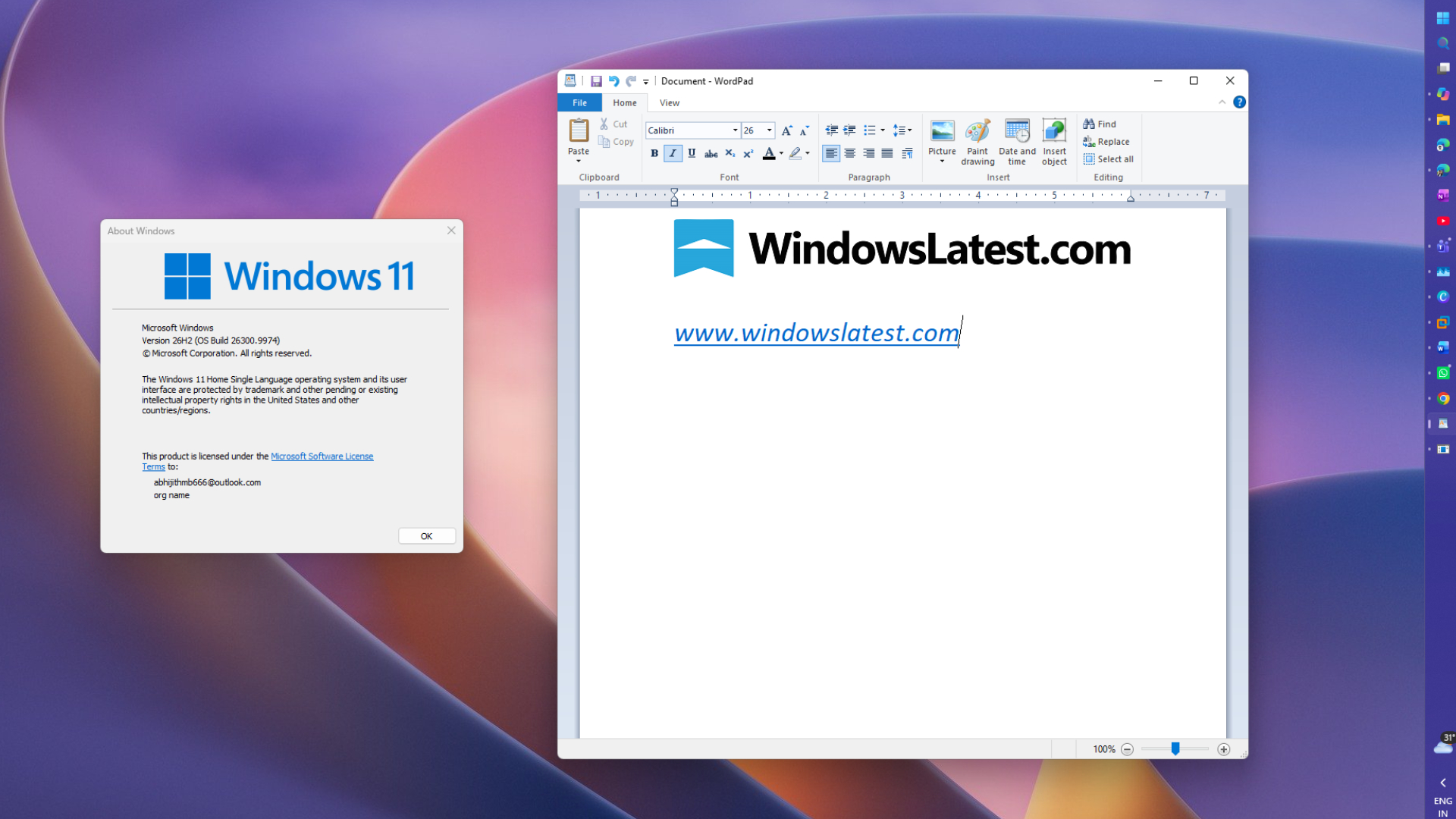
WordPad running on a Windows 11 26H2 PC
WordPad running on a Windows 11 26H2 PC. Credit: Windows Latest

Microsoft removed WordPad in Windows 11 24H2, and it’s still missing in 26H2

Microsoft deprecated WordPad in September 2023, saying it was “no longer being updated and will be removed in a future release of Windows.” In March 2024, the company confirmed WordPad would be gone from all editions of Windows 11 24H2 and Windows Server 2025, and they kept their promise when the 2024 update rolled out later that year.
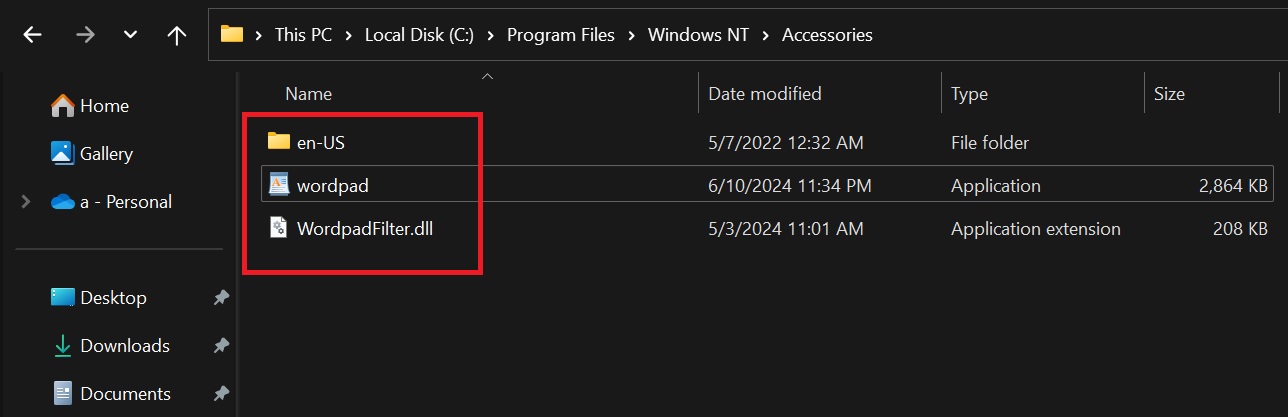
wordpad core app files in windows 11 23h2
WordPad core app files in Windows 11 23H2. Credit: Windows Latest

There were specifically three files that got removed, as Microsoft’s developer documentation mentions: wordpad.exe, wordpadfilter.dll, and write.exe. It also confirmed that Windows no longer has a built-in RTF reader. Microsoft recommends you to Word for rich-text documents like .rtf and .doc, and Notepad for .txt files. Although the software giant didn’t give a reason for killing WordPad, they probably wanted one less app to update in Windows 11.
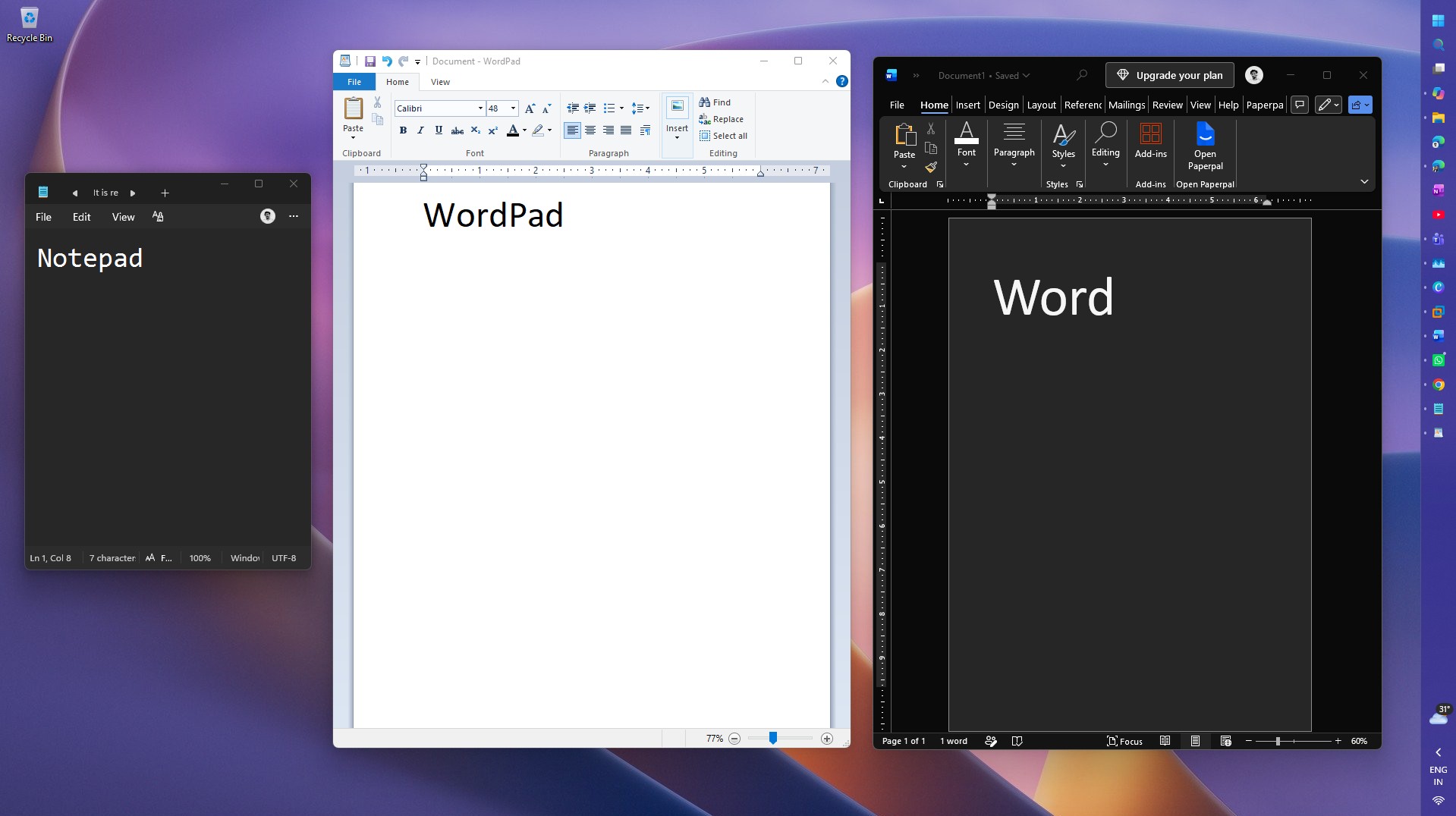
Notepad, WordPad and Word running side by side in a Windows 11 PC
Notepad, WordPad and Word running side by side on a Windows 11 PC. Credit: Windows Latest

I recently updated my father’s PC to Windows 11 26H2, and he asked me if it had WordPad. When I told him Microsoft had deprecated it, he just sighed and said it was enough for him. Yes, he has a point. A letter or a list doesn’t need Word. He just wanted a digital version of his notepad (the physical one, that is).

WordPad does proper rich text, while Notepad’s formatting is Markdown

WordPad sat gracefully in between Notepad and Word for almost three decades. Its Office-style ribbon came with Windows 7, and the Home tab has fonts and sizes, bold, italic, underline, strikethrough, subscript and superscript, text highlighting and font colors, plus alignment, indentation, line spacing and bulleted lists.
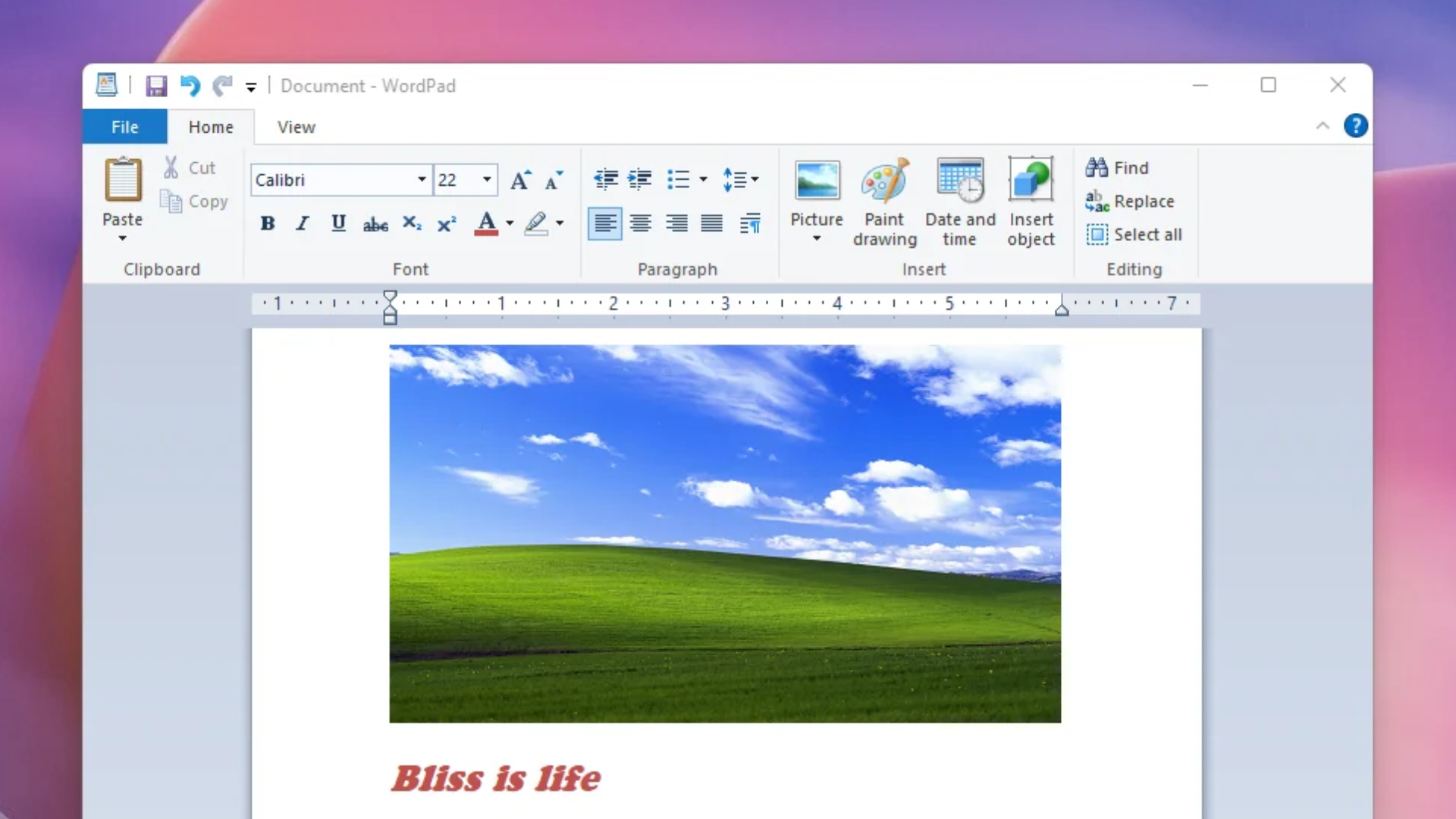
WordPad was the perfect middle ground between Notepad and Word
WordPad was the perfect middle ground between Notepad and Word. Credit: Windows Latest

The Insert group lets you add pictures, date and time, and objects from other apps. It even has a ruler that lets you drag paragraph margins. This might come as a surprise for a few, since WordPad documents save as RTF by default, but it can also save .docx, .odt, and plain text files.

But where I see people misunderstand WordPress is with Tables. It has no option to insert or edit a table, and Microsoft’s old Knowledge Base article Q135079 lists tables, borders, shading and columns among the Word formatting that disappears in WordPad, calling it “a design limitation of WordPad.”
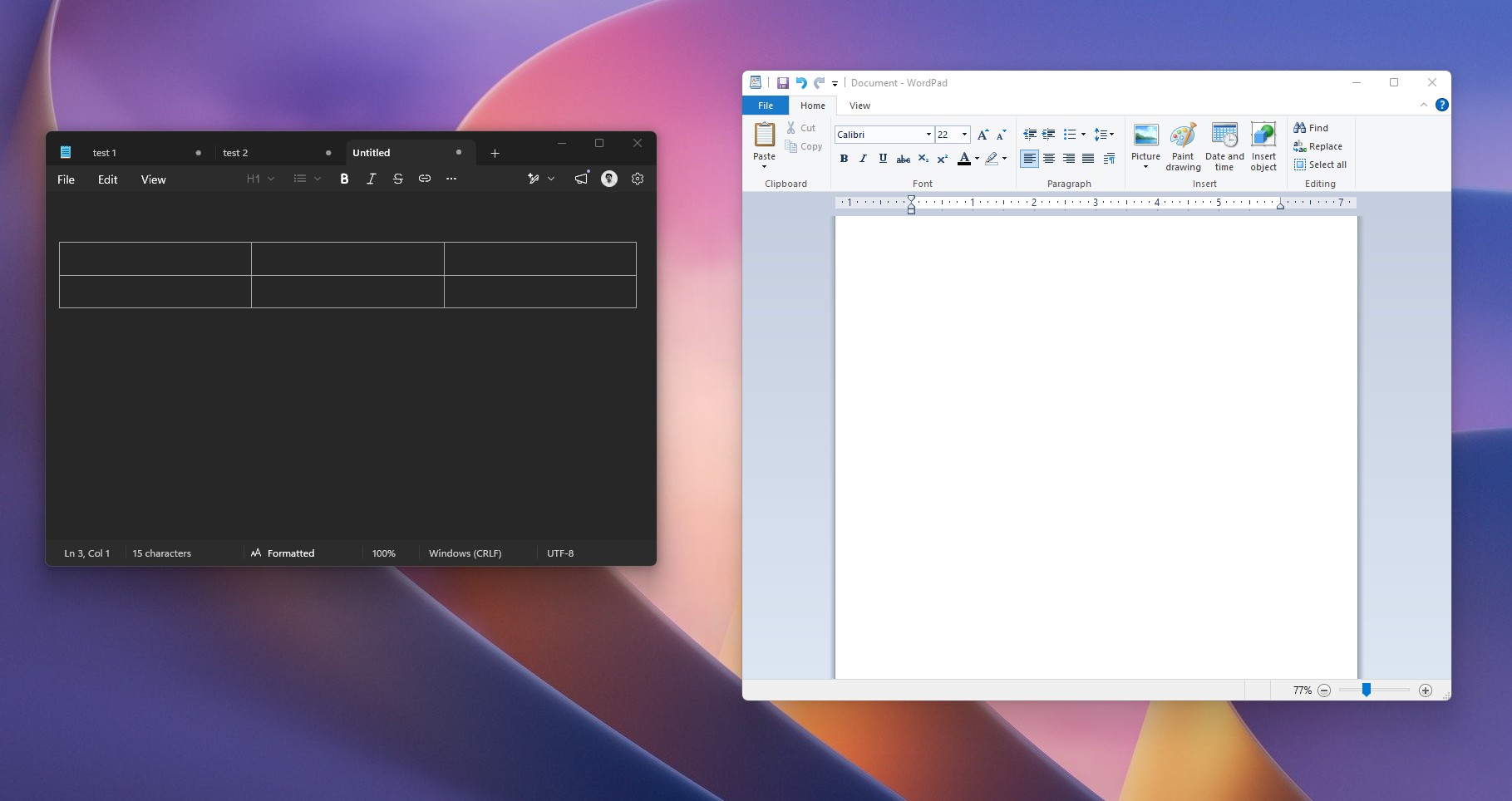
Notepad has tables but WordPad doesn't
Notepad has tables, but WordPad doesn’t. Credit: Windows Latest

Funnily enough, what was supposed to be the basic text editor, Notepad, got a Create a table option for everyone in January 2026. But those tables, along with bold, italics, headings, and lists, are stored as Markdown in a plain-text file. So, Notepad is great for quick notes, while a letter with your choice of font, color, and a photo is still WordPad territory.

Notepad’s AI Writing Tools are optional, but WordPad doesn’t have any

Heavy backlash has forced Microsoft to drop the Copilot branding in Notepad, but the AI is still there under a new name, Writing Tools. Write generates text from a prompt, Rewrite changes the tone or length of what you’ve written, and Summarize shortens it. Microsoft’s support page says these features are powered by GPT, which also means that you have to sign in with a Microsoft account to use them.
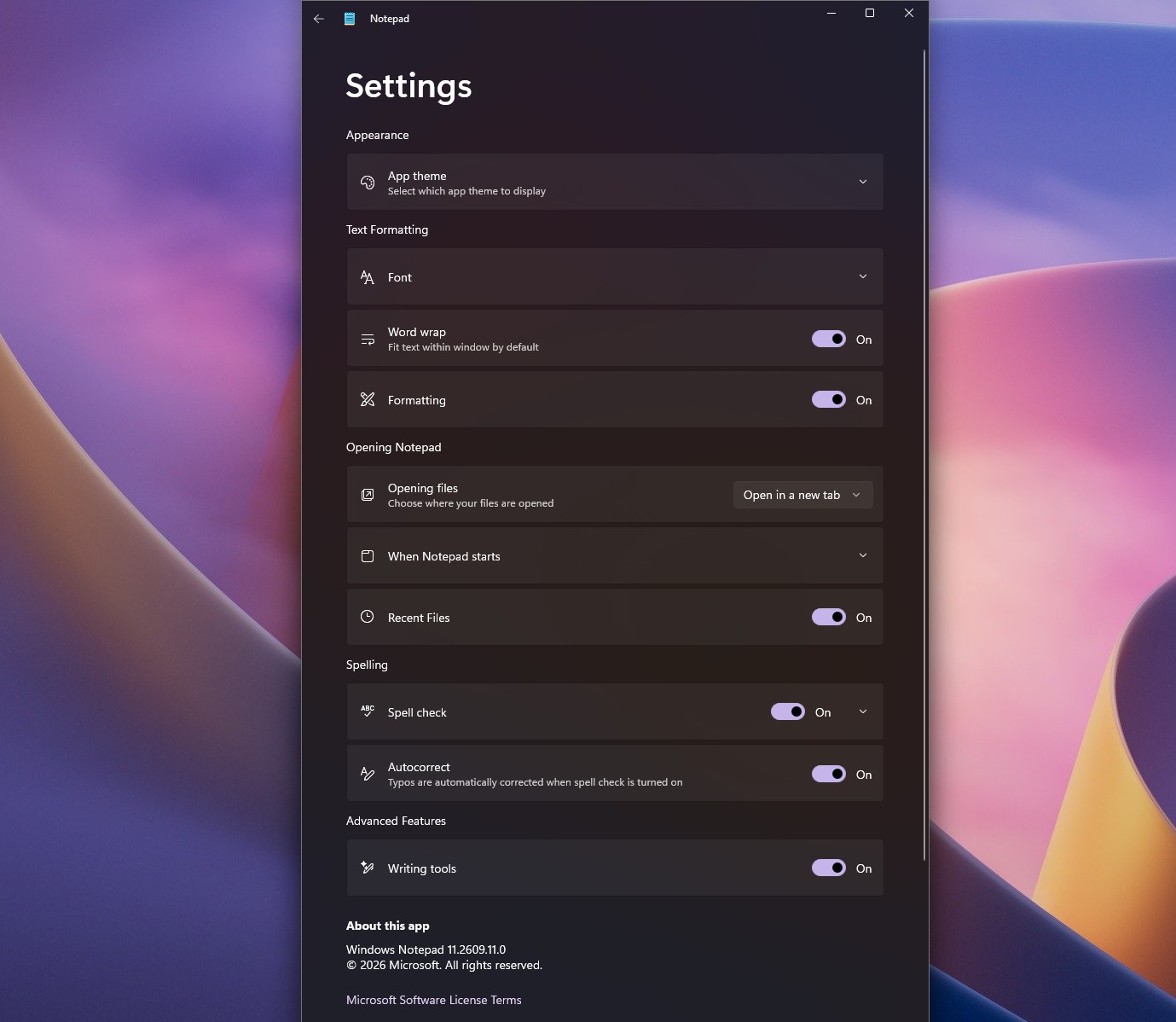
Toggles in Notepad lets you remove Formatting, Spell check, Autocorrect, and Writing tools
Toggles in Notepad lets you remove Formatting, Spell check, Autocorrect, and Writing tools. Credit: Windows Latest

Fortunately, you can turn the Writing Tools off from Notepad’s Settings under Advanced features, and disabling formatting gives you back the barebones Notepad. Personally, I don’t mind these new features, and I sometimes use them.

But WordPad has no account prompt or AI button, and it won’t get any updates. Ironically, Microsoft did test Office banner ads inside WordPad in a January 2020 Windows 10 Insider build, but they were hidden behind a feature flag, and regular users didn’t see them.

WordPad can’t replace Microsoft Word, and here’s what it can’t do

Feature WordPad Microsoft Word
Fonts, colors, bold and italics Yes Yes
Pictures and bulleted lists Yes Yes
Tables No Yes
Spell check and word count No Yes
Track changes and comments No Yes
Headers, footers and footnotes No Yes
Mail merge and citations No Yes
AI writing tools No Yes (Copilot)
Cloud collaboration No Yes


For me, a missing spell check is the one that hurts the most, especially when the new Notepad has it. Also, if you open a Word document with headers, footers or comments and save it in WordPad, Microsoft’s old WordPad help page warned that you’d lose that content.

So, for a resume or a document with tracked changes, Word (or the free Word for the web) is still the right tool. For letters, notes, and simple memos, WordPad does the job.

How to restore WordPad on Windows 11 26H2 using files from Windows 10

I recently installed a fresh copy of Windows 10, and as expected, WordPad was there in C:\Program Files\Windows NT\Accessories.
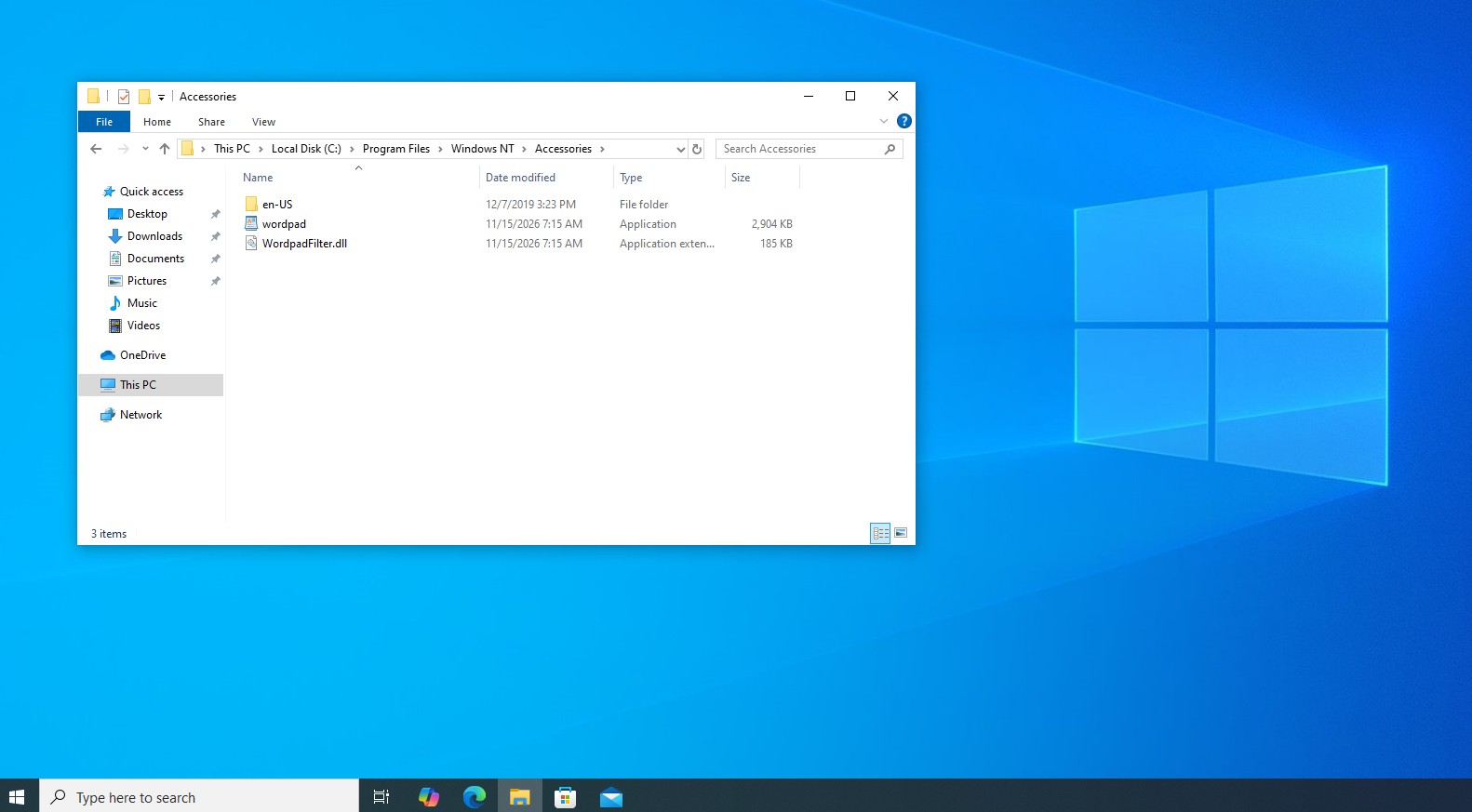
WordPad files in a Windows 10 PC
WordPad files in a Windows 10 PC. Credit: Windows Latest

On my Windows 11 26H2 PC, the folder still exists, but only the en-US folder is left inside. I copied WordPad’s files without modifying them and uploaded the archive to Windows Latest, so you don’t need an older PC.
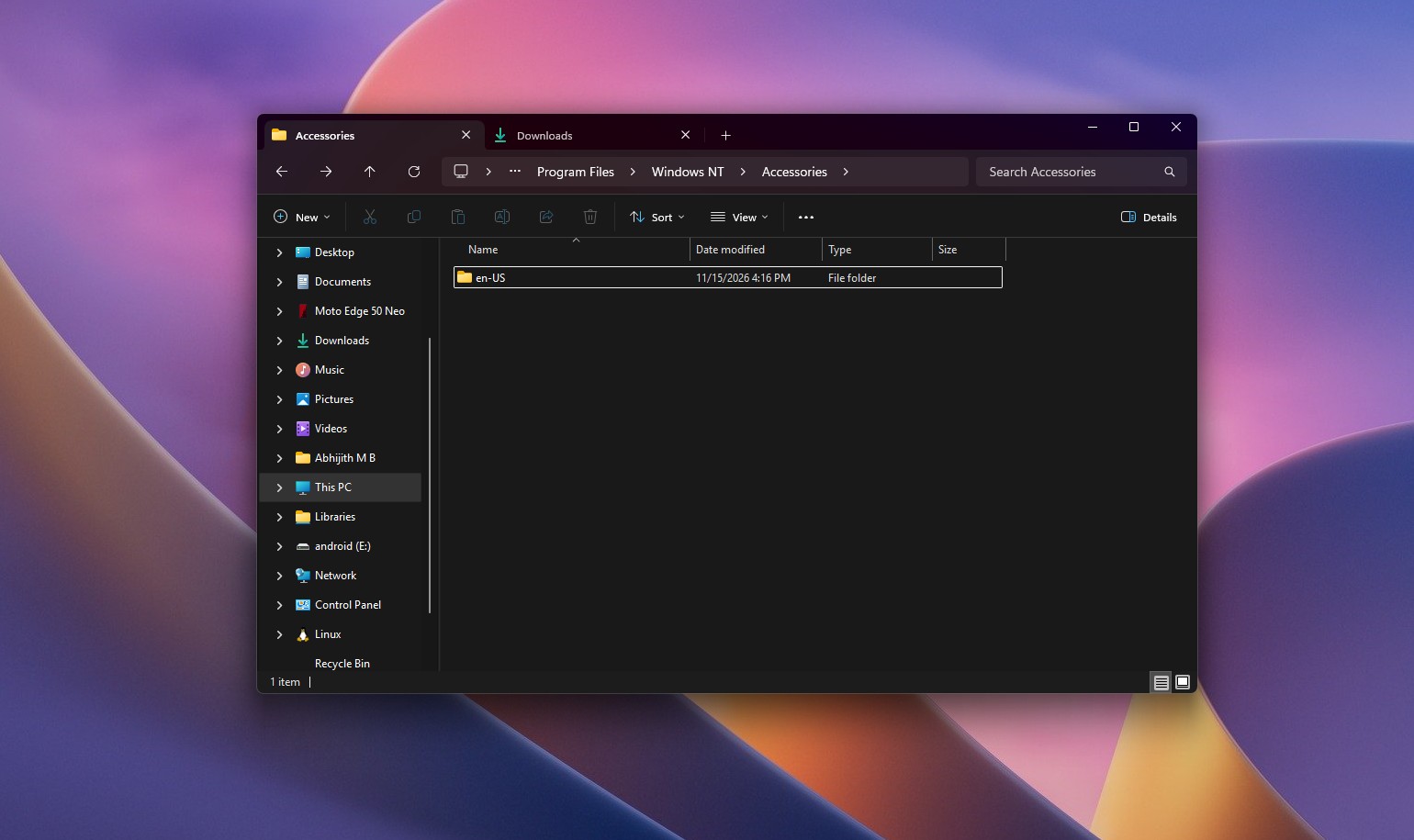
Windows 11 26H2 doesn't have WordPad core files
Windows 11 26H2 doesn’t have WordPad core files. Credit: Windows Latest

Copy WordPad’s files to the Accessories folder

The archive has wordpad.exe, WordpadFilter.dll and an en-US folder with wordpad.exe.mui, which holds WordPad’s English text.

  1. Download the WordPad archive and extract it.
  2. Open File Explorer and go to C:\Program Files\Windows NT\Accessories. 
  3. Copy wordpad.exe, WordpadFilter.dll and the en-US folder into it, and approve the administrator prompt.
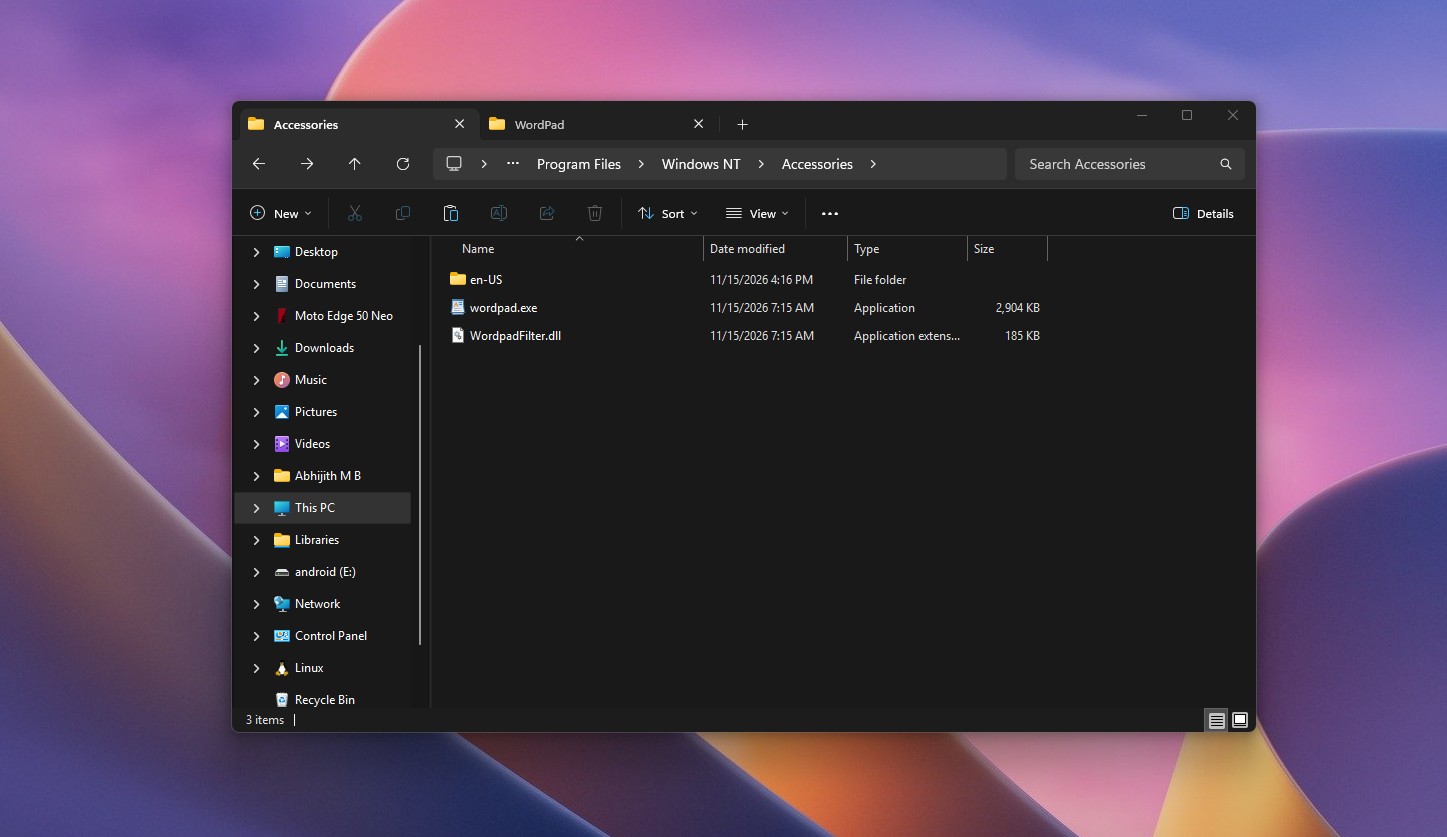
    Windows 11 26H2 with WordPad files pasted
    Windows 11 26H2 with WordPad files pasted. Credit: Windows Latest
  4. Double-click wordpad.exe to open WordPad.

If your Windows display language isn’t English (US), you’ll need the matching language folder from a PC that uses it. WordPad also won’t appear in the Start menu search this way, so pin it to the taskbar, and set it as the default app for .rtf files from Open with > Choose another app.

Keep in mind that WordPad doesn’t get security fixes anymore, so avoid opening RTF or DOCX files from people you don’t trust.

WordPad is a reminder of when Windows apps did one job well

WordPad arrived with Windows 95 in August 1995, replacing Microsoft Write, and the Windows 95 Reviewer’s Guide admitted that “it is not a full-blown word processor.” It didn’t need to be. It came free with every copy of Windows, and small tools like it are a big part of why people still remember Windows XP and 7 so fondly.

Credit where it’s due, Windows 11 still runs a Windows 10 copy of a 1995-era app without complaint, which is more than macOS can say for 32-bit apps after Catalina dropped support for them in 2019.

My father doesn’t need Copilot or a Microsoft 365 subscription to write a letter. He needs WordPad, and it takes two minutes to bring it back.

The post I brought back WordPad on Windows 11, and it beats the AI-stuffed Notepad Microsoft wants you to use instead appeared first on Windows Latest

Read the whole story
alvinashcraft
4 minutes ago
reply
Pennsylvania, USA
Share this story
Delete

Database Performance: Up to 11× Faster Workloads with Connection Pooling

1 Share
Connection pooling significantly enhances database operation efficiency by reusing existing connections, reducing setup time. In SQLite benchmarks, pooling achieved up to an 11× speedup under heavy concurrency. While beneficial for applications with frequent connections, pooling should be enabled by default, with exceptions for specific cases requiring immediate connection release.
Read the whole story
alvinashcraft
5 minutes ago
reply
Pennsylvania, USA
Share this story
Delete

#588 - 15th November 2026

1 Share

.NET 11 was released this week, with Day 1 support on Azure Functions. This milestone also means .NET 8 & 9 go out of support. The Developer Tools section is particularly busy this week with related updates.

Other highlights include:

And a reminder that Microsoft Ignite runs from 17th to 20th November. The Learning and Certifications section has session guides for PostgreSQL, SQL, Arc, Defender, Sentinel and more.

Read the whole story
alvinashcraft
5 minutes ago
reply
Pennsylvania, USA
Share this story
Delete

50th Anniversary of 'Star Wars' Celebrated with iMax 70mm Re-Release, Special Events, New Movie

1 Share
"Lucasfilm and Disney have restored the original Star Wars (1977) and will release the film in multiple formats, including Imax 70mm [starting February 19], as part of the franchise's 50th anniversary celebrations," reports Deadline. The original film will also be displayed in its original 16:9 format on the center of Cosm's 12K+ LED Dome, in a special presentation developed with Disney, Lucasfilm, ILM, and MakeMake. They're calling it a "Shared Reality production" where "the surrounding visual environments dynamically evolve to immerse the audience in iconic Star Wars locations and moments." Deadline reports more 50th anniversary celebrations In addition to the Imax 70mm screenings, the film will also be presented in Digital Imax, Digital Cinema, 70mm, 35mm, and 4DX. On May 4th, 2027, Lucasfilm will release a new behind-the-scenes documentary, The Hero Awakens, from filmmaker R.J. Cutler on Disney+. Star Wars events already on the calendar for 2027 include Shawn Levy's [movie] Star Wars: Starfighter, which will be released May 28. There's also a new poster paying homage to the original 1977 film, reports the Disney news site Mickey Visit, plus a newly orchestrated score by John Williams that they assume "will be used on all the projects that debut this year." On April 2-3, [Disney] will debut the new "Star Wars in Concert: The Skywalker Saga" at the Hollywood Bowl. The show will be hosted by Anthony Daniels, known for his role as C-3PO. Special performances of John Williams' iconic film scores will feature scenes and music from all nine Skywalker Saga films. The concert is a sweeping celebration of the stories, themes, and music that have inspired audiences around the world for five decades... They also teased that new and legacy licensees — including Hasbro, the LEGO Group, adidas, Mars, Aston Martin, Steinway, Hajime Sorayama presented by Complex, and more — will introduce 50th-anniversary collections... In the opening of the press release, Disney mentioned that as part of the announcements there will be "reimagined Disney Parks and Cruise Line offerings." The article adds that the April's Star Wars Celebration at the Los Angeles Convention Center has already sold out. There's more Star Wars news, writes long-time Slashdot reader schwit1 A light saber used by Darth Vader in the "Star Wars" movies The Empire Strikes Back and Return of the Jedi sold Thursday for nearly $5 million in an auction. The light saber, which was used in the climactic duel in Cloud City in which Vader tells Luke Skywalker "I am your father" sold for $4.875 million at the Ultimate Star Wars Auction held by Heritage Auctions. The sale marks a world auction record for any "Star Wars" collectible, according to the auction house. The previous record was Heritage's $3,750,000 sale of Luke Skywalker's lightsaber and severed hand effects rig on July 15, 2026. And they're still auctioning more Star Wars memorabilia...

Read more of this story at Slashdot.

Read the whole story
alvinashcraft
7 hours ago
reply
Pennsylvania, USA
Share this story
Delete

Which Model Should You Use? Frontier, Hosted or Local? It Depends.

1 Share

This article provides a roadmap for choosing where to run a model: on your own machine, through a hosted API, on Cloud Run, or on an accelerator you rent. Every figure comes from a measured run in gemma4-dev, which serves Gemma 4 on more than a hundred hardware and engine combinations and now carries five Gemini API models as sibling rigs.

https://github.com/xbill9/gemma4-dev

The New Gemini Models in One Table

Gemini 4 Hydrogen, Carbon and Argon arrived on the Gemini API next to 3.5 Flash-Lite, 3.8 Flash and Gemma 4. On 2026-11-14 all seven ran through the same Gemini API endpoint, started together, with the same GSM8K (1,319 math word problems) and BFCL simple (400 function calls) questions and scoring, with thinking set as low as each model accepts:

Model GSM8K BFCL simple Cost, both tasks Output price, per 1M tokens GSM8K median per request
Gemma 4 31B 0.9735 🥇 0.9675 🥇 free tier free tier only 8.96 s
Gemma 4 26B 0.9742 0.9575 🥇 free tier free tier only 8.16 s
Gemini 3.5 Flash-Lite 0.9629 0.9350 $0.92 $2.50 🥇 1.10 s
Gemini 3.8 Flash 0.9788 0.9400 $1.81 $3.75 3.79 s
Gemini 4 Hydrogen 0.9803 0.9550 $5.02 $7.50 🥈 2.84 s
Gemini 4 Carbon 0.9803 0.9600 $4.02 $10.00 7.34 s
Gemini 4 Argon 🥇 0.9841 🥇 0.9675 $3.46 $10.00 7.63 s

Hydrogen, Carbon and Argon are ahead of Gemma 4 31B on GSM8K, with the 95% range of the difference above zero, and level with it on BFCL. Output prices include thinking tokens, and thinking decides the bill. On Hydrogen and 3.8 Flash it cannot be turned off: Hydrogen has the lowest Gemini 4 price, thought on every problem at its lowest setting, and cost the most. It is also the fastest Gemini 4 model, about 2.7 times quicker per problem than Argon. The times come from all seven sharing one connection at once. Carbon and Argon double in price on 2026-12-01. The method is in the companion article, Gemini 4 Hydrogen, Carbon and Argon Against Gemma 4.

The Options

Four ways to run a model, each measured in this repo:

  • Local: a GPU or CPU you own. Measured on an RTX 3050 OEM (8 GB desktop card), a GTX 1650 Ti (4 GB laptop card) and an Intel i7-10750H laptop CPU.
  • Hosted API: someone else's server, reached with a key. Measured on the Gemini API (the five Gemini models) and AMD Token Lab (Gemma 4 31B, free with the AMD AI Developer Program).
  • Cloud Run: Google's serverless containers with one NVIDIA L4, serving Gemma 4 E2B on vLLM.
  • Your own accelerator: a rented machine you start and stop. Measured on a TPU v5e (one chip and four), an EC2 G6 with one L4, and an AMD MI300X on DigitalOcean.

Option 1 — Local

The RTX 3050 serves Gemma 4 E2B on six engines. One request at a time without a drafter they run from 61.9 tok/s (LiteRT-LM) to 121.1 tok/s (vLLM); with Google's speculative-decoding drafter vLLM reaches 230.5 tok/s. Under load, with 64 requests at once of 128 tokens in and 512 out, SGLang delivers 1,711.3 tok/s in total and vLLM 1,651.2.

The same card holds the larger models one request at a time: 12B at 56.4 tok/s with its drafter, 26B A4B at 40.6 tok/s on code with its experts in system RAM, and 31B at 4.0 tok/s with two thirds of it on the CPU. Quality rises with size: GSM8K 0.9014 (E2B), 0.9629 (12B), 0.9735 (31B).

The 1650 Ti laptop card decodes E2B at 73.75 tok/s for one request and peaks at 164 tok/s through its server at 16 requests. The laptop CPU decodes 16.71 to 18.86 tok/s.

Setup: llama.cpp is ready 4 s after start, vLLM 48 s. vLLM's first start compiles for about 3.5 minutes. The hardware is already paid for, and nothing is billed per hour.

Option 2 — Hosted API

Gemini API. A key and an HTTP call. The Gemini models and Gemma 4 26B and 31B answer the OpenAI chat format at /v1beta/openai/chat/completions. Estimated from the token counts returned and list prices, a full 1,319-problem GSM8K run cost $0.87 on Flash-Lite, $1.66 on 3.8 Flash, $3.15 on Argon, $3.70 on Carbon and $4.51 on Hydrogen. Gemma 4 is on the free tier only, with paid use not available, and its free-tier rate limit answered three requests in the GSM8K and BFCL runs with HTTP 429 after every retry.

AMD Token Lab. Gemma 4 31B on an SGLang router on AMD GPUs, free with the AMD AI Developer Program: 10 points for 30 days, with Gemma 4 31B at 0.035 points per million input tokens and 0.07 per million output. One request at a time decoded at 2.0 to 7.6 tok/s on the shared service, with up to 5 s before the first token. The limit is 128 requests at once across all users; over that, the reply is HTTP 429.

Option 3 — Cloud Run

One L4 GPU in us-east4 with 8 vCPU and 32 GiB, Gemma 4 E2B on vLLM. Output rose with concurrency to 188.46 tok/s at 4 requests and stayed there at 8 (189.53), because the service was deployed with --concurrency=4; more users means more instances. The same L4 on EC2 reached 360.17 tok/s at 8.

At list price the instance costs $1.4209 an hour, which works out to $7.95 per million output tokens at one request and $2.08 at eight. Cloud Run scales to zero by default, so an idle service costs nothing and the next request waits for a cold GPU start; the startup check waits 180 s before its first look. The weights load from Cloud Storage.

Option 4 — Your Own Accelerator

TPU v5e, one chip. Gemma 4 E2B on vLLM: 143.9 tok/s for one request, 1,689.1 tok/s at 64 requests (128 in, 512 out), GSM8K 0.9007 and BFCL 0.920. Flex-start costs $0.60 per chip-hour, about $0.089 per million output tokens at full batching and $1.31 at one request. Capacity came within two to five minutes in us-west4-a, and the engine took 12.6 to 14.1 minutes to start on most rigs, most of it compiling (27.2 on one).

TPU v5e, four chips. E2B as four one-chip engines reaches 7,788 tok/s at 64 requests and 14,189 at 256. The 12B fits with 122,624 tokens of context cache, against 9,728 on one chip.

EC2 G6, one L4. vLLM at 132.8 to 140.4 tok/s for one request and 3,715.7 tok/s at 64; with the drafter, 4,516.3. A spot g6.2xlarge measured on an older vLLM cost $0.9412 an hour, $0.73 per million output tokens at eight requests.

AMD MI300X. 192 GB on one card: E2B at 340.4 tok/s for one request and 10,293.6 tok/s at 64 (128 tokens of context). $1.99 an hour, billed while powered off too: $0.054 per million output tokens at 64 clients and $1.624 for a single stream.

🔎 Tip: Price Per Hour Becomes Price Per Token Only Under Load

Every rented option above has two prices per million tokens, one at a single request and one at full batching: Cloud Run $7.95 and $2.08, TPU v5e $1.31 and $0.089, MI300X $1.624 and $0.054. A machine that serves one user at a time costs about what a hosted API charges, or more. A per-token API charges the same at any load.

Compare and Contrast

Local 3050 Gemini API Token Lab Cloud Run L4 TPU v5e-1 MI300X
Users at once 64 measured 8 measured 128 shared 4 per instance 64 measured 64 measured
Most output, tok/s 1,711.3 not measured not measured 189.53 1,689.1 🥇 10,293.6
One request, tok/s 230.5 not measured 2.0–7.6 49.63 143.9 340.4
Cost 🥇 card you own per token 🥇 free $1.4209/hr $0.60/hr $1.99/hr
Best GSM8K 0.9735 (31B) 🥇 0.9841 (Argon) not measured not measured 0.9007 (E2B) not measured
Ready in 🥇 4 s 🥇 a key 🥇 a key minutes, cold start 12–14 min minutes

The Roadmap

Pick by the axis that matters most, then check the others.

By number of users.

Users at once Start with
1, yourself Local card, or the Gemini or Token Lab free tier
2–10 Gemini API, or Cloud Run with more instances
10–64 A batching engine on your own card (vLLM, SGLang), a TPU v5e-1, or an L4
Hundreds TPU v5e-4 as four engines, or an MI300X

By cost. Free first: your own card, Token Lab, and the Gemini free tier, which carries Gemma 4 26B and 31B, Flash-Lite, 3.8 Flash and Hydrogen. For paid use with light or uneven traffic, pay per token: both tests cost $0.92 on Flash-Lite and $3.46 on Argon. Hydrogen thought on every request and 3.8 Flash on most; Google's docs say reasoning cannot be turned off on Gemini 3 or Gemini 4 models, and the API runs none as low. Compare models by cost per answer. From 2026-12-01, when Carbon and Argon go to $4 / $20, this run costs $6.93 on Argon and $5.02 on Hydrogen, by arithmetic from list prices. A rented machine wins only when it is kept busy, which brings TPU v5e to $0.089 and MI300X to $0.054 per million output tokens.

By speed. On a hosted API, Flash-Lite answered a GSM8K problem in 1.10 s and Hydrogen in 2.84 s; Gemma 4 on the Gemini API took 8 to 9 s. For one user, a local card with a drafter (230.5 tok/s on the 3050) or an MI300X (340.4). For many users, the MI300X or four TPU v5e chips. Cloud Run as deployed here stops at 189.53 tok/s per instance.

By accuracy. Gemini 4 Argon leads GSM8K at 0.9841, and Argon and Gemma 4 31B lead BFCL at 0.9675, on short problems with thinking at its lowest setting. For hard, multi-step work Google calls Carbon "our strongest frontier model"; that case was not measured here. Where a model runs did not change its score: Gemma 4 31B answered 1,284 of 1,319 GSM8K problems through the Gemini API and 1,284 on an RTX 3050 with llama.cpp, differing on 8 problems. Model size matters more than where it runs: E2B scored 0.8954 to 0.9030 on GSM8K across six engines on the RTX 3050, the L4 and TPU v5e, and the 31B 0.9735.

By ease of use. A hosted API needs a key. A local card needs a driver and an engine, and llama.cpp is ready in seconds. Cloud Run needs a container and a deploy and then scales on its own. A rented accelerator needs capacity, a 12.6 to 14.1 minute engine start on TPU, and someone to turn it off.

So, Which One?

Start hosted with Gemma 4 31B on the Gemini free tier: it tied the best BFCL score and costs nothing. If the task needs the best math scores, move to Gemini 4 Argon. If the task needs Gemma 4 for its open weights, privacy or offline use, run it on your own card, 12B or 31B on 8 GB. Move to Cloud Run when a few users need an always-reachable endpoint without managing a machine. Move to a TPU v5e or an MI300X when traffic is steady enough to keep it busy, because that is where the per-token cost falls below every API.

Summary

The goal of this article was to map where each way of running a model fits. The key to the solution was a single repo that measures local cards, hosted APIs, Cloud Run and rented accelerators with the same engines, scoring script and questions. The results were:

  • 🟢 Gemini 4 Argon has the best GSM8K score measured, 0.9841; Argon and Gemma 4 31B lead BFCL at 0.9675.
  • 🟢 Gemma 4 31B scored the same 1,284 of 1,319 on GSM8K through the Gemini API and on an 8 GB RTX 3050.
  • 🟢 Gemma 4 31B is free on the Gemini API and tied Argon on BFCL; Argon cost $3.46 for both tests.
  • 🟢 A busy MI300X or TPU v5e serves Gemma 4 E2B at $0.054 and $0.089 per million output tokens.
  • 🟢 AMD Token Lab and the Gemini free tier cost nothing to start.
  • ⚠️ A rented machine at one request costs $1.31 (TPU v5e) to $7.95 (Cloud Run) per million output tokens.
  • ⚠️ Cloud Run as deployed caps one instance at 4 requests, 189.53 tok/s.
  • ❌ Token Lab's shared endpoint decoded one request at 2.0 to 7.6 tok/s.

Scope: figures come from separate runs between 2026-09-03 and 2026-11-14 in gemma4-dev, on different engine versions and days; each is quoted from its run's report, and ratios between runs on different hardware are indicative. Prices are list prices on the date each run recorded them. Accuracy was measured on GSM8K and BFCL simple only, and not on Cloud Run, Token Lab or the MI300X; the throughput figures are Gemma 4 E2B unless a size is named. Gemini API throughput under load was not measured.

The strategy for choosing where to run Gemma 4 and Gemini was validated with an incremental step by step approach.

References

Hope you enjoyed it!

Read the whole story
alvinashcraft
7 hours ago
reply
Pennsylvania, USA
Share this story
Delete

Claude Fable 5.2 vs. GPT-6 Astra: A lower list price didn’t mean a lower bill

1 Share
Two floating wireframe towers hold different arrangements of metallic cubes and textured spheres in mint green and lavender.

Anthropic is positioning its new model, Claude Fable 5.2, for demanding coding and technical work. Anthropic launched Fable 5.2 on Nov. 9 and reported higher scores than OpenAI’s GPT-6 Astra on two coding benchmarks. Fable 5.2 also has lower standard API rates.

Anthropic’s launch benchmarks put Fable 5.2 ahead of Astra, 49.1% to 42.8% on FrontierCode 2.0 and 69.9% to 65.5% on FrontierSWE v2. Fable’s 49.1% came at X high effort. At High, its default on the Claude API, it scored 45.3%. Benchmark leads don’t always carry over to real work.

The cost side is less simple than the price list. Tokens are the chunks of text a model reads and writes, and AI companies bill by them. At standard API rates, Fable 5.2 costs $8 per million uncached input tokens and $40 per million output tokens. OpenAI launched GPT-6 Astra in September at standard API rates of $10 per million uncached input tokens and $50 per million output tokens. “The price per task is what matters,” OpenAI President Greg Brockman said at Astra’s launch. Both APIs charge for reasoning tokens as output and have separate rates for cached input.

In my experience, Anthropic’s models have used more tokens than OpenAI’s. I put this positioning to the test and ran Fable 5.2 against Astra on tasks that simulate real developer work.

The tests

I ran both models on the same three tasks, once each, through each vendor’s API at default settings. Each test is worth 50 points, and I used a script to grade all the answers. Here are the tests:

  • Bug fix: I planted 10 bugs in a 2,600-line billing codebase and wrote a support ticket describing 10 customer complaints. The ticket’s guesses about the causes are wrong, two of the codebase’s own tests are wrong, and one bug only shows up after another is fixed.
  • Code review: I planted 45 defects in its VAT ID checks for 27 countries, its IBAN rules, its European Central Bank payment calendar, and its date formats for 50 locales in an EU invoicing package. The models had to prove each defect with an input the code gets wrong and identify the correct answer. Flagging false alarms cost the models points.
  • Code writing: The model wrote the same helpers from scratch, including VAT ID validation for 27 countries, IBAN checks for 34 countries, the payment calendar, and long dates.

Bug fix

Fable 5.2 and Astra fixed all 10 bugs and passed all 50 hidden checks, both in 12 turns (the matching number of turns surprised me).

The difference is in how much each model spent to get there. Fable 5.2 used more than 17,000 reasoning tokens, and Astra used 819 (wow). Astra passed the checks in about two minutes at an estimated cost of 98 cents. Fable 5.2 took more than five minutes and cost an estimated $2.51.

The numbers:

  • Fable 5.2: 12 turns, 696,863 in, 36,135 out (17,387 reasoning), $2.51, 326 s.
  • Astra: 12 turns, 231,854 in, 6,823 out (819 reasoning), $0.98, 122 s.

Code review

This is the only test where the scores differ. Fable 5.2 scored 49, and Astra scored 45. Fable 5.2 proved 44 of the 45 defects and raised no false alarms across 71 findings. Astra proved 41 and incorrectly classified one Spanish ID as valid. Astra missed defects in check-digit rules for Spain, Ireland, and Luxembourg. Both models missed the same Spanish defect: two swapped letters in a 23-letter lookup table.

Fable 5.2’s thoroughness came at a price. It cost more than six times what Astra did and took more than four times as long. If your code handles invoices (or simple approvals), one validation rule the review misses can get real invoices rejected, so Fable 5.2’s four extra points may be worth the higher price. For a routine review, Astra found 91% of the defects for 16% of the cost. Each model ran once, so a four-point gap could shift on another run.

The numbers:

  • Fable 5.2: 26 turns, 2,207,564 in, 103,240 out (77,641 reasoning), $6.05, 993 s.
  • Astra: 12 turns, 192,018 in, 8,664 out (4,307 reasoning), $0.95, 227 s.

Code writing

Both models scored 50 of 50. Each one wrote working checks for 27 countries’ VAT IDs and 34 countries’ IBANs with no libraries to lean on. Neither model had trouble here. Both passed all the checks in one run.

Astra took 23 turns, almost as many as Fable 5.2’s 24. Fable 5.2 still cost 2.3 times as much and took 1.7 times as long for the same score. In this run, the extra tokens didn’t raise the score.

The numbers:

  • Fable 5.2: 24 turns, 1,495,712 in, 87,542 out (47,458 reasoning), $4.83, 838 s.
  • Astra: 23 turns, 460,271 in, 24,007 out (9,328 reasoning), $2.06, 483 s.

Results

TestClaude Fable 5.2GPT-6 Astra
Bug fix (of 50)5050
Code review (of 50)4945
Code writing (out of 50)5050
Total tokens in / out4,400,139 / 226,917884,143 / 39,494
Estimated cost$13.39$3.99
Total time2,157 s832 s

Fable 5.2 led on code review and tied Astra on the other two tasks. Across the two tied tasks, its estimated API cost was 2.4 times Astra’s ($7.34 vs. $3.04), and it took 1.9 times as long (1,164 vs. 605 seconds).

What do I think?

For tasks like these, I’d start with Astra. It matched Fable 5.2’s scores on bug fixing and code writing at about 41% of the estimated cost, and it finished all three tasks faster. I’d consider Fable 5.2 for a careful code review, where it found three more defects in this test. Both models missed defects.

Fable 5.2’s standard token rates are lower, but it used about five times as many tokens as Astra across these three runs. Brockman’s point about price per task held up here.

The post Claude Fable 5.2 vs. GPT-6 Astra: A lower list price didn’t mean a lower bill appeared first on The New Stack.

Read the whole story
alvinashcraft
7 hours ago
reply
Pennsylvania, USA
Share this story
Delete
Next Page of Stories