Nvidia CEO Jensen Huang apologized to staff during his first all-hands since returning to the company, while attempting to distance himself from the narrative that the White House and tech leaders helped him get his job back, according to reports from Bloomberg,The New York Times, and The Handbasket's Marisa Kabas.
During the meeting, Huang reportedly called claims that President Donald Trump was directly involved in his reinstatement - an idea publicly promoted by Trump himself - "completely untrue." He added, "Don't think for a second politics played a role in the company. We are the most apolitical company," according to Kabas.
Judson Althoff, CEO of Microsoft’s commercial business, speaks during the Ignite 2026 opening keynote in San Francisco, which was dedicated mostly to AI. (Photo by Marshall Miller for Microsoft)
Many Microsoft business customers are still wading through the session slide decks and “Book of News” collection of product and strategy announcements from Microsoft’s Ignite confab last week. But not all the new goodies announced there (or simultaneous with this year’s Microsoft Ignite show, which kicked off Nov. 17) might have made it onto everyone’s radar.
Microsoft’s curated Ignite keynote and session spotlights were, unsurprisingly, dedicated to Microsoft AI in all its guises — Copilot, the Microsoft IQ intelligence platforms and Agent 365. But there was some other important news last week that Microsoft customers could find equally, if not more, interesting and useful.
Among my picks for the “make sure you didn’t miss this” list:
Copilot without the M365 subscription prerequisite arrives next week: Despite a LOT of talk about Copilot, “a new OS for work,” Microsoft didn’t mention anything at all during Ignite about a new purchasing option for Copilot that is set to go live on Dec. 1. Starting then, Microsoft will offer a version of Copilot to small business and enterprise customers without the current prerequisite of having a certain paid Microsoft 365 plan.
For a flat fee of $21 per user per month for small businesses and $30 per user per month for enterprise customers (before discounts), users will be able to buy this new standalone Copilot offering, as Microsoft quietly announced back in October on its Partner Center site.
Currently, to buy Copilot, business customers need to have purchased a qualifying Microsoft 365 subscription plan before they shell out even more money for Copilot. Because of this requirement, Microsoft isn’t competitive price-wise when pitted against OpenAI’s ChatGPT or Anthropic’s Claude entry-level business tiers.
The new offer is for new customers buying through any of Microsoft’s channels, including its Cloud Solution Provider program, across commercial, education, government and nonprofit sectors.
I’ve got a lot of questions about this new offer, including where Copilot chats are stored and how/if customers will get some kind of access to the Microsoft IQ technology that underlies Copilot and is positioned as its secret sauce if they don’t have a Microsoft 365 subscription. I’ve asked Microsoft, but no word back so far.
Azure Linux 4.0 is now ready for prime time: Announced on the same day Ignite kicked off (but without a mention during the conference), Microsoft’s own commercial Linux distribution, Azure Linux 4.0, is now generally available.
The 4.0 release is interesting for a few reasons. First, it is the first release of Azure Linux — formerly known as Common Base Linux (CBL)-Mariner — designed as a general-purpose server OS for customer virtual machines, and it is based on the Fedora Linux stack. Checking off the requisite AI box, Azure Linux 4.0 is “purpose-built for cloud native and AI workloads,” as Microsoft said back in May.
Microsoft officials have said two-thirds of customer cores in Azure run Linux (not Windows Server). Microsoft has acknowledged the platforms running Microsoft 365, GitHub and OpenAI’s ChatGPT “all sit on Linux foundations.”
Microsoft has supported a wide variety of Linux distributions on Azure for years but never made its own available for commercial use by customers and partners until now.
Windows Server 2028 is in the works: Yes, another on-premises version of Windows Server is coming. Christened Windows Server 2028, the next release, likely to debut in late 2027, is now in public preview.
Microsoft mentioned Server 2028 in its Book of News and in passing in some sessions, but it was not positioned as a top-tier announcement.
The 2028 release includes some expected and a few surprise features, such as making 32-bit app support an optional component rather than installing it by default. That change, along with a hardened Server Core configuration included by default, is designed to improve the security of the platform from the get-go. But they may present potential backward-compatibility risks.
Microsoft is positioning Server 2028 similarly to the way it has been pushing Windows client lately: as a way to run AI workloads more cheaply because they can run locally. The “unmetered intelligence” pitch strikes again.
Sure, Microsoft can’t make every announcement a centerpiece in a two-plus-hour (waah!) opening keynote. But sometimes, hidden gems deserve their moments in the sun. Or pouring rain …
Anthropic on Tuesday marked the second anniversary of the Model Context Protocol (MCP) by bringing support for skills, long-running tasks, and file uploads over MCP to Claude.
Skills over MCP, which lets MCP servers publish skills alongside their tools, is now available in public beta, while Tasks, which first landed in Claude Code as a beta in October, and Elicitation are now generally available. File uploads will roll out soon.
All three are meant to help agents work more autonomously and for longer stretches of time, which, according to the protocol’s maintainers, is also where the project focused much of its second year. In its announcement, Anthropic says these features let Claude treat an MCP server more like another agent that it can learn from and delegate work to.
Den Delimarsky, a lead maintainer of MCP at Anthropic, tells The New Stack, “You have long-running tasks, you have events, you have file uploads and downloads, you have skills over MCP, and all of them working together now enable a completely different spectrum of scenarios.”
Credit: MCP project.
From early adoption to agents
When Anthropic first launched MCP in November 2024, it wasn’t clear whether the protocol would pan out, says David Soria Parra, who co-created MCP at Anthropic and remains one of its lead maintainers. That first year was mostly about adoption, he says.
Anthropic says the MCP SDKs now see more than 700 million downloads per month (up from the 400 million it reported in July) and that there are now more than 10,000 MCP connectors for Claude. claude
It’s no secret that MCP saw an impressive adoption curve, and by its first birthday, it had become clear that there was a need for an open protocol, but also that it still had a lot of pain points, especially for companies that deployed it in production at scale.
At the same time, Claude Code also kept getting more popular, and it became clear that the industry wanted agents, Soria Parra says. MCP, though, had launched without any primitives built specifically for agents. But as Soria Parra notes, that is part of the development philosophy behind MCP.
“MCP never tries to predict where the future goes, but tries to pick up people where they currently are, which is why we did not have agentic primitives from the very beginning, but just tools and resources,” Soria Parra tells The New Stack.
Anthropic’s David Soria Parra at AGNTCon+MCPCon Europe 2026. Credit: AAIF.
Building for autonomous agents
Now, however, agents are everywhere and the MCP community is reacting to that.
“We’ve seen in the past year the world shift from the expectation that somebody’s always in front of the keyboard to a world where agents are now autonomously doing things,” Delimarsky says.
When MCP first launched, for example, its authorization flow still assumed that a user would be there to always click a consent button. That’s not the case now that agents have become widely used. With the Enterprise-Managed Authorization extension, which the MCP team worked on with Okta and others, admins can now authorize an MCP server once for all of their users.
The team is now also working on the Workload Authorization Grant (WAG), Delimarsky says, a standard for agents that need to access third-party services on their own.
Like most of the recent additions to MCP, this work didn’t start with the maintainers deciding what they wanted to build, he says: “It actually comes from real industry needs that we see shifting.”
Long-running tasks and Elicitation
Among the MCP features that are now generally available in Claude are Tasks and Elicitation. Tasks allow an MCP server to start a long-running job in the background and then report back when it’s done, while Elicitation lets the server pause and ask the user for input.
Developers have been asking for a way to handle these long-running operations for quite a while, Soria Parra says. “People effectively use MCP servers not just to provide tools that are singular actions, but effectively expose full-on agents.”
Credit: Anthropic.
This means a developer in Claude Code could, for example, ask an MCP server to investigate a failing CI run. The agent on the other side might then work on this for a few hours, and once it’s done, the chat session pops back open with the answer.
That’s also closer to how people tend to work with each other, Soria Parra argues, since they usually kick something off and then wait for the work to get done “rather than just always sitting there and interacting with something.”
Quite a few companies already use Tasks internally, where they control their own harnesses, he says, and he expects that usage will pick up now that Claude supports the feature. ZoomInfo, for example, uses Tasks for account and contact research jobs that previously took users several prompts, Anthropic says.
Servers will mostly use Elicitation to get a user’s approval, through a form or a link, before they do something that costs money or can’t easily be undone. Supabase, for example, now confirms the cost with the user before it creates a paid project, while GitHub asks users to type in a repository’s name before an agent can delete it.
Both features are now generally available in Claude and Claude Code for users on Anthropic’s Pro, Max, and Ultra plans and are still rolling out to Team and Enterprise users.
Skills over MCP
Skills over MCP, which became an official MCP extension in September, brings the Agent Skills format to MCP servers. A server can now provide not only its tools but also the instructions for how to best use them.
Since these skills live on the server, developers can update them whenever they update their tools, and users don’t have to install anything. Claude also only loads a skill into its context when it actually needs it.
Soria Parra believes this is one of the most exciting features to come to MCP in a long time.
“If you are a Figma MCP server, you could — and I don’t know if they do it, but you could hypothetically support a skill for designers and a skill for engineers,” he says.
Since many MCP servers already require users to log in, they can now also serve skills that are highly personalized for a specific user or organization. That’s something a plugin can’t do, Soria Parra says.
“You can totally imagine an MCP server that just generates a skill that’s only for you,” he says.
Credit: Anthropic.
Shopify, HubSpot, and Atlassian are among the first companies to offer skills through their MCP servers. Shopify’s skills, for example, walk Claude through building and updating a merchant’s online store.
Adding skills to an MCP server is quite easy, Soria Parra notes, but supporting them in a client like Claude Code is a bit harder.
“Skills are text that steers the model, and that comes with security and approval implications, and those are the difficult part,” Soria Parra says. “Reading a file over MCP and giving it to a context is the easy part. Making sure that it’s done safely and securely is a much harder piece.”
Skills over MCP is now available in Claude and Claude Code and turned on by default for users on the Pro, Max, and Ultra plans. Admins on the Team plan have to enable it first, and support for Enterprise plans is coming soon.
It’s worth noting that Anthropic isn’t the only company working on this, though. The extension is also already available in preview in Microsoft’s Foundry.
File uploads are coming soon
File uploads remain the most experimental of these new features.
In Claude and Claude Code, they’ll roll out soon to users on the Pro, Max, and Ultra plans (and eligible Team and Enterprise plans), and at first, they’ll only work with the MCP servers from Intuit and Dropbox.
It was already possible to send files to an MCP server before, Delimarsky says, but that was “a little hacky” because it involved encoding the file in base64 and embedding it in a tool call. That doesn’t work for the large audio and video files that some of his favorite MCP servers handle.
“I can’t rely on base64 and loading a 1.2 gigabyte file,” he says.
With the new extension, the file never passes through the model’s context. Instead, the server provides an upload target (typically a pre-signed URL) and the client then sends the file there directly over HTTPS.
The team built this on top of existing HTTP conventions because it’s “trying not to reinvent the wheel unless we absolutely have to,” Delimarsky says. The protocol also doesn’t set any limits on file sizes (though servers can set their own).
“We inherently did not bake any limits because we don’t know,” he says.
Extensions as a testing ground
All three of these features are extensions to MCP and not part of the core protocol. That also means they aren’t specific to Claude, and Anthropic notes that a server that supports them will work in any other compatible client, too.
That’s very much by design, Delimarsky says and he credits Soria Parra with the idea that “adding things is easy, removing them is very hard.” With so many MCP clients and servers now in production, removing a feature from the core protocol and breaking those servers is “just not acceptable anymore,” he says.
Extensions give the team a way to try new ideas with partners first. Some of them could later become part of the core protocol, but others, like MCP Apps, will always remain extensions because not every client can support them.
“You need an HTML rendering interface, so terminals are out,” Soria Parra says.
The team has some experience with features that didn’t take off. Soria Parra says he was a big proponent of sampling, for example, which allowed MCP servers to use the client’s model for inference.
“It turns out people really don’t want that for a variety of reasons,” he says.
The July spec deprecated sampling (though it will keep working for at least another 12 months), and Soria Parra notes that prompts, another early MCP feature, have mostly fallen out of use as well.
MCP’s popularity also means that the maintainers now get a lot of proposals for new features. “Everybody wants to fit their tiny little use case in and comes with proposals exactly perfect for that, and it’s a selection choice,” Soria Parra says.
The core maintainers, who work at Anthropic, Microsoft, Google, OpenAI, and Amazon, have been good at picking the features that the major harnesses then adopt, he belives. He does acknowledge, though, that the group has been “a bit slow” to finalize the Events extension, for example, which lets MCP servers notify an agent when something happens.
Both Delimarsky and Soria Parra stressed that all of this work happens in public working groups. The file uploads group, for example, was led by Delimarsky and two Google engineers, with others from Microsoft and Dropbox (which will be one of the launch partners for the feature in Claude) also participating.
Anthropic donated MCP to the Linux Foundation’s Agentic AI Foundation (AAIF) last December. Soria Parra says little has changed in how the project is steered since then, but that the neutral governance has helped with adoption.
Angie Jones, the foundation’s vice president, says in a statement that she has “watched independent developers and engineers from competing companies bring real problems back to the project and solve them together.”
What’s next for MCP
As for what’s next, Soria Parra stresses that the team isn’t trying to predict where things are going. Streaming is on the list, as are voice and other modalities, but the general idea is to keep “carefully observing what the industry is doing” and then standardize that.
The team will likely also add better support for what Anthropic calls programmatic tool calling (and what others often call “code mode”), where an agent writes code that calls its tools and doesn’t have to call them one at a time. That idea has been around for more than a year and a half, Soria Parra notes, but it’s only now becoming widely known.
“Things are moving fast, but they are also at the same time slower than you expect,” he says.
Delimarsky expects that real-world usage will shape the new extensions, too. Events, for example, supports push, poll, and webhook delivery. “We don’t know which one of these three would be the most popular,” he says.
Soria Parra notes that while the major harnesses continue to invest in MCP, they’re picky about which features they support. It remains to be seen how quickly clients beyond Claude will pick up these new extensions.
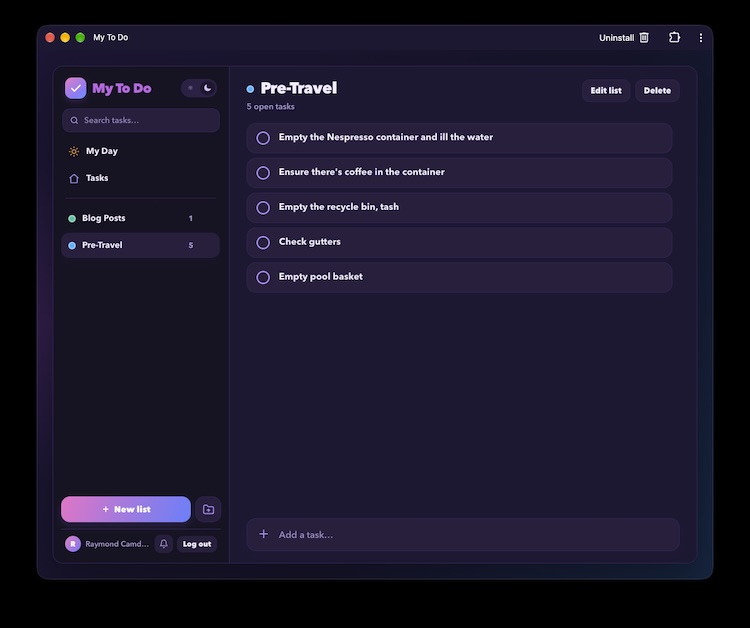
Earlier this week I shared the bad news that Microsoft is killing off To Do, one of the best, simplest apps around. I built a simple export tool to let you get your existing To Dos in either JSON or HTML format. At the time, I hinted at a plan to replace the app, and today I'm happy to share it.
My To Do is a web application based heavily on the UI and functionality of Microsoft's app. It's got a few lists built in, but then lets you add your own and create to dos to your heart's content. Functionality includes:
The ability to create groups of lists
The ability to set due dates and reminders.
The ability to create repeating tasks.
It's an installable PWA with offline support as well.
Here's an example of it running as a Mac OSX app:
For folks curious, when I travel for work I try to remember to do things that make it easier for my wife while I'm gone. This is that list.
The application was built with Google Antigravity and is hosted on Netlify. I'm going to be moving my usage this week and probably will not use my own export tool as I think I probably need to clean up my blog idea's list. (I mean I'll still export it, but I'm not going to import everything.)
This is part 2 of a 3-part series on the agentic SDLC. In part 1, the design phase produced a package for the architect to review: saved Context Graph findings, spec.md, the OpenAPI contract, governance checks, design tests, collections, mocks, and simulations. Now the developer picks it up.
The developer’s job in an agentic SDLC looks different from the usual one. There’s less time spent working out what to build, because the design package already answers that, and more time spent checking that what got built matches the design. This post walks through that handoff: what the developer starts with, how Claude builds the check-in feature, and how the code gets checked against simulated dependencies before anyone else sees it.
Develop against the design package
Once the architect approves, it’s time for the developer to start implementation. This is where the time we spent on design should start paying back.
I am asking Claude to implement the appointment check-in contract, reuse the existing appointment and eligibility interfaces, and build against isolated simulated dependencies. The rule stays explicit: do not change appointment status unless eligibility is approved.
Notice how much I do not have to explain again. The API choices, the error cases, and the instructions for running the integration already live in the design package. Another developer or agent can read them and have full context.
That last point matters more than it first appears. Without a design package, the developer prompt has to carry all of the context: which services to call, how to authenticate, what to do on a timeout. Every detail left out becomes a guess. With the package, the prompt can stay short because the repository holds the answers. A new teammate, or a different agent, can pick up the same work and reach the same decisions.
What the developer starts with
The package from part 1 is the input to this phase. Each piece has a job during development:
Design asset
How the developer uses it
spec.md
Explains what to build and how the feature fits the system
OpenAPI contract
Defines the request, response, and error shapes
Saved Context Graph answers
Shows why the existing appointment and eligibility APIs were chosen
Collections
Turn expected behavior into runnable requests and assertions
Mocks
Stand in for the appointment and eligibility services
Simulations
Put the mocks together into repeatable environments, including outage and timeout cases
The prompt also states one rule outright: do not change appointment status unless eligibility is approved. Writing the rule into the request and encoding it as a test gives you two chances to catch a violation. If the code ever marks a patient as checked in without an approved eligibility response, a test fails.
Build the check-in feature
Develop: Claude builds the check-in feature, runs it against the design mocks, and reports the collection results.
Claude now takes the design we just reviewed and builds the check-in feature. It connects the existing appointment and eligibility APIs, checking coverage before marking the patient as checked in.
Then we need to see whether the code follows that design. Approved coverage should allow check-in. Denied coverage, an error, or a timeout should leave the appointment unchanged.
The order of operations is the whole feature. The code asks the eligibility API about coverage first, and only a clear approval leads to an update on the appointment. Everything else, whether that’s a denial, an error, or a response that never arrives, leaves the appointment exactly as it was. Here are the four outcomes side by side:
Eligibility result
Check-in
Appointment status
Approved
Allowed
Marked as checked in
Denied
Refused
Unchanged
Error
Refused
Unchanged
Timeout
Refused
Unchanged
A feature like this can look finished while the failure paths are still wrong. The happy path works on the first try, and the bugs hide in the other three rows. That’s why the next step spends its effort on the failure cases.
Run the new code against the design mocks
Using the Postman plugin’s api-simulation skill, Claude runs the new code against the mock APIs created during design. These stand in for the appointment and eligibility services, so we can test without starting those services. The api-mocking skill helps adjust their behavior when needed.
We can make eligibility approve, deny, fail, or respond too slowly. After each request, we read the appointment back from the mock to check that its status matches what we expected.
With api-testing, Claude runs the design collection against the new code: 27 requests and 30 assertions pass, plus six outage assertions. We now have a working feature checked against the design, ready for independent verification.
Two habits in this step are worth borrowing:
Control the dependency, not only the request. Because the eligibility mock can approve, deny, fail, or stall on demand, you can reproduce an upstream failure in seconds. Waiting for a real service to go down isn’t a test plan.
Read the state back. A response that says “check-in refused” tells you what the code claimed. Reading the appointment from the mock afterward tells you what the code did. The feature’s whole promise is that the status stays unchanged on failure, so that’s the thing to check.
The numbers in the last paragraph are specific for a reason. 27 requests and 30 assertions come from the design collection running against the new code, and the six outage assertions cover the failure scenarios on top of that. Passing here means the code follows the design. It doesn’t yet mean the design is right, which is why a separate person tests the feature next.
Review the workspace assets and hand off to QA
From the Postman workspace, we can see the collection, mocks, and simulation that were created.
The output from development is the implemented check-in feature, including the code that connects the appointment and eligibility APIs and applies the rules from the design. The developer has checked that integration against the simulations.
Now, the developer hands this off to the QA engineer who will independently test the feature against the approved contract.
Keep the limits of this phase in mind. The simulations are stand-ins built from the design, so a pass tells you the code behaves correctly against those stand-ins. It doesn’t tell you the real appointment and eligibility services behave the same way. The developer’s checks are a strong first line, and the QA engineer in part 3 supplies the independent second look.
Tips for developing against a design package
Keep the package in the repository. spec.md, the contract, and the collections only help the next agent if it can read them from the checkout.
Say the rule out loud in the prompt. “Do not change appointment status unless eligibility is approved” is short enough to repeat, and it gives the agent a boundary to check its own work against.
Run the failure cases first. If the denial, error, and timeout paths pass, the approved path rarely surprises you.
Treat a failing assertion as a design question. When the code and the collection disagree, decide which one is wrong before you change either.
Try it yourself
If you ran the design phase from part 1, open Claude Code in the same repo with the design package in place and give it the implementation request. Swap in the names from your own feature:
Prompt
Implement the appointment check-in contract, reuse the existing appointment and eligibility interfaces, and build against the isolated simulated dependencies. Do not change appointment status unless eligibility is approved.
Then run the design collection against the new code with the Postman CLI:
postman collection run path/to/design-collection.json
Replace the path with wherever the design phase saved your collection. Make the eligibility mock deny, fail, and respond slowly in turn, and read the appointment back from the mock after each request. If the status changes when it shouldn’t, you found the bug before QA did.
Once the run is clean, look at the workspace assets and confirm that the collection, mocks, and simulation are all there for the QA engineer to pick up. A handoff only works if the next person can find what you built.
Part 3 follows the QA engineer, who tests the running feature against the approved contract.
 Log in